I think músmus and tutúsh both came from Plains Cree/Ojibwe
On the topic of stuff I’ve thought for many years but evidently haven’t said in so many words here:
I think músmus and tutúsh both came from Plains Cree/Ojibwe, via the Canadian/Métis French (and/or incipient Michif) spoken widely by fur-trade employees 200 years ago.

Image credit: Comic Book Legal Defense Fund
My thoughts, beyond that, are simple:
Both can refer to cows.
Thus, I suspect tutúsh ‘breasts; milk’ at first referred to a ‘cow’s udder’ in earlier Chinuk Wawa.
Could músmus ‘cow’ have been some sort of baby-talk variant of the original Cree mústus?
We keep finding stuff in Chinook Jargon that seems it could have been household “parentese” (like bibi, huyhuy, tintin), even though we can’t locate any documentation to prove it.
Bonus fact:
While I’m at it, I want to (seem to) contradict myself in public — the splendid Grand Ronde 2012 dictionary of Chinuk Wawa is marred, I tell you, marred by a reference to me claiming that tutúsh has an etymology in the Klamath and/or Molala languages.
That, I do not believe.
The reference is actually to me referring to one of Howard Berman’s published articles that cites those 2 languages having words shaped like mosmas for a native ‘deer’ species.
From his “The Position of Molala in Plateau Penutian” (1996:17):
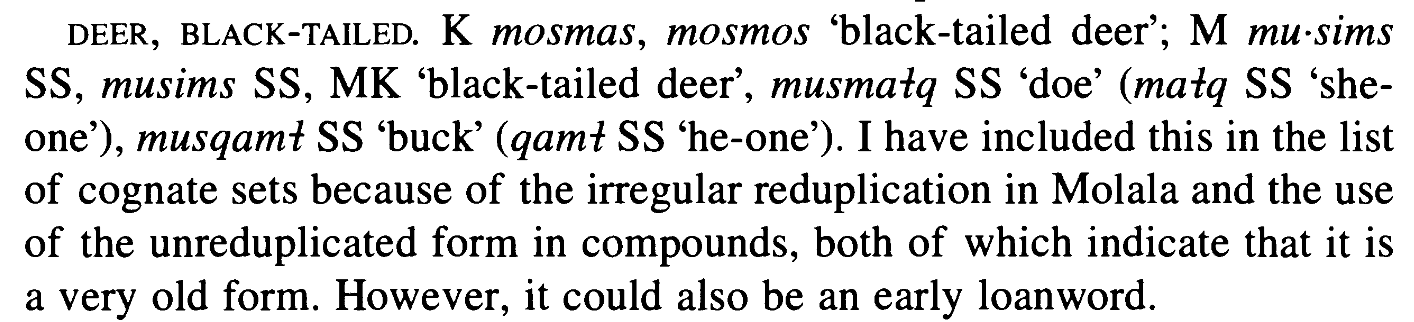
DEER, BLACK-TAILED. K[lamath] mosmas, mosmos ‘black-tailed deer’; M[olala] mu.sims S[tevens] S[avage], musims SS, MK ‘black-tailed deer’, musmaɬq SS ‘doe’ (matq SS ‘she-one’), musqamɬ SS ‘buck’ (qamɬ SS ‘he-one’). I have included this in the list of cognate sets because of the irregular reduplication in Molala and the use of the unreduplicated form in compounds, both of which indicate that it is a very old form. However, it could also be an early loanword.
Aside from the fact that Molala and Klamath played little to no role, known or inferable, direct or indirect, in shaping Chinook Jargon at any time, I see every reason to consider these a chance resemblance with the CJ word for ‘cow’.
There are other parallels among Molala and Klamath animal words (e.g. ‘owl’), so even if you consider the Penutian hypothesis to be unverifiable by the scientific method, those ethnic groups may very well have happened to share a musmus-like word for a different ungulate long before contact.
𛰅𛱁𛰃𛱂 𛰙𛱁𛱆𛰅𛱁 𛰃𛱄𛰙𛰃𛱄𛰙? qʰáta mayka tə́mtəm?
kata maika tumtum? Qu’en penses-tu?
What do you think?
And can you say it in Chinuk Wawa?
Hey! Teach Yourself northern-dialect Chinook Jargon!
And join free Zoom sessions…
Contact me for the Zoom link.
