A, I, O and sometimes Y: Even more about writing PNW indigenous words weird
I’ve found even more examples supporting my observation that old-time spellings of Chinook Jargon words often wrote < i > (or < y >) when they meant [á].
I’ve found even more examples supporting my observation that old-time spellings of Chinook Jargon words often wrote < i > (or < y >) when they meant [á].
The Umatilla Sahaptin dictionary is a treasure.
The earliest, and effectively the only, occurrence of “wahpoos” as a word for a snake in Chinuk Wawa is found in George Coombs Shaw’s 1909 dictionary, published in Seattle.
Further Chinook Jargon reading practice, in the Northern Dialect, from“Kamloops Wawa” #125, page 18.
Today’s piece is dedicated to friend of Chinuk Wawa and Francophone extraordinaire, George “La” Lang 😁
I credit Leo Barker for this find.
Definitely in the Northern Dialect of Chinook Jargon is song #11 from Myron Eells’s little book, “Hymns in the Chinook Jargon Language“, 2nd (expanded!) edition (Portland, OR: David Steel, 1889):
“Trade language”, as Chinuk Wawa has often been called, also means exchange of services, as well as goods…
Chinook Jargon has always been a rapidly changing language.
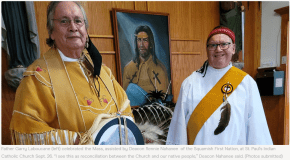
Readers of the Chinook paper loved to see pictures in it, we’re always told; here’s one of a missionary priest.