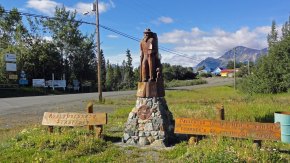
Nika illahee, nika illahee!
Here’s an Oregon Country frontier-fiction piece from post-frontier Seattle, a time and place that allowed an author to use extensive Chinook Jargon. I like that. I also like how the character Muriel at… Continue reading

Here’s an Oregon Country frontier-fiction piece from post-frontier Seattle, a time and place that allowed an author to use extensive Chinook Jargon. I like that. I also like how the character Muriel at… Continue reading
A quirky by-product of operating a Chinook Jargon newspaper supported mostly by English-speaking merchants: Advertisements in English-language Chinuk pipa shorthand. Check it out, nasal vowels and all! Can you imagine yourself writing English phonetically? I’ve… Continue reading
Emphases and explications added freely by yr editor. — DDR I’m inferring that someone got on this Nanaimo newspaper reporter’s case about his poor command of Chinook Jargon. Look at the timing of… Continue reading
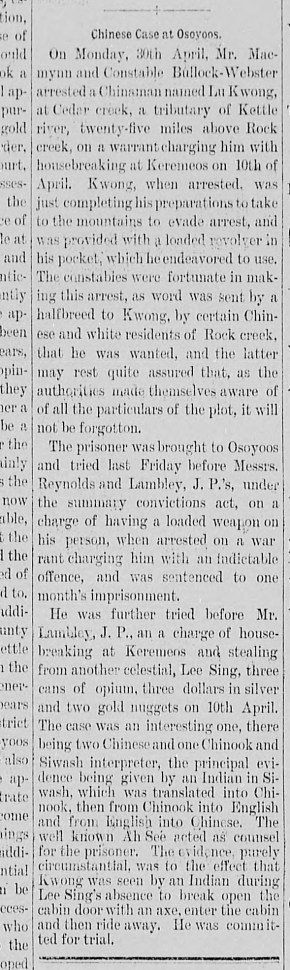
A short note today on a 4-step chain of interpreters in a court case involving folks of several cultures. The case was an interesting one, there being two Chinese and one Chinook and… Continue reading
“Narrative of the Voyage of H.M.S. Herald during the Years 1845-1851: Under the Command of Captain Henry Kellett Being a Circumnavigation of the Globe…” (volume 1) by Berthold Seemann (London: Reeve and Co.,… Continue reading
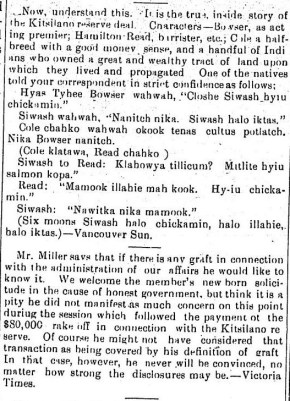
If you’re a newspaper reporter in post-frontier British Columbia, how do you get around the British-style libel laws of young Canada, so that you can write about what look like questionable dealings by government officials with the native… Continue reading
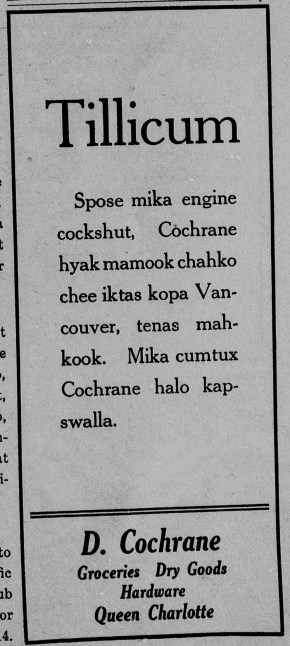
An advertisement in Chinook Jargon, in a post-frontier BC newspaper. As we often see in this time period, settlers could be expected both to be literate and to comprehend the pidgin. [My clarifications… Continue reading
Regular readers will understand that the Chinook Jargon word siwash migrated into Pacific Northwest regional English, with mostly distressing results. Today I’m sharing an 1898 local-colour piece from the Boundary Country of British Columbia,… Continue reading
This Chinook Jargon letter from Greenwood, BC, is not only a neat new example of the post-frontier, English-language-influenced, genre of writing in the language– –it also gets us closer to the origins of the… Continue reading
Again with the late-frontier era tilt towards English in people’s Chinook Jargon. This time we’re taken to far northwestern British Columbia’s Taku River district. I’ll add clarifications and translations in brackets: The Siwash… Continue reading