Muskrats, and the good and bad of El Comancho
Thanks to a comment from nenamooks on another post here at my site…
I got thinking about muskrats again.
First off, “muskrat” in English does indeed go back to “musk” + “rat”, signifying a “smelly rat” in this language. That’s not too hard to figure out, especially if you’re a literate English user. (It may be a folk etymology, though: there’s a high chance it’s originally a loan from an Algonquian language back east.)
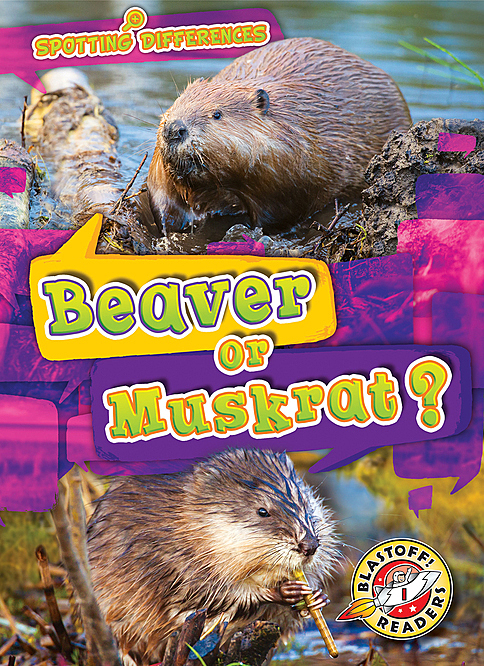
Image credit: Bellwether Media
Next, muskrats are rather smaller than beavers, and more numerous. So if you were in the fur business, muskrat pelts would be of lesser value than beaver. Therefore muskrats have been called kʰə́ltəs-ína “worthless beavers” in Chinuk Wawa.
El Comancho a.k.a. Walter Shelley Phillips took this knowledge and overthought it, when he found < e-min’-te-pu > for “muskrat” in JK Gill’s Chinook Jargon dictionary; Comancho figured Gill meant to say the better-known Jargon word < enapoo(h) > (which is “a flea”!), and rationalized this as an infallible previous authority having considered < enapoo(h) > to be < eena > “beaver” + < poo(h) >, which Comancho made to mean “smelly”.
This is nonsense.
We don’t know of < poo(h) > having ever meant anything but “shoot” or “fart”, and Comancho isn’t claiming either of those senses for muskrats; was he just being polite and merely hinting at “a beaver that farts” to make its smell? — Well, muskrats aren’t known for making any such sounds. Furthermore, in the old Chinook Jargon dictionaries, when a descriptive circumlocution was used to name a person or animal, it typically involved the relative subject yaka. (We’d expect *< eena yaka poo(h) >, “beaver that farts”, on analogy with the supposed (man) yaka kumtuks hiyu lalang “linguist, i.e. (a man) who knows lots of languages”.)
And of course, in any case, the universally used word for “smelly, stink” and so on in every Chinuk Wawa dialect is hə́m (“hum”)!
Another sign of El Comancho getting all creative despite reality is his dictionary’s claim that “muskrat” in the Jargon is also < chuck hias-hoolhool >, a “big water rat” in his translation. That phrase doesn’t roll naturally off my tongue as a speaker of Chinook. The natural order of modifiers before a noun is first “big”, then “water”, so *< hias chuck-hoolhool >. Also undermining this particular claim of Comancho’s is his own admission that in the Northern Dialect (which is what he apparently spoke), < hoolhool > was an uncommon word, mostly used by “Indian women who work about ranches for white women”. I have a hard time accepting that it would’ve been mostly women that were discussing muskrats, an animal you mostly encounter if you’re out on the water or intentionally trapping it for profit!
Now, that claim, I can believe, and I find it compelling to consider that it may have been women’s intercultural contacts with women that perpetuated some Central Dialect words for a while in the Northern Dialect.
But I remind you, El Comancho made his living popularizing Chinook Jargon to kids and non-Northwesterners as a caricature of an oldtime cowboy mountain man…years into the post-frontier era, well after CJ was routinely spoken. Some skepticism of him is well-placed.
Guess what?
We have another Jargon word for “muskrat” on very good authority, from Franz Boas’s documentation of the Central Dialect (lower Columbia River area): tsinístsinis. I rather like this word, unknown elsewhere, for the fact that it means nothing but muskrat and can’t be mistaken for a discussion of rat or beaver!

Not sure that kʰəltəs-ina necessarily has to be taken as a ‘worthless-beaver’ (though no doubt that is one way can be/has been understood). A kʰəltəs-palach (gift) is not necessarily so by virtue of being of little value – it is so because it is “merely” given. Is kʰəltəs-smuk an inferior kind of smoke? Is a kʰəltəs-xulxul (mouse) inferior to a xuxlul (rat)? I would think that these things are kʰəltəs by virtue of being similar to, but “not really” the thing being referenced.
LikeLiked by 1 person
Thanks, this is a good point, Henry, that “kʰəltəs” can be the opposite of “dret”.
In this light we can think of “kʰəltəs” + Noun as having a similar idiom-forming function to that of “sitkum” + Adjective/Noun, or “kakwa” + Noun.
LikeLike