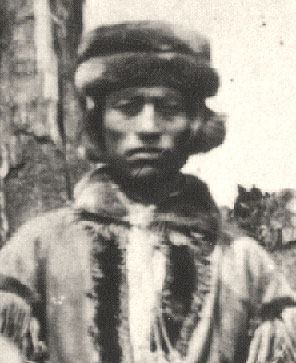
Another Chinook Jargon name: Sidcum Jim = Sitkum-Leg James (and the old Chinook newspaper proves it!)
“LLexwexwusem (150 Mile House): A Brief Introduction to Its History” is a fine 2011 newspaper article by Jean William with the assistance of Henry Michel.
It’s in the Williams Lake (BC) Tribune of July 8th of that year, on page Z3, columns 1-6.
I’m a huge fan of local histories, and this Cariboo-region article holds lots of community knowledge about the contacts among Indigenous Secwépemc, Chinese, and Euro-Canadian cultures.
So it’s a nice source from which to learn another person’s Chinook Jargon name:, parallel to known ones such as Chickchick Scarface, Klatawa Kate, Cultus Jim, Olla-Piska, Lakit Joe, and so forth…we find:
Sidcum Jim:
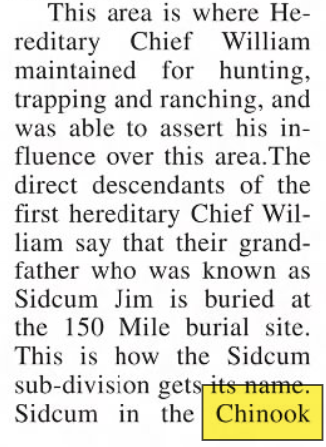
This area is where He-
reditary Chief William
maintained for hunting,
trapping and ranching, and
was able to assert his in-
fluence over this area. The
direct descendants of the
first hereditary Chief Wil-
liam say that their grand-
father who was known as
Sidcum Jim is buried at
the 150 Mile burial site.
This is how the Sidcum
sub-division gets its name.
Sidcum in the ChinookJargon means ‘half way’
and apparently Sidcum
Jim owned the place.
That’s the word you may know from the awesome 2012 Grand Ronde Tribes dictionary as sítkum, spelled the same in the BC Learners Alphabet, and as sitkom in the historic (and endangered) Chinuk Pipa of British Columbia.
Sitkum can also mean ‘(in the) middle’, ‘half’, ‘part(ly)’, ‘kinda’, and so on.
Did local oral tradition gets the story exactly right about Sidcum Jim’s Chinook name?
When I first read the above, I thought, it doesn’t seem likely that the Chinuk Wawa word in this case was describing the man’s appearance.
But then I remembered an actual example of that happening in the same exact area of BC.
And I think the person I was recalling, Sitkum-Leg James, was in fact Sidcum Jim!
Check this out, from page 118 of the Sugarcane Tintin mini-newspaper in Kamloops Wawa #131 (August 1895):
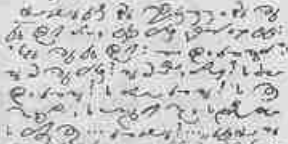
Pus klaska kolan naika Shugir-Kin Tintin, naika chako
‘When they heard I was the Sugarcane Bell, coming’kopa Wiams-Lik ilihi, ukuk ol-man brothir aiak wawa:
‘from the Williams Lake country, the old brother asked right away,’“Maika chako kopa Wiams-Lik: taii Wiam, kata iaka alta?
‘ “You come from Williams Lake? Chief William, how is he nowadays?’Iaka na chako-ol-man? Iaka na tlus, ilo sik? Pi Batist
‘Has he gotten to be old? Is he well or sick? And Baptiste’Wiam, kata iaka? Pi Aliksis kata iaka? Pi Shon
‘William, how is he? And Alexis, how is he? And John’Shyupulawh, pi Sitkom-Lig Shims, pi Kamlups Ogyust
‘Shyupulawh, and Half-Leg James, and Kamloops August’pi Origon Shoni…kata klaska?…”
‘and Oregon Johnny…how are they doing?…” ‘
The variation between Sidcum Jim and Sitkum-Leg James is about equivalent to that between the above-mentioned Oregon Johnny and Oregon Jack.
I’m convinced we’ve found two independent mentions of the same person!
Bonus fact:
We have found Chief William’s own words in Chinook Jargon. You should go read those.
Other words of his, put into English, are found here.