A correction to H. Rubenstein on Father Le Jeune’s “diary entries”
I don’t care to engage with the obviously political goal of its author, but his scholarship is shoddy and needs correcting…
The usual internet searching for stuff relating to Chinook Jargon brought me to an opinion piece, ” ‘Land Back’ & Papal Audiences“, by Hymie Rubenstein (The Dorchester Review, July 17, 2024).
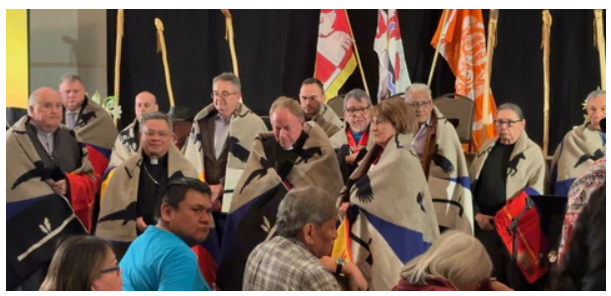
Image credit: Tk’emlúps te Secwépemc
You’re a saint if you have the patience to read his — I think — intentionally confusing, pompous, LONG rant, so here’s “just the bullets, dear one”, as Vi Hilbert used to say to us, where I’ll helpfully highlight the problem:
CONTRAST THE PAPAL audience on October 4, 1904, and the events that preceded it to the on described in the diary in which Father Le Jeune made daily entries from the day he and the chiefs left Kamloops to the day of their audience with the Pope.
• • •
According to Father LeJeune’s diary entries:
To the right side of this [St. Peter’s] church stands the pope’s house [Vatican Palace]; it’s a very big house;… we went to that house, and we arrived at a room where there was a bishop who makes arrangements for those who want to see the pope. We spoke with him, and he told us, “When I find which day is good for you folks to see the pope, then I’ll send a note to you.”
Oct. 4, 1904. In the morning, we again went to the pope’s house; now we received tickets for us to see the pope. Then we went to see the big church, St Peter’s church. And we stayed at that church until midday…. Now it was nearly four o’clock in the afternoon; we went to the pope’s house, and we were taken close to where the pope was. Many other people were there, about fifty. We knelt all in a line; then the pope came; he gave his hand to each of these people, and each of us kissed his hand. He placed his hand on Louis’ and Celestin’s [Chillihitzia’s] head, [and] he also gave a large medal to them; he looked a little tired, and seemed a bit sad. When he was done giving medals to all, he stood and he blessed everyone…. [H]e was really glad about everyone coming to see him. He also blessed the 2,000 medals we had gotten from “St Anthony Louise” and then brought to Rome. We wanted the pope to bless all of our [Indian] people, and he said, “Indeed, I bless [them] all.” Then we went back to our house in Rome, and we got ready to leave Rome and return to our home [British Columbia].
Very few reading this will have spotted the problem with Rubenstein’s writing yet.
It’s this —
Those words quoted as “Father Le Jeune’s diary entries” are:
- Not from a diary, but from a published newspaper;
- Not Le Jeune’s, in that they’re translated from his original words;
- And not credited — they’re my own (David Douglas Robertson, PhD’s) professional work of translation from Chinook Jargon into English.
I might add #4, that I’ve seen Le Jeune’s diaries with my own eyes, and they’re radically different from what he chose to print in his CJ newspaper to inform and educate Indigenous people.
In my experience, when you can use your personal area of expertise to find this many problems with a small part of someone’s published work, and I mean Rubenstein’s here, their entire piece is usually unreliable and unusable without much caution and much research that you yourself have to do.
Pus maika makuk ukuk man iaka pipa, tlus nanich! (Caveat emptor!)

Thank you for the reference to taqʷšəblu, Vi Hilbert, and her polite and sweet way of getting people to talk appropriately in various contexts. I’m sure she would have something interesting to say regarding the denialist nonsense represented by Rubenstein et al in the Dorchester Review. We need to remember Vi’s wisdom as we approach the coming months.
LikeLiked by 1 person