1912: Address delivered at…Grand Ronde! (Part 2 of 5: PNW folklore about Chinuk Wawa)
Moving right along now…

Perhaps falsely accused: Governor Salomon (image credit: Wikipedia)
Qalis and Alex Code sent along the “Address Delivered at Dedication of Grand Ronde Military Block House at Dayton City Park, Oregon, Aug. 23, 1912” by M. C. George, published in The Quarterly of the Oregon Historical Society, Vol. 15, No. 1 (Mar., 1914), pp. 64-70.
Today’s installment #2 of this mini-series comes from page 68.
It’s a different version of one of Chinook Jargon’s most popular pieces of linguistic folklore, this time attributing the “flowery” Chinook to German-Jewish immigrant, US Civil War hero, and 1870-1872 governor of Washington Territory Edward Selig Salomon (1836-1913).
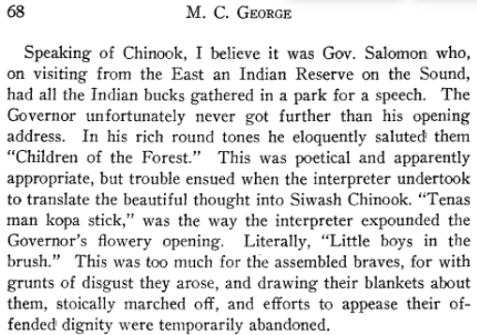
Speaking of Chinook, I believe it was Gov Salomon who, on visiting from the East an Indian Reserve on the Sound, had all the Indian bucks gathered in a park for a speech. The Governor unfortunately never got further than his opening address. In his rich round tones he eloquently saluted them “Children of the Forest.” This was poetical and apparently appropriate, but trouble ensued when the interpreter undertook to translate the beautiful thought into Siwash Chinook. “Tenas man kopa stick,” was the way the interpreter expounded the Governor’s flowery opening. Literally, “Little boys in the brush.” This was too much for the assembled braves, for with grunts of disgust they arose, and drawing their blankets about them, stoically marched off, and efforts to appease their offended dignity were temporarily abandoned.
This old saw about the “children of the forest” in Chinook is probably apocryphal.
It shows up in too many forms, even earlier than today’s telling, to be precisely true:
- The ill-fated visiting dignitary was sometimes said to be
- a Methodist preacher,
- sometimes an Episcopalian,
- sometimes the Jewish governor of Washington…
- …and I’ve not managed to locate confirming reports of any of these supposed incidents….
- …and the reported wording in Jargon varies from one teller to another.
What we have here instead is Chinuk Wawa again contributing a core element of Pacific NW folklore in the historical era!

I’ve even seen it attributed to an early settler in Port Coquitlam…
LikeLiked by 1 person
Would love to see that version, Alex. Someone grad student could do up a paper…
LikeLike
I’ll send you the clipping which unfortunately didn’t have the date written on it, but it’s probably out of the Coquitlam Star c. 1912.
I sort of misremembered it though- I guess they aren’t necessarily attributing it to Donald McLean as I thought, and also it’s a pretty weird telling of it. It’s from a biography of Donald McLean, early Port Coquitlam settler, and the relevant bit reads:
To go back to early days, the natives were only half-civilized, and hence their distinction between meum and tuum was only such in name. These “hias” men often seized the cattle of father (Capt.) Alex McLean on the ground, perhaps, that they, like the deer belonged to the aboriginies. There was one redeeming feature and that, that Donald (“Tonal”) McLean spoke the Indian language with possibly more facility than the mother tongue. (Those “Injuns” have a very exalted idea of self, e.g., a speaker on one occasion addressing them, and wishing to be real eloquent said, “Ye men of the forest” which translated would read, “Hias stick tenas man.” Immediately came the remonstrance, “Halo: Wake closh, hyas man, tenas stick.”
LikeLiked by 1 person
Bulmer repeats this story in the Kamloops Wawa in Chinook Jargon too. if you haven’t seen it, I could try to dig it up.
LikeLiked by 1 person