How many commandments is this, total? :) (10 Commandments, Part 4)

So now we’ve looked at “10 Commandments” translations from a pioneer girl, 3 British preachers, and an American crank…
…How could things get any weirder?
I have the answer to that question, and it’s a surprising source — the normally sedate religious newspaper out of Kamloops!
We’ve previously seen the Ten Commandments as a 1903 Jargon hymn from the Kamloops Wawa newspaper.
(See “Crowdsourcing: What’s the Tune to This Chinook Hymn?“)
I’m going to present that anew here, to go into greater analysis and to show you why the non-musical version below is such a huge surprise!
Okay — here’s the 10CC hymn:
<1-2.>
Mamuk haha S[ahali] T[aii],
mamuk-x̣aʔx̣aʔ sáx̣ali-táyí,
make-holy above-chief,
‘Worship God,’kwansim aias tiki iaka;
kwánsəm hayas-tíki yaka;
always very-to.like him;
‘always love him;’tlus ilo kansih mamuk nim
(t)łúsh (h)ílu-qántsix̣ mamuk-ním
good not-any.time make-name
‘never say the name of’ST kopa kaltash.
sáx̣ali-táyí kʰupa kʰə́ltəsh.
above-chief in no-purpose.
‘God for no good reason.’<3-4.>
Ilo mamuk kopa Sondi
(h)ílu mámuk kʰupa sánti
not work on Sunday
‘Don’t work on Sundays’pi tlus nanich maika styuil;
pi (t)łúsh nánich mayka st’íwiʔəł;
and good-watch your prayer;
‘and pay attention to your prayers;’hilp maika papa pi mama,
hélp maika pápá pi mámá,
help your father and mother,
‘help your father and mother,’kakwa maika lili mitlait.
kákwa mayka líli míłayt.
that.way you long.time live.
‘so you’ll live long.’<5-6.>
Wik mamuk mimlus klaksta man
wík mamuk-míməlus łáksta-mán(,)
not make-dead anyone-person(,)
‘Don’t kill any person,’wik tiki pus klaksta mimlus;
wík tíki pus łáksta míməlus;
not want in.order.that anyone die;
‘don’t wish anyone dead;’wik mamuk shim maika itluil
wík mamuk-shím mayka íłwəl(i)
not make-shame your flesh
‘don’t bring shame to your body’pi wik tomtom kopa kakwa.
pi wík tə́mtəm kʰupa kákwa.
and not think about being.that.way.
‘and don’t think of doing so.’<7-8.>
Wik kansih maika kapshwala
wík-qántsix̣ mayka kapshwála
not-any.time you steal
‘Never steal’hloima man iaka iktas;
x̣lúyma mán yaka íkta-s;
other person his thing-s;
‘another person’s property;’ilo wiht maika tliminhwit
(h)ílu wə́x̣t mayka t’łəmínxwət
not also you tell.lies
‘don’t lie either’pi wik lolo kaltash siisim.
pi wík lúlu kʰə́ltəsh syə́tsəm.
and not carry worthless news.
‘and don’t spread gossip.’<9-10.>
Wik tomtom kopa masachi
wík tə́mtəm kʰupa masáchi(,)
not think about evil.thing(,)
‘Don’t think of evil things,’aiak kilapai maika tomtom;
áyáq k’ílapay mayka tə́mtəm;
quickly turn your heart;
‘be quick to turn your mind away;’wik wiht maika ayu tiki
wík wə́x̣t mayka (h)ayu-tíki
not also you much-want
‘neither should you long to’tlap klaksta man iaka iktas.
t’łáp łáksta mán yaka ikta-s.
get anyone person his thing-s.
‘get any person’s property.’
— from Kamloops Wawa #207 (December 1903), page 116
I have no great commentary to offer about this hymn, as it appears to be in excellent BC Chinuk Wawa and, typically for the Catholic missionaries there, is very good at expressing what it means. I do notice that it differs from the first 3 translations in our mini-series, in that it’s not focused on sexual morality (‘doing nasty things with women’).
Anyhow, now to the prose version of the Commandments, in the form of an excerpt from the Chinuk Pipa (‘Chinook Writing’ — i.e. shorthand alphabet) book “Chinook Bible History“:
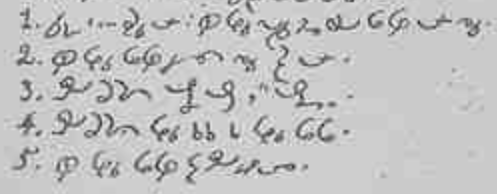

<1.> Kopit iht naika ST: wik maika iskom ikta pus mamuk ST iaka [SIC].
<2.> Wik maika mamuk kaltash iaka nim ST.
<3.> Tlus nanish sabat son, “Sondi”.
<4.> Tlus nanich maika papa pi maika mama.
<5.> Wik maika mamuk mimlus klaksta.
<6.> Wik maika mamuk masachi kanamokst kluchmin.
<7.> Wik maika kapshwala ikta.
<8.> Wik maika tliminuit.
<9.> Wik maika mamuk tomtom pus mamuk masashi kanamokst kluchmin.
<10.> Wik maika mamuk tomtom pus maika kapshwala hloima tilikom
klaska iktas.
— from Kamloops Wawa #118[a] (July 1894), page 16
My readers may be noticing that I’m passing up the chance to comment on the details of that passage. Very un-me! 🙂 The reason?
Plagiarism.
This is the same vicious problem that plagued dictionary after Chinook dictionary (see the fine 1978 dissertation by Samuel V. Johnson) has crept into the religious sphere!
Here Father Le Jeune has silently stolen the 10 Commandments from the 1898 “Indian Methodist Hymn-Book”. LINK.
That’s amazing! In 1903, it was far from kosher for Catholics & Protestants to acknowledge each other’s work as legitimate.
It’s less stunning that Le Jeune refrained from crediting C.M. Tate et al. for their original work translating these rules into Jargon. Just think if he had publicly said he was getting good use out of their heretical ideas!
I think what struck me the most forcefully as I read this in Kamloops Wawa #118[a] was a feeling of strangeness. The grammar in these 10 Commandments is far less fluent & the level of expressiveness far less clear than the thousands of words of Chinook Jargon surrounding it in the same newspaper.
(Which reinforces my claim, in my article about the original 1898 Indian Methodist translation, that that’s one mediocre piece of work indeed.)
All in all, this mini-series about all the known Chinuk Wawa versions of the “10CC” has demonstrated how greatly people’s translations can vary.
And contrary to some previous scholars’ prejudice against even looking at religious materials in North American Indigenous languages, I hope I’ve shown you that there is a great deal of useful information there, regarding this language’s history, grammar, and usage.

It’s even stranger to me that Le Jeune plagiarizes Tate, et al. when Demers and St. Onge already have a “Catholic” version in the1897 Missionary Companion (6 years earlier!) on p. 36 (I didn’t see it treated in the miniseries, but maybe I’m just missing it?)
LikeLike
Hi Kevin, thanks for your input here. It looks like you’re referring to page 36 of the 1871 CHINOOK DICTIONARY, CATECHISM, PRAYERS AND HYMNS of Demers & Blanchet. Definitely there’s a lot we can learn by reconstructing who had access to, and relied on, which previous and contemporary texts…
LikeLike
Yes, that’s it. Don’t know where I got the 1897 from (I had multiple pdf files open at the same time, so I think I grabbed the wrong one).
LikeLiked by 1 person
I figured 🙂 Pretty interesting to compare multiple translations of the same text, isn’t it? Someone should publish this…!
Dave R.
LikeLike
I’m hoping to work on an article in the year ahead comparing and contrasting the Catholic versus Protestant missionary translations of identical scripture passages: Fr. Le Jeune’s Devotions has several passages from Mark which I’ve lined up next to Tate’s from St. Mark’s Kloosh Yiem (there are some interesting–and I think occasionally strategic–convergences and divergences, Tate’s facility in the language relative to Le Jeune’s aside), you have already collected and analyzed the various versions of the Lord’s Prayer, and then we have these versions of the 10 Commandments. I am planning to limit myself to just missionary translations (so ignoring other settler-colonial versions of the Lord’s Prayer or 10 Commandments).
LikeLiked by 1 person
This is interesting because this version was also printed in the Chinook Manual (1896) so it would have been prayed in some Catholic communities.
A few points could be raised:
1. Do we have evidence that the Methodists used this version of the 10 Commandments before 1898? After all, the excerpt from the Bible History was published in an 1894 edition of the Kamloops Wawa (and again in the April 1895 edition of KW).
2. Le Jeune reminisces in the March 1916 edition of KW that, when he came to BC in 1879, the 10 commandments were part of the “ordinary prayers” that Indigenous Catholics prayed: why would a plagiarized version, different from what would be familiar to people?
3. It would actually have been Durieu, and not Le Jeune, who would have plagiarized it since Durieu wrote the text of the Chinook Bible History and he proofread drafts of Le Jeune’s transcription in Chinuk pipa. When proofreading, Durieu was careful to use “correct” Chinuk Wawa (based on his standards of what was good CW) so one would wonder why he wouldn’t improve the strange grammar.
4. In fact, there are a few differences between the text in the Methodist hymnal and that of Durieu/Le Jeune, namely the beginning (1,2) and the end (9,10). The differences in these numbers normally encompass the main differences between protestant and catholic versions of the 10 commandments. So, again, why weren’t grammar/word improvements made?
LikeLiked by 1 person
I believe you have identified the substance of a good paper waiting to be written, my friend!
Thank you for commenting in such thoughtful detail here.
Dave R
LikeLike