BC: a Chinookan or Chinook Jargon word in Secwépemc?
The First Voices Secwepemc site tells us about a word, (s)llekméw̓es, meaning ‘stick games / lahal‘, i.e. slahal in much of Chinook Jargon.
Here’s an example of it that they give:
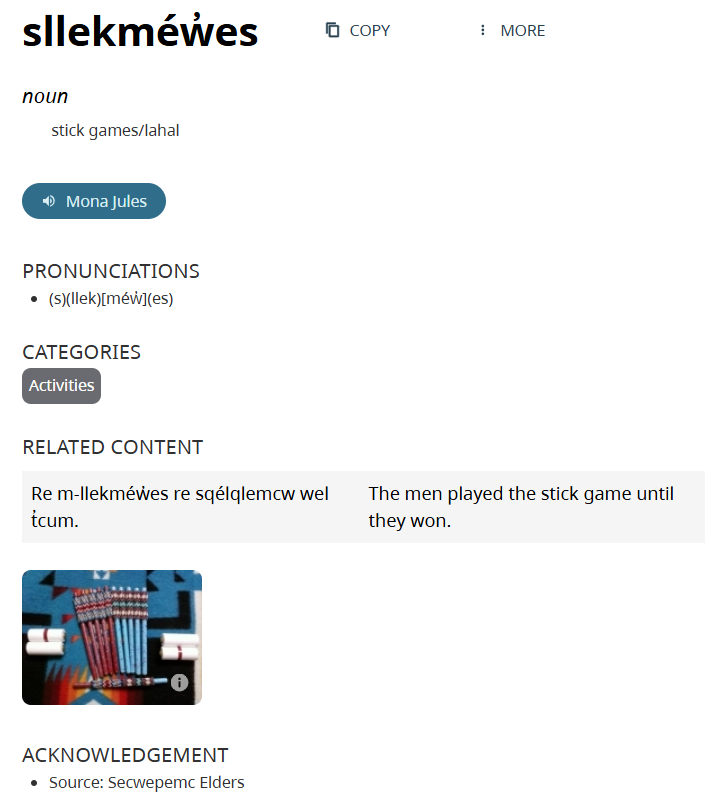
The amazing thing about noticing this word up around Kamloops is, the root part of it, {llekm}, is clearly related to what we know as a native Lower Chinookan word that also shows up in Chinuk Wawa, íɬukuma, referring to the same Indigenous game. (The “ll” in llekm is the same slurpy-L sound as ɬ.)
That’s a mighty long way for a word to travel, isn’t it?
And in the case of the Secwépemc version of it, I don’t see any necessary reason to think Chinook Jargon was involved — although maybe it was.
Words for such widely shared cultural practices can sure get around, even without a shared language. I’m thinking of how a word for ‘banana’ is shared between a New Guinea source language and Arabic!
By the way, the Salish ending –éw̓es would connote something like “on both sides”. Can you picture how stickgame teams face off?
Bonus fact:
We’ve seen the same Chinookan word loaned into Quinault Salish of the northwest Washington coast! It’s also in St̓át̓imcets a.k.a. Lillooet Salish of BC as ɬəkmáw̓as ‘(to play) lahal’.
íkta mayka chaku-kə́mtəks?
Ikta maika chako-kumtuks?
What have you learned?
And, can you express it in Chinuk Wawa?
* Adding a search engine note: Quileute, Umatilla, Nez Perce — see Comments.

Oh interesting, I’d always wondered about the etymology of this word! I wonder if it entered Secwepemctsín and St̓át̓imcets via a third Salish language, since the ending -ew̓s/-aw̓s for “both/middle” is monosyllabic in those two languages…
LikeLiked by 1 person
Hi Ethan, now that is a really neat observation, thank you. You’ve inspired me to go look in Kuipers’s 1974 grammar / dictionary of Secwépemc.
At section 17.3.78, on page 68, for this lexical suffix I see he gives it a canonical shape as a monosyllable, but under it he shows -éw̓əs-qn [‘top of the head’]. (He stipulates that the schwa is “intrusive” and Deadman’s Creek dialect “lacks it”, but there it is.) In that section, only one full word with this suffix shows the 2-syllable variant. So you may be onto something, I reckon.
What would you think of the idea of inter-dialect borrowing to account for the 2-syllable -éw̓es in our ‘slahal’ word? Would that suffice?
If not, I’m intrigued by your thought that not only the etymology, but also the pronunciation, of llekméw̓es may point to its status as a foreign loan.
While we’re talking, can I ask what you recommend as the best available dictionary of Secwépemc?
Dave Robertson
LikeLike
The main thing that suggested borrowing is the ananlyzability, AFAIK, of the root, which I had assumed to be /llek/, interpreting the /-m/ as the middle suffix.
I have noticed some dialectal/idiolectal variation in the pronunciation of glottalized resonant clusters, which seem to frequently surface with epenthetic schwa, so /VR̓C/ > [VR̓əC]. Another possibility is that this happened to become lexicalized in the “slahal” word.
It would be good to know if related forms are attested in any languages between Chinook and St̓át̓imcets/Secwepemctsín (noting the Quinault form as belonging to the same etymological family). Unfortunately I don’t have any dictionaries on hand at the moment.
I will shoot you an email about the Secwepemctsín dictionary!
LikeLiked by 1 person
I’ve checked every dictionary of the languages between Lower Chinookan and Northern Interior Salish, I believe. I can only add:
No indication of this being taken into Nuuchahnulth or Vancouver Island Salish.
LikeLike