1859, OR: A picayune a peck
While I was working with Father LN St Onge’s kinda huge manuscript dictionary of the Central (oldest) dialect (centered on the lower Columbia River) from around 1870, his entry pikaiun for ‘a nickel’ got me thinking.
I’ve previously reported that “picayune” was a Chinuk Wawa word. It comes from North American French, which gave it to informal North American English. The first traces I found of it were in Indigenous languages that had very little direct exposure to French itself, a fact that points us toward Chinook Jargon instead, with its ample New World French content.
Now here’s an occurrence of that word along with some overt Chinook (and a colorful synonym for “a dime a dozen”):
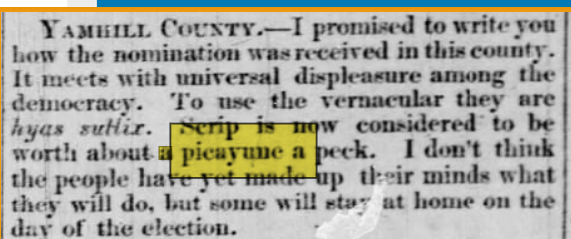
YAMHILL COUNTY .- I promised to write you how the nomination was received in this county. It meets with universal displeasure among the democracy. To use the vernacular they are hyas sullix. [hayas-sáliks ‘very angry’.] Scrip is now considered to be worth about a picayune a peck. I don’t think the people have yet made up their minds what they will do, but some will stay at home on the day of the election.
— from the Salem (OR) Weekly Statesman of May 10, 1859, page 2, column 4
The other Jargon term for ‘a nickel’ (5 cents) was sítkum-mít / sítkum-bít, ‘a half-dime’, which is what that denomination of USA currency was officially called from 1794 to 1873.
