Suttles, “Musqueam Reference Grammar”, Part 1
Naika wawa masi kopa Paisley pi Mokwst Alex, for reminding me of a great book by a great anthropological linguist!
Typically I’ll rake through a dictionary of a Pacific NW Indigenous language, and report to you here on the patterns of Chinook Jargon to be found there.

“Big Daddy” hydrangea (image credit: Wilson Bros Gardens)
Wayne Suttles’ “Musqueam Reference Grammar“, however, isn’t a dictionary, and I don’t know of one that’s available to me for this particular variety of what some folks have called a single, wide-ranging “Halkomelem” Salish language.
So instead, I’ll snoop through the aforementioned grammar, and…
I’m going to give you a reaction video. 🤩
Just kidding, what I’m gonna do is write my reactions to everything Wayne said about Chinuk Wawa. He had more experience than any living linguist with the Jargon, for a good stretch of years. (Then he taught Henry Zenk, and wow, look what we’ve learned!)
• Page 5:
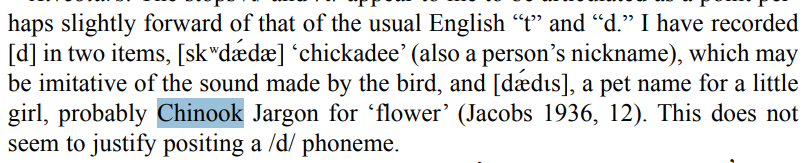
I have recorded [d] in two items, [sk”dædæ] ‘chickadee’ (also a person’s nickname), which may be imitative of the sound made by the bird, and [dædis], a pet name for a little girl, probably Chinook Jargon for ‘flower’ (Jacobs 1936, 12). This does not seem to justify positing a /d/ phoneme.
I think there’s even more reason to doubt the case Wayne is experimenting with there: that word for ‘flower’, tatís, is known in Chinook Jargon only in the very restricted area of the Grand Ronde Indian Reservation in Oregon, and nowhere else. And with its differing stress placement and its use a phonetic [æ], that name might even be from English “Daddy’s”.

Any chance that /dædis/ might indeed be from CW /tənas/? I mean via Lushootseed, where the same word would have sounded /tədas/ (vowels aside, which I think are a bit unstable). In child-centered-speech, a “softening” (i.e. voicing, [t] > [d]) of voiceless stops would not be out of the way. From which direction did Musqueam receive their first CW exposure?
Cheers, Henry K
LikeLiked by 1 person
I hadn’t thought of that, Henry, thanks for the idea. I don’t have any indication that Lushootseed or other nasalless languages played any particular role in the Chinook Jargon exposure of Musqueams. Instead it was mainly non-Indigenous folks that were involved in those interactions.
LikeLike
Any chance that /dædis/ might indeed be from CW /tənas/? I mean via Lushootseed, where the same word would have sounded /tədas/ (vowels aside, which I think are a bit unstable). In child-centered-speech, a “softening” (i.e. voicing, [t] > [d]) of voiceless stops would not be out of the way. From which direction did Musqueam receive their first CW exposure?
Cheers, Henry K
LikeLike
Any chance that /dædis/ might indeed be from CW /tənas/? I mean via Lushootseed, where the same word would have sounded /tədas/ (vowels aside, which I think are a bit unstable). In child-centered-speech, a “softening” (i.e. voicing, [t] > [d]) of voiceless stops would not be out of the way. From which direction did Musqueam receive their first CW exposure?
Cheers, Henry K
LikeLike