George Robinson’s store vocab from Kitamaat, BC (Part 1 of 2)
(Here’s the link to Part 2 of 2.)
The late, admired linguist Emmon Bach (1929-2014) “worked on”, as we linguists say, some BC languages.
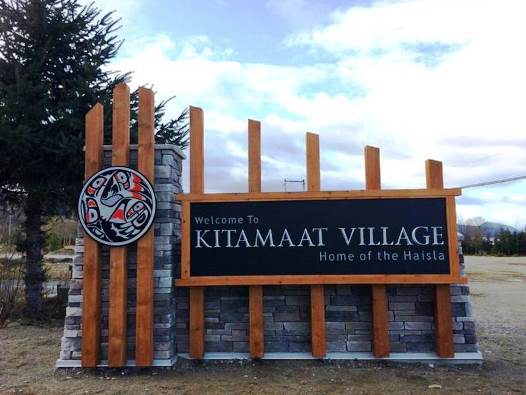
Image credit: kitimat.ca
In particular he’s known for his valued research on the X̄a’islak̓ala / Haisla language (northern branch of the Wakashan family). So Emmon spent time in Kitamaat (a.k.a. Kitimat), British Columbia, building relationships with native speakers there.
Shortly before his passing, Emmon emailed me a kind note of compliment on my dissertation “Kamloops Chinuk Wawa, Chinuk Pipa, and the Vitality of Pidgins“, and on my investigation of an apparently pidginized version of Haíɬzvq (Heiltsuk), a sister language of Haisla.
He was moved to repay me for my work by sending over a document that “friends in Kitimat” had given him many years before.
This unpublished treasure of Chinook Jargon, Emmon told me, is
from a notebook by George Robinson, a lay preacher and storekeeper who settled in Kitamaat village in the nineteenth century. I’m guessing the notebook is from the 1890’s.
I’ve managed to learn that George Robinson was born in 1869, that he married a Haisla woman named Kate, and that they had a son Samuel. George was sworn in as an official interpreter (presumably of Chinuk Wawa) for the McKenna-McBride commission’s hearings in Kitimat in 1913. He must have been trading for skins at his store, judging by such entries below as ‘animal’ and ‘hunt’; this source confirms that, and says he’s been in the locality since about 1892.
There was also a local Kitamaat Native author, Gordon Robinson, whose surname perhaps comes from an association with George’s family. He may have been a descendant of George Robinson.
As for George’s notes on Jargon, I present them here as transcribed, with a linguist’s great care for details, by Emmon Bach; I have not yet seen the original document.
Some of the spellings used by Robinson are modeled after published popular sources, but not all are. SImilarly, the storekeeper assigns a “part of speech” abbreviation to the entries, much as George Gibbs’ influential 1863 lexicon did. (As a linguist I disagree with many of these syntactic analyses!)
There are entries here (such as ‘afternoon’; ‘animal’, ‘gun nipple’, ‘mask’, ‘oar’) that aren’t found in those previous authorities.
So this document would appear to reflect Chinuk Wawa as actually used on the northern BC coast in the late frontier era. That date makes this information interesting to compare with the voluminous CW data we have from the southern interior of BC, especially Kamloops, at the same era. The same result as always emerges: BC Chinook Jargon was a remarkably uniform thing, with such words as ask, sleep, box, brother, scotty (here scot-te(e), for ‘crazy’), cut, lost, meat, help, and long showing up as CJ throughout the province.
Among the features that give away the more precise geographical origin of this vocabulary are ‘railway engine’, given in CJ as steam-boat koppa’ il lay (literally ‘steamboat on land’), clearly a calque with local Indigenous languages such as Tsimshian.
When I first looked through Robinson’s lexicon, I was surprised by the frequency of his spelling < ay >, often where I’m accustomed to the sound /a/ in Jargon. But I’ve come to suspect that this digraph frequently represents something like [ε], the “short e” sound in English ‘bet’. Perhaps this, as well as Robinson’s < ar, er, ur > where there’s certainly no /r/ sound in Jargon, indicate that this Englishman came from some particular dialect area in Britain.
With no further preamble, here’s the first half of George Robinson’s Chinuk Wawa vocabulary:
adze n English: uncertain Chinook: “(lay-ash)” crossed out twice
afraid v kwass
after prep kim-tah
afternoon n kop-pet.sit-cum-sun
again ad waght
all a kon-a^-way
also wa’t
always ad kwaine.sum Chinook: may be “kwine.sum” or “kura’ne.sum”
amid } prep (k’oppa’ set.cum) Chinook: may be among } prep “(koppa’ set.cum)”, or “(k’oppa’ sit.cum)” with “i” not dotted
alike ad ka’r-kwa’ Chinook: apostrophe after/above first “a” may just be xeroxing imperfection
angry man n sol.lex-man Chinook: may be “sol-lex-man”
and con pe^
angels n sock-kel-e il lay-he til le-cum English: may be “angel” Chinook: may be “sock-kel-e il lay-he til.le-cum”
anger n sol-lex
animal n skin
answer v kel-le^-pie waw-waw Chinook: may be “kel-te-pie waw waw”, “kel-le^-jue waw-waw”,
or “kel-te-jue waw-waw”arise v get-up
ascend v coo-ley sock.kel.e Chinook: may be “coo-ley sock-kel-e”
ask v waw waw (or ask)
awake v {mash sleep} {wake up }
axe n lay-ash
bad adj me-sat.she Chinook: may be “me.sat.she“
bag n le-sack
barrel n tay-mol itch
believe v {believe } [DDR; is the preceding word being presented as being in use in Jargon?] Chinook: may be {mit lete tum tum} “mit lite tum tum” with “i” not dotted
belly n kwa’t-tin
bell n tin tin
berry tree n o^.lal.le stick
berry n o^.lal-le^
big adj hy-as
bird n kul-lay kul.e
biscuit n biscuit ((le bisk.ke))
bite v muc-a muc English: “i” not dotted Chinook: may be “muc^-a muc“
bitter adj hay lo tsee
black blanket n klale pay-sis.se Chinook: may be “klale pay-sis se“
black adj klale Chinook: may be “kl ale” or “kl.ale”; but cf. “black blanket”
bleached calico n t.h’ope sail Chinook: may be “t’h’ope sail” or “t’kope sail“
bleed v (pil pil chak.he) Chinook: may be “(pil pil chak.hi)” with final “i” not dotted, “(pil pil chak. ho)” with “o” not fully closed, or “(pil pil chale.he)”
blind adj hay-lo se^.ah host
blood n pil-pil
board n lay-plash
boil v lip-lip English: “i” not dotted
bone n bone
boot laces n (whale.um koppa’ shoes) Chinook: may be “(whaleum koppa’ shoes)”
boots n boots or shoes
bottle n lay-boo-ti
bow n stick musket
box n box ((lak-kay set))
boy n ten-nas man
bracelet n (kwe^-e kwe^ koppa le^ mah) Chinook: may be “(kwe^-e kwe^ koppa le-mah)” or “(kwe^-kwe^ koppa le^ mah)”
branch n (le^-mah koppa stick)
breathless adj haylo** wind Chinook: first word uncertain; cf. “calm”
breath n wind
brother n brother (ow)
bull n man moos-moos
bullet n le-ball
buy v mah-cook
by & by ad al ki English: connective uncertain
calf n ten-nass-moos-moos
calico n sail
call v (waw-waw) (call) (haul) [DDR: not sure why ‘haul’ is here]
calm n –hay-lo wind
cannon n hy-as mus ket
cannot wake kahla’ Chinook: uncertain
canoe n cay-nim
cat n puss
chain n chick-a-min rope
change v hoi-hoi Chinook: may be “koi-koi“
chief adj e^-lep Chinook: may be “e^-lip” with “i” not dotted
chief n ty.he
child n ten-nass
chop v kock.shit
clean adj hay-lo.me^sat.she Chinook: may be “hay-lo.me^ sat.she“
cloud n (sock kel le smoke) {smoke koppa’ sock ke le} Chinook: uncertain whether apostrophe follows “koppa’ “
coffin n mem-mel-loost box
cold adj cold
come back v chack-ho. kel.le pi
come in v chack-ho koppa (house) English: “i” not dotted
come v chack-ho
commandment n law
conceal v ip-scot
cow n klootch man moos-moos
crab apple tree n si-wash apple stick
crab apple n si-wash apple
crazy adj scot-le Chinook: may be “scot-te” with second “t” barely crossed
cry v cry
cut v cut
damp adj hay-lo-dry
darkness n po^.lak.le^
day n sun
deaf adj hay-lo kur.laar Chinook: “laar” uncertain
dear adj hy-as mah.cook Chinook: may be “hy-as mah cook“
death n mem.mel loost Chinook: final “t” not crossed; may be “mem.mel loosh“; cf. “die”
deer n mow-itch
devil n le-jawb
die v mem. mel-loost
different adj hul loi moi Chinook: may be “hul loi mei““
dirt} as earth) n (me-sat-she) dirt
dog n kam-ox
door n lay-po te Chinook: may be “lay-pote” or “lag-po te“
drink v muc-a-muc chuckk Chinook: final “k” uncertain
dry adj dry
dung n me.sat.she Chinook: may be “me.sab.she“
earring n kwo-lan kwe-e.kwe Chinook: may be “kwo-lan kure-e.kwe” or something else; untranscribed mark above middle “kwe-” may be significant
earth n il.lay.he Chinook: “i” not dotted; may be “el.lay.he“
ear n kwo-lan
eat v muc-a-muc
empty ” adj English: ditto mark uncertain
empty (people) adj hay.lo klax ta mit.lite English: “(people)” appears after Indian word in second column
empty (things) adj hay-lo ik-la^’ mit-lite English: “(things)” appears after Indian word in second column Chinook: may instead be “hay-lo ik-ta’ mit-lite” with “t” of “ta’ ” crossed above “a” of “ta’ “
end n nose Chinook: uncertain
eternal adj waks kun sick kop.pet
evening n (ten-nass) po^.lak.le
Any comments, readers?

Pingback: George Robinson’s store vocab from Kitamaat, BC (Part 2 of 2) | Chinook Jargon