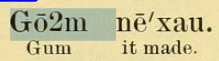
Another example of how clunky Chinuk Pipa’s own number symbols were
Right now I’m not re-finding the document, but in one edition of “Sténographie Duployé”, a textbook of the French-language ancestor of Chinuk Pipa, I found this:
The title (no pun intended) page of David Montgomery Nesbit’s “Tide Marshes of the United States” (Washington, DC: Government Printing Office, 1885) mentions our Chinook-speaking friend Eldridge Morse!
In the summer of 1881, a newly noticed comet was all over the newspaper pages.
The connection with Chinook Jargon here is awful thin…
And, why does < u > have 2 different shapes in BC Chinook Writing?
Here’s yet another of the things about Chinuk Wawa that researcher Franz Boas was the first to notice.
Palach dala. Patlach tala. Give!
It’s not an unusual situation for proper names to be everything we know about some previously-existing language.
Is there even a single trace of Chinuk Wawa in northwest California’s Hupa language?
On the subject of a linguistic urban legend that I’ve already busted (see “Hawai’i Pidgin ‘High Makamaka’ Helps Us Bust a Jargon Myth“) —