Kamloops’ JMR Le Jeune’s letters to the inventor of Duployé shorthand (Part 2)
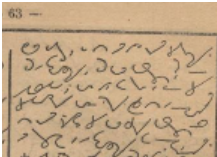
In the 1893 book “La sténographie en France“, which is mostly in French shorthand, the inventor thereof, Émile Duployé, reports years of contact with Jean-Marie-Raphaël Le Jeune, who is famous to us as the originator of Chinook-Peipa (“Chinook Writing”) of British Columbia.
(My thanks to David Corbett and Alex Code for bringing all of this to my awareness!)
MARS 1891
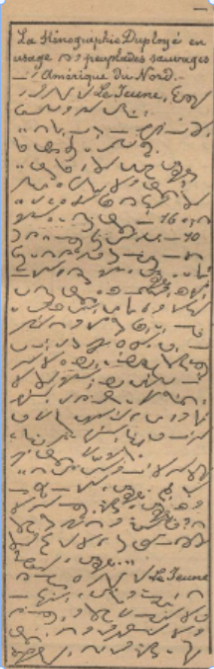
“(from) MARCH 1891”La Sténographie Duployé en usage chez les peuplades sauvages de l’Amérique du Nord.
“Duployé Shorthand in use among the Indigenous peoples of North America.”Le très révérend père Le Jeune, missionaire m’addresse la lettre suivante:
“The most reverend Father Le Jeune, missionary, addresses the following letter to me:”“Je viens du fond* de l’Amérique du Nord, vous souhaitant bonne et heureuse année.
“I come from the ends* of North America wishing you a good and happy new year.”“Savez-vous que votre système sténographique réussit à merveille pour les sauvages?
“Did you know that your shorthand system is succeeding marvelously for the Indigenous people?”“Il y a quatre mois j’ai montré votre écriture à un jeune sauvage de 16 ans; je ne lui ai donné qu’une seule leçon de 10 minutes et je lui laissais une dizaine de pages de prières que
“Four months ago I showed your writing to a 16-year-old Indigenous youth; I only gave him a single lesson of 10 minutes and left him ten or so pages of prayers that”j’avais écrite en sténographie. Et bien ce jeune sauvage a tout déchiffré, tout appris, et cela tout seul, si bien qu’à la première rencontre je l’ai pris avec moi, et,
“I’d written in shorthand. And indeed this Indigenous youth figured it all out, learned it all, and this all by himself, so well that our next meeting I took him along with me, and,”depuis ce temps, il fait l’école aux autres. C’est*, de leur part à tous, un enthusiasme vraiment étonnant pour votre écriture; tous s’impressent dans l’apprendre. Ils l’ont trouvé un
“since that time, he schools the others. It is, on the part of all of them, a truly amazing enthusiasm for your writing; all rush to learn it. They find a”grand avantage: c’est qu’ils peuvent s’écrire entre eux sans que les blancs y* puissent rien comprendre, puisque c’est dans leur langue sauvage qu’ils écrivent.
“great advantage in it, in that they can write to each other without White people being able to understand a thing, as it’s in their Indigenous language that they’re writing.”“Je suis sur les dents pour leur fournir des copies de prières en sténographie. Comment faire pour leur donner imprimer* en sténographie tous les volumes avec lesquels je les
“I’m working flat out to supply them with copies of prayers in shorthand. How can I have all the volumes printed for them in shorthand, with which to”instruissais? Je voudrais même faire pour eux une sorte de journal hebdomadaire en sténographie…
“instruct them? I’d even like to make them a sort of weekly newspaper in shorthand…”J’ai demandé au révérend père Le Jeune de m’écrire, en suivant les indications que je lui
“I asked Reverend Father Le Jeune to write for me, following the indications that I”donne, les volumes qu’il désire pour ses sauvages. Je les ferai reproduire par la photogravure, j’en ferai imprimer un nombre
“give him, the volumes that he wishes for his Indigenous people. I’ll have them reproduced by photoengraving, have a fairly”
assez élevé, et je les lui ferai parvenir. Ni le missionaire, ni ses sauvages n’ont de ressources; si l’on me vient en aide pour poursuivre cette oeuvre comme je le désirais je
“large number printed, and forward them to him. Neither the missionary nor his Indigenous people have resources; if anyone comes to my aid to pursue this project as I’d wish, I’ll”ferai imprimer pour ces pauvres sauvages tous les volumes que le missionaire me demandera.
“have all the volumes the missionary asks me for printed for these poor Indigenous people.”
Much more to come.
