“Jib boom” and another Indigenous metaphor

Does mokison nos mean “jib boom” in Chinuk Wawa?
I daresay:
“N.O.!”
Instead, what Demers, Blanchet, and St Onge mean on page 18 of their 1871 Central Dialect dictionary is that the word they spell as mokison is defined as “nose”, and also means a sailing vessel’s “jib boom”:
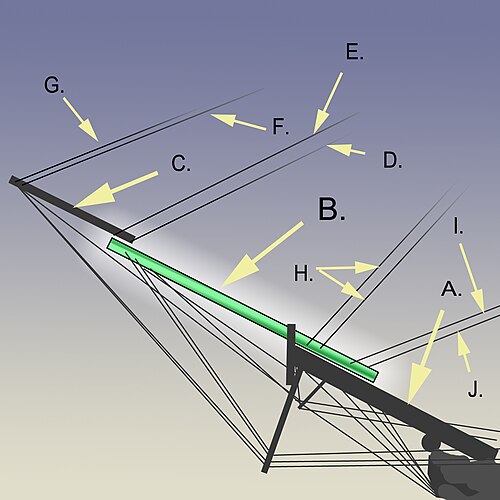
“A diagram of the three spars and some of the rigging that can make up a bow:
A.) Bowsprit, B.) Jibboom, C.) Flying jib-boom, D.) Jibstay. E.) Fore Topgallant Stay, F.) Flying Jibstay, G.) Fore Royal Stay, H.) Topmast stays, I.) Outer Forestay, J.) Inner Forestay”
(credit: “jibboom” on Wikipedia)
Demers, Blanchet, and St Onge are doing our community a service by documenting yet another of the scads of SW Washington Salish words in Jargon.
Quinault Salish, Cowlitz Salish, and Upper Chehalis Salish all have a mə́qsən form for “nose”. Of these, it’s Cowlitz, traditionally spoken around Fort Vancouver, that’s the most likely source of the early-creole-era Chinook Jargon “mokison“.
Almost always, Jargon words sourced from Salish come from Chinuk Wawa’s major ancestor language ɬəw’ál’məš (Lower Chehalis Salish). But once in a while, that’s not the case. And in fact this noun has the shape mə́qs, instead, in Lower Chehalis. (Only from one speaker, who was a foreign slave from Vancouver Island, Canada, do we find this word ending in an “N”.)
In all 4 SW WA Salish languages, the cognate of mə́qs(ən) and its shorter forms that are used as a suffix (-qs and so forth) mean a person’s or animal’s nose, and can also be used metaphorically for the tip of any object. So the metaphor of a watercraft’s “nose” is apparently pre-Contact in vintage, and indigenous to Salish.
Elsewhere on the same page, Demers, Blanchet, and St Onge, also provide the vastly more common Chinook Jargon word for “nose”, which is nos, from English:
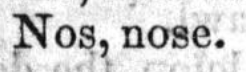
It challenges belief, doesn’t it, that any stage of this language would’ve used a noun-noun compound *mokison nos*, literally a “nose nose”.
We have corroboration from the great George Gibbs’ Central Dialect dictionary that boat nose was in fact the compound used to express “the bow of a boat”.
Bonus fact:
The excellent 2012 dictionary of Chinuk Wawa from the Confederated Tribes of Grand Ronde has an entry for this word, also noting that Father Lionnet had it as “chin” in his Central Dialect dictionary.
CTGR 2012 correctly notes Chinookan–language etymologies for that, which sound pretty similar to mokison but are unrelated to Salish.
It would seem Lionnet, or the people he was speaking to in the mid-1800s, confused their protuberances!
For that matter, “chin” in French is also vaguely similar to the above: menton…
