1914: LBDB’s “Chinook-English Songs”, part 12 of 15 “Mamook, Polakely Chaco”
Good news, we’re near the end! 😊Laura Belle Downey-Bartlett, “pioneer” daughter, left us with quite the collection of oldtime popular songs that she attempted to put into Jargon.

Image credit: DavidHeuser.com
Here’s the thing. I believe she must have been a perfectly good Chinuk Wawa talker.
But how good are YOU at translating creative works from one language, fluently, into another?
Translation is hard, honey! (That’s why you need to HIRE A LINGUIST.)
Ask my Sunday & Wednesday night students! I’m always demanding that they turn existing high-quality Jargon from back in the day into “real people English”. Gets ’em thinking.
With that said, let’s observe another case of LBDB’s good-hearted intentions going a bit astray. These translations of hers are precious historical documents, but don’t you dare talk like she talked Chinook…
Which raises the notion: we can add all of these oldtime bad Jargon songs to our list of items to “back-translate” into good Jargon!
(A link to all installments in this mini-series.)
Oh, I just thought of another silver lining: At least LBDB’s song lyrics usually aren’t straight out racist like most other people’s Pacific NW doggerel poetry of her era!
Pages 32 & 33 of LBDB’s book, “Chinook-English Songs” (Portland, OR: Kubli-Miller, 1914) are her song #12 “Mamook, Polakely Chaco” / (link to the original:) “Work For the Night is Coming“.
I’ll show this with the corresponding Grand Ronde-style (Southern Dialect) spellings (although it has to be considered as Central Dialect). (A number of the words will be meaningless to Northern Dialect users.)
I’ll incorporate some analysis and explanation for you. But I’ve given up the will in my soul to point out every little fail in these LBDB songs, sorry!
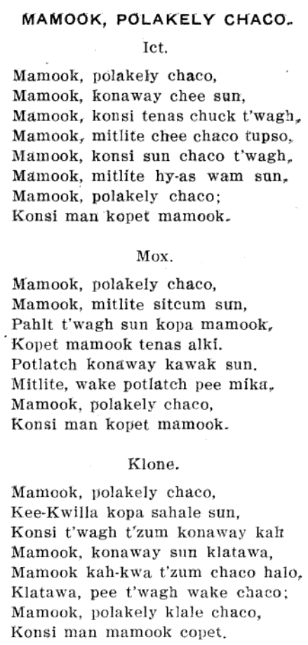
MAMOOK, POLAKELY CHACO.
mámuk, púlakʰli cháku.
work, night come.
{intended meaning: “WORK, FOR THE NIGHT IS COMING.”}
actual meaning: “WORK, NIGHT’S COMING.”Ict.
íxt.
one.
{“One.”}
“One.”
Mamook, polakely chaco,
mámuk, púlakʰli cháku,
work, night come,
{“Work, for the night is coming;”}
“Work, night’s coming,”Mamook, konaway chee sun,
mámuk, kʰánawi chxí-sán,
work, every new-day,
{“Work through the morning hours;”}
“Work, every morning,”Mamook, konsi tenas chuck t’wagh,
mámuk, qʰə́nchi tənəs-tsə́qw t’wáx̣,
work, when little-water bright,
{“Work while the dew is sparkling;”}
“Work, when the creek is bright,”Mamook, mitlite chee chaco tupso,
mámuk, míɬayt chxí-cháku típsu,
work, there’s new-grown grass,
{“Work mid springing flowers;”}
“Work, there’s freshly grown grass,”Mamook, konsi sun chaco t’wagh,
mámuk, qʰə́nchi sán cháku-t’wáx̣,
work, when sun get-bright,
{“Work when the day grows brighter;”}
“Work, when the sun gets bright,”Mamook, mitlite hy-as wam sun,
mámuk, míɬayt hayas-wám sán,
work, there’s very-warm day,
{“Work in the glowing sun;”}
“Work, there’s a hot sun,”Mamook, polakely chaco;
mámuk, púlakʰli cháku;
work, night come;
{“Work, for the night is coming,”}
“Work, night’s coming;”Konsi man kopet mamook.
qʰə́nchi mán kʰəpít-mámuk.
when man stop-work.
{“When man’s work is done.”}
“When a man stops working.”Mox.
mákwst.
two.
{“Two.”}
“Two.”Mamook, polakely chaco,
mámuk, púlakʰli cháku,
work, night come,
{“Work, for the night is coming;”}
“Work, night’s coming,”Mamook, mitlite sitcum sun,
mámuk, míɬayt sítkum-sán,
work, there’s mid-day,
{“Work through the sunny noon;”}
“Work, sit down at noon,”Pahlt t’wagh sun kopa mamook,
pʰáɬ t’wáx sán kʰupa mámuk,
full.of bright sun for work,
{“Fill brightest hours with labor;”}
“Full of sunshine for work,”Kopet mamook tenas alki.
kʰəpít-mámuk tənəs-áɬqi.
stop-work little-later.on.
{“Rest comes sure and soon.”}
“Stop working a bit later.”Potlatch konaway kawak sun.
pá(t)lach kʰánawi qʰáwaq sán.
give all flying day.
{“Give every flying minute”}
“Give everything, fly to the sun.”Mitlite, wake potlatch pee mika,
míɬayt, wík pá(t)lach [Ø] pi mayka,
sit.there, not give it and you(SINGULAR),
{“Something to keep in store;”}
“Sit down, don’t give it, and you,”Mamook, polakely chaco,
mámuk, púlakʰli cháku,
work, night come,
{“Work, for the night is coming,”}
“Work, night’s coming,”Konsi man kopet mamook.
qʰə́nchi mán kʰəpít-mámuk.
when man stop-work.
{“When man works no more.”}
“When a man stops working.”Klone.
ɬún.
three.
{“Three.”}
“Three.”Mamook, polakely chaco,
mámuk, púlakʰli cháku,
work, night come,
{“Work, for the night is coming,”}
“Work, night’s coming,”Kee-Kwilla kopa sahale sun,
kíkwəli kʰupa sáx̣ali sán,
under from high sun,
{“Under the sunset skies;”}
“Under the high sun,”Konsi t’wagh t’zum konaway kalt
qʰə́nchi t’wáx̣ ts’ə́m kʰánawi kʰúl*????
when bright mark all cold*???
{“While their bright tints are glowing,”}
“When the bright marks are all cold*???”Mamook, konaway sun klatawa,
mámuk, kʰánawi sán ɬátwa,
work, all day go,
{“Work, for daylight flies.”}
“Work, go every day,”Mamook kah-kwa t’zum chaco halo,
mámuk kákwa ts’ə́m chaku-hílu,
work like mark become-nothing,
{“Work till the last beam fadeth,”}
“Work like the marks are disappearing,”Klatawa, pee t’wagh wake chaco;
ɬátwa, pi t’wáx̣ wík cháku;
go, and light not come;
{“Fadeth to shine no more;”}
“Go, and the light won’t come;”Mamook, polakely klale chaco,
mámuk, púlakʰli-ɬíʔil cháku,
work, night-black come,
{“Work, while the night is darkening,”}
“Work, the night-dark is coming,”Konsi man mamook copet.
qʰə́nchi mán mámuk kʰəpít.
when man make finished.
{“When man’s work is o’er.”}
“When a man stops working.”
English lyrics, to compare with:
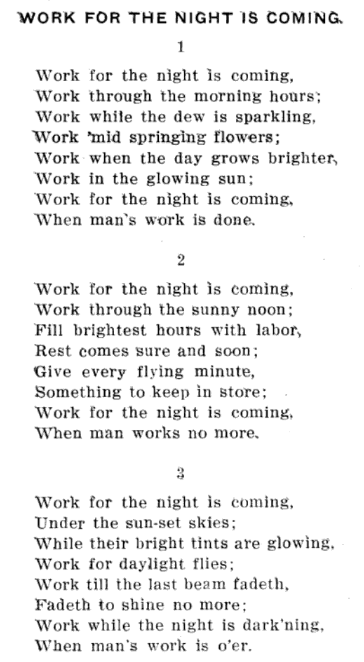
WORK FOR THE NIGHT IS COMING.
1Work for the night is coming,
Work through the morning hours;
Work while the dew is sparkling,
Work ‘mid springing flowers;
Work when the day grows brighter,
Work in the glowing sun;
Work for the night is coming,
When man’s work is done.2
Work for the night is coming,
Work through the sunny noon;
Fill brightest hours with labor,
Rest comes sure and soon;
Give every flying minute,
Something to keep in store;
Work for the night is coming,
When man works no more.3
Work for the night is coming,
Under the sun-set skies;
While their bright tints are glowing,
Work for daylight flies;
Work till the last beam fadeth,
Fadeth to shine no more;
Work while the night is dark’ning,
When man’s work is o’er.
Does all of this work for you? No offense to anyone connected with the song, but the Chinook Jargon version is purely atrocious music to me.
