Is ‘purple’ in K’alapuyan from Métis/Canadian French?
And, by implication, should we take it as a Chinuk Wawa word?
There’s a precedent for that. Previously, French-derived words have been found in K’alapuyan of the Grand Ronde Reservation community, and been logically inferred to reflect local Chinook Jargon usage. This is the story of ubut, for instance.
K’alapuya purple (image credit: Indianz.com)
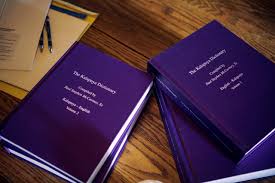
We find in Paul Stephen McCartney, Sr.’s “The Kalapuya Dictionary” an entry for ‘purple’ as K’alapuyan lila.
McCartney suggests perhaps this is from French lilas or English lilac. The latter is implausible on its face: Pacific NW English [láylak] sounds very different from the K’alapuyan form.
As to the French idea:
I have doubts. For ‘purple’, Michif, another Métis language born about the same time as Chinook Jargon, says vyalet. As in ‘violet’.
Plus, there’s already a similar-sounding word entry for ‘purple’ in the K’alapuyan dictionary that seems purely Indigenous: tsilulu and other variations. (The various K’alapuyan languages can have quite varying vowels among a set of cognate forms.)
Also: ‘lilac’ is an imported plant, from the Mediterranean regions of Europe. It may not have shown up in noticeable quantities in the Pacific Northwest until well into the Settler era. About the first definite mention of lilac shrubs in Oregon is in the year of statehood, 1859. This I take as mighty late to have influenced Indigenous languages; there are scant few Settler English words in our region’s Native languages — other than those coming in via the Jargon, which in northwest Oregon occurred before the named time.
So, no, we haven’t found a “new old” Jargon word for ‘purple’ here.
Let’s look at Chinuk Wawa for a moment:
- I like the recently coined Southern Dialect word for ‘purple’: salál-t’wáx̣, ‘salalberry-colored’.
- Unsurprisingly, the Northern Dialect, being of a slightly more recent vintage than the Southern, uses the English word, purpul.
- At last report, we don’t know how (or if) the Central Dialect expressed this concept with its own term. We can reasonably hypothesize that because this earliest form of Jargon came from such a heavily Indigenous base, it may have expressed ‘purple’ as a shade of blue or red. This I infer from (A) the dearth of ‘purple’ words in local language documentation and (B) the known broadness of their color terms. (Which as you may know is an extremely common thing in the languages of the world. In fact, in English, the color terms ‘purple’, ‘pink’, and ‘orange’, which we take now as being fundamental, are newish borrowings from Latin, Dutch [or Latin], and French, respectively.)
