1910, BC: Memorial To Sir Wilfrid Laurier, Premier of the Dominion of Canada, From the Chiefs of the Shuswap, Okanagan and Couteau Tribes of British Columbia
Much as with the Stevens Treaties in the US, back-translation into Northern Chinook Jargon awaits this important BC document.
And, as with those treaties, the point is that it was Chinook Jargon in which this statement of understanding was largely worked out.
These Indigenous leaders’ wishes and experiences were also conveyed to the Whites on their team (James A. Teit, J.M.R. Le Jeune, certain Indian Agents and lawyers) via tribal languages like Nɬeʔkepmxcín (“Couteau”) and Secwepemctsín (“Shuswap”) — but frankly none of those Settlers had a deeply fluent understanding of those forms of speech.
Some tribal chiefs had a degree of understanding of English by 1910, and older ones knew some Métis/Canadian French from fur-trade times. It would be a fairly wild claim to say that they knew English or French legal terminology or proper forms of address to use in a formal document to the Prime Minister.
(For instance, “memorial” is a legal term:
- (law) A statement of facts set out in the form of a petition to a person in authority, a court or tribunal, a government, etc. [from 17th c.] )
The most useful BC intercultural language in 1910 remained Chinuk Wawa.
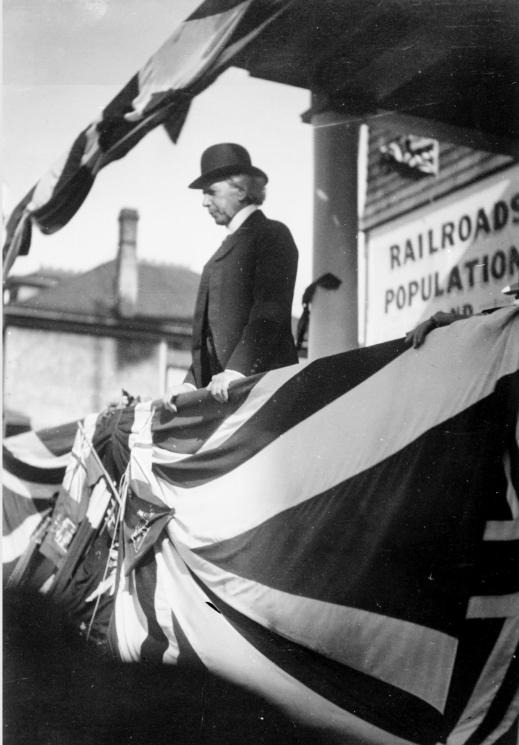
Sir Wilfred (image source: British Columbia, An Untold History)
Sir Wilfred (the proper spelling) Laurier, Prime Minister of Canada at the time, was traveling through Kamloops on August 25, 1910, and was handed this important political message from the Indigenous leaders of that area:
I myself am not going to start into back-translating this Memorial right now. But when that happens, I guarantee its Chinook Jargon will demonstrate great differences of understanding between Indigenous and Euro-Canadian people.
I am not saying that the two parties totally failed to grasp each other’s points of view.
I am saying we can legally establish that the two sides were talking past each other to a significant degree.
My experience of a large number of languages, as a professional linguist, is that there’s no such thing as a perfect translation — and the greater the cultural dissimilarities, the less likely a translation is to be a perfect tool.
By the way, there exist numerous other written Memorials from tribal leaders of BC to the Canadian government…

Ah! I look forward to reading the back-translation some day, whenever that day might come. The 1910 Memorial is important for many reasons…
Back-translation has always seemed to be more or an art than a science and the final product contains a whole set of historical and cultural hypotheses.
You mentioned that “memorial” is a legal term. I’ve found the expression “since time immemorial” to be very interesting and I’ve wondered about it’s origin. This perfectly apt phrase is also an English legal term.
Your strong assertion “…frankly none of those Settlers had a deeply fluent understanding of those forms of speech” is noteworthy. Certainly Le Jeune had significant blind spots in this cultural literacy of the Interior Salish peoples but was there anyone better positioned to assist the Indigenous chiefs than Teit?
R. & M. Ignace relate in their book:
“By all accounts, among Secwépemc elders, he was remembered as fluent in the Secwépemc language, although Tessie Dillabough of Kamloops, probably his last housekeeper before he retired, remembered him replacing his plain p’s with glottalized p’s, which created some amusing mispronunciations. In Secwepemctsín, situations around fixing a bed or room as opposed to someone’s privates can be imagined!”
In her book on Teit, W. Wickwire describes Teit as being “fully fluent in three Interior Salish languages (Nlaka’pamux, Secwépemc, and Syilx).”
She also quotes James McKenna:
“There is some prejudice against Mr. Teit. He may have views in respect to
Indians in which all interested in the Indians would not agree [but] I have
thought since I first knew him that it would be wise to make of him a friend
than an enemy … Shortly after arriving from Scotland to serve under his
late uncle, who was an Indian trader, he took to mingling with the Indians
of the country with whom his uncle’s chief trading was carried on. He not
only thoroughly mastered the language, but entered into the minds of the
people, from among whom he took a wife, who died some years ago. His
sympathies with and interest in her tribe grew and extended to other tribes.
His view-point on the Title question pretty well, I think, accords with the
Indian view-point. But his larger range of vision and experience bring into
play alongside the Indian view-point the consideration of practicality. I
don’t believe that he would urge the Indians to refuse attainable good for
problematic benefit.”
LikeLiked by 1 person