Lempfrit’s legendary, long-lost legacy (Part 27B, the 10 commandments: don’t not learn Negative Imperatives!)
Yes, more good stuff for us to learn from. Here we have some very Catholic stuff.
Page 2 of the 27th pair of pages (mis-numbered as “26” on the original page) from this precious document again brings us plenty of stuff worth knowing about Chinook Jargon — this time moving from lists of words into texts.
(Here’s a link to the other posts in this mini-series.)
“[SIC]” shows that someone mis-wrote a word. It wasn’t necessarily Lempfrit, since he was copying from someone else’s manuscript, Modeste Demers’ now-lost original to be exact.
For today’s installment, Alphonse Pinart’s “Anonymous 1849” copy (read it for free online) lacks any pages that correspond to what we’re seeing from Lempfrit.
Where you see [le]tters in square brackets, they’re not visible on the page copy that I’m working from, but we infer that they really are there!
By the way, the notation ___ means that the preceding entry is repeated in that position, along with some additional word(s).
See if you recognize words in these unusual spellings! I think we have a couple more small discoveries today, again showing the value of examining every Chinuk Wawa document — even those that appear to be straight copies of each other!
Beginning with today’s textual materials, we have the rewarding experience of seeing how a French-speaker (in the pre-Anthropology era, no less) conceptualized the word-to-word flow of spoken Jargon. Lempfrit’s “glosses” of each Chinook Jargon word might be pretty different from how you think of each word’s meaning!
If you need some quick proof that Chinook Jargon is an Indigenous language, take a look at how different Lempfrit’s French, and the conventional English lines, are from what the Jargon here is literally — and fluently — saying.
When I say that this Chinuk Wawa is fluent, I’m saying that it’s totally characteristic stuff from what I’ve now come to call the Central Dialect. That’s the oldest variety of the language, the early-creolized Jargon associated with Fort Astoria and Fort Vancouver. The document we’re looking at here was created before the Northern or Southern dialects (associated with British Columbia and with Oregon’s Grand Ronde Reservation, respectively) even existed.
The English translations of THE TEN COMMANDMENTS seen below come from a randomly selected Catholic website. I’m showing the Grand Ronde (Southern) equivalents of each Chinuk Wawa word, in the 2nd line of each set here — although Central Dialect differs in some respects, e.g. saying kʰupa rather than kʰapa for the all-purpose preposition.
Here you go, learn about how to make Negative Imperatives (prohibitions)…I mean, don’t not learn it!
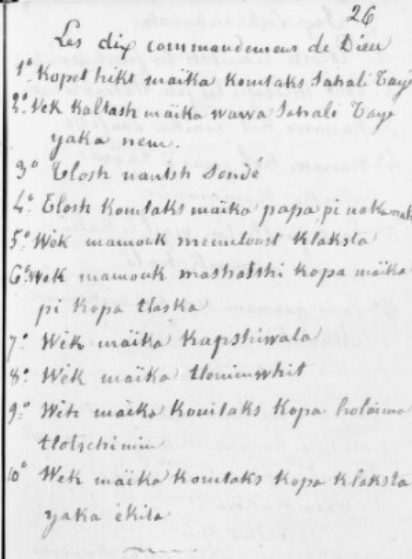
Les dix commandements de Dieu
‘The 10 commandments of God’1o Kopet hikt maïka komtaks Sahalé Tayé
kʰəpít-íxt mayka kə́mtəks sáx̣ali-táyí.
only-one you know sky-chief.
LITERAL: ‘1st, You (will) only know one Creator.’
‘1st: I am the Lord thy God. Thou shall not have strange gods before Me.’2o Wek kaltash maïka wawa Sahalé Tayé yaka nem.
wík kʰə́ltəs mayka wáwa sáx̣ali-táyí yaka ním.
not messing.around you say sky-chief his name.
LIT.: ‘2nd, Don’t name the Creator just to mess around.’
‘2nd: Thou shall not take the name of the Lord thy God in vain.’3o Tlosh nantsh* Sondé
ɬúsh-nánich sánti.’
well-watch Sunday.
LIT.: ‘3rd, Pay attention to Sundays.’
‘3rd: Remember to keep holy the Lord’s day.’4o Tlosh komtaks maïka papa pi maka* naha
ɬúsh-kə́mtəks mayka pápá pi mayka náha.
well-hear* your father and your mother.
LIT.: ‘4th, Listen well to your dad and mom.’
‘4th: Honor thy father and mother.’5o Wék mamouk memeloust klaksta
wík mamuk-míməlust ɬáksta.
not make-dead anyone.
LIT.: ‘5th, Don’t kill anybody.’
‘5th: Thou shall not kill.’6o Wek mamouk mashatshi kopa maïka pi kopa tlaska
wík mamuk-másháchi kʰapa mayka pi kʰapa ɬaska.
not make-harm(ful) with you(rself) and with anyone.
LIT.: ‘6th, Don’t do harmful things involving yourself and anyone else.’
‘6th: Thou shall not commit adultery.’7o Wék maïka kapshiwala
wík mayka kápshwála.
not you steal.
LIT.: ‘7th, Don’t steal.’
‘7th: Thou shall not steal.’8o Wék maïka tleminwhit
wík mayka t’ɬəmínxwət.
not you tell.lie.
LIT.: ‘8th, Don’t tell lies.’
‘8th: Thou shall not bear false witness against thy neighbor.’9o Wék maïka komtaks kopa holoima tlotschimin
wík mayka kə́mtəks kʰapa x̣lúyma ɬúchmən.
not you know about different woman.
LIT.: ‘9th, Don’t know about different women.’
‘9th: Thou shall not covet thy neighbor’s wife.’10 Wek maïka komtaks kopa klaksta yaka ékita
wík mayka kə́mtəks kʰapa ɬaksta yaka íkta.
not you know about anyone her/his thing.
LIT.: ’10th, Don’t know about anyone’s belongings.’
’10th: Thou shall not covet thy neighbor’s goods.’———–
That’s some good Central-Dialect Chinook Jargon. Read & learn!

Dave, thanks much for posting this. One small correction: the 10 commandments are indeed in the Pinart “Anonymous 1849” MS: pp 27-28.
LikeLiked by 1 person
naika wawa masi!
The drawbacks of copying and pasting from previous installments…
LikeLike