1899: A trilingual Nsyilxcn – Chinook Jargon – English vocabulary
I’ve commented on how cool it is to learn how speakers of various languages have mentally translated Chinuk Wawa for their own uses.
Here’s a super-rare set of equivalences between “Okanagan” Salish (Nsyilxcn), Chinook Jargon, and English.
It’s in Kamloops Wawa #182 (November 1899), on page 127:
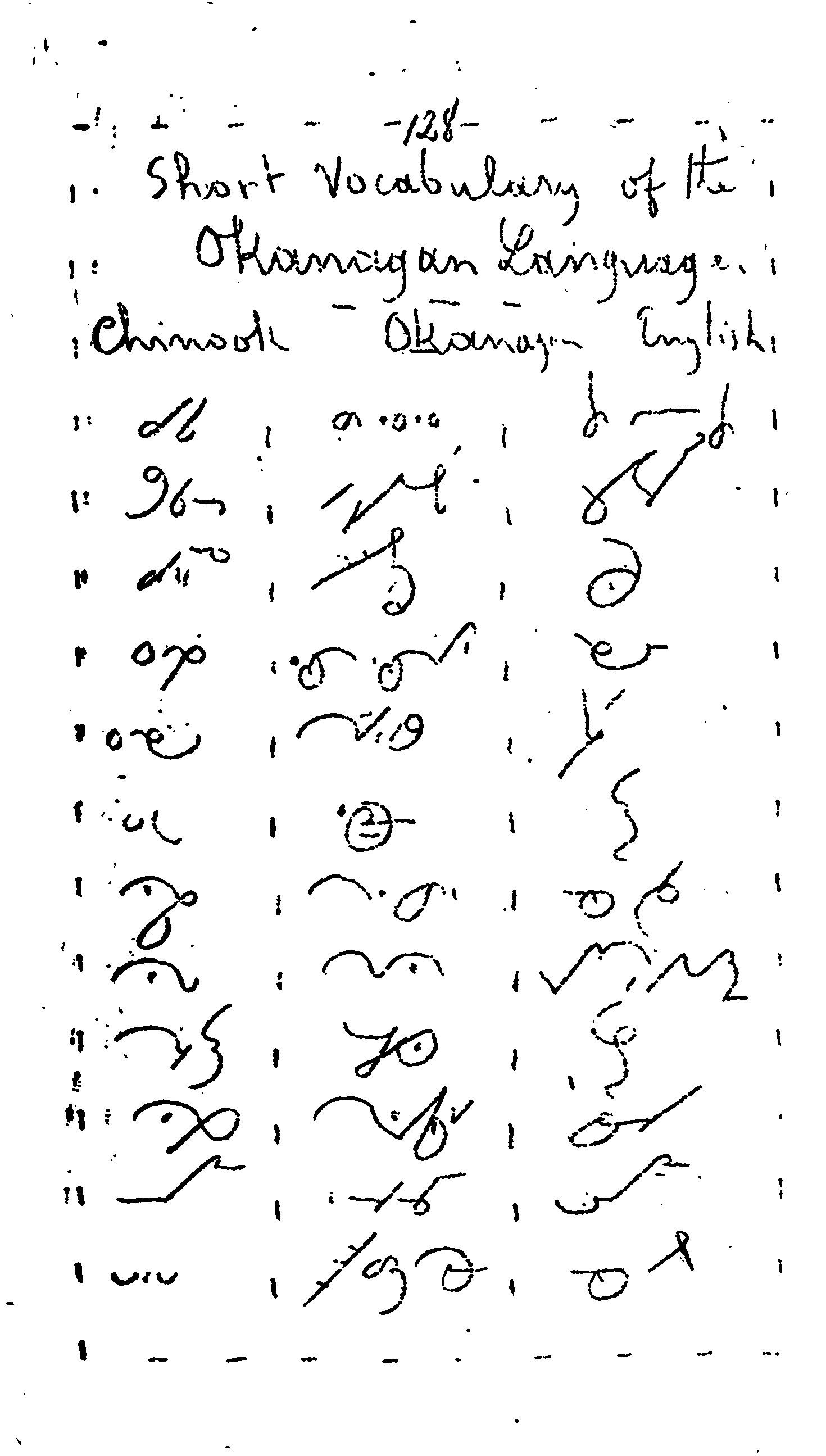
Short Vocabulary of the Okanagan Language
Chinook Okanagan English
alki aihaha by and by
(aɬqi ayxáxaʔ)ankati l krsápi formerly
(ánqati l_q̓sápi)alta řapná now
(álta ʕapnáʔ)aiak hushhushlih fast
(áyáq xʷsxʷústlx)aias shílhwa big
(háyásh sílxʷaʔ ‘big [singular]’)ayu hwīt many
(háyú xʷʔít)chako shhoih to come
(cháku cxʷúyx ‘come!’)chi shich fresh, recent
(chxí síc)chikmin skalaw money
(chíkʰəmin sqláw̓)chok shyuhlkŭ water
(chə́qw~tsə́qw síwɬkʷ)drit tiltalt straight
(dlét~drét tɬtáɬt)ihi r’ainshut* to laugh
(híhi ʕ́ʷyncút)
Another interesting thing in this page of Kamloops Wawa is the newly invented characters for Indigenous Salish sounds.
- The “Okanagan” word for ‘now’ uses a shorthand “r” with 2 tick marks on the side.
- The word for ‘many’ has a shorthand “wi” diphthong with a vowel-length bar inside it.
- And the word for ‘to laugh’ has a shorthand “r” with no less than 3 ticks on the side of it!

…and I know what ʕ is, but what does the accent on it mean?
(Yay! Commenting works again! For months, the form was broken.)
LikeLike
ɬax̣áwyam, David, the Interior Salish languages have glottalized pharyngeal resonants, and I don’t have a handy keyboard to put an apostrophe over the symbol, so it came out funky! Sharp eyes!
Dave Robertson
LikeLike