Why are there handwritten marks and notes in St Onge’s copy of Demers and Blanchet (and St Onge) 1871?
This online copy of “Chinook Dictionary, Catechism, Prayers and Hymns” belonged to its editor, Louis-Napoléon St Onge.
“Any one using this book will please return it to me, as it is the only copy I have — and the edition is out of print — L.N. St Onge”

That’s inscribed right inside the cover.
After several years of using it, I’ve come to realize someone made further marks in this copy.
It may have been St Onge, or else the implied borrower, who could well have been Thomas Sanderson Bulmer, although to judge by correspondence I’ve seen, that guy may not have returned the stuff St Onge loaned him.
The remaining mark-ups are in the Dictionary section.
On page 14, an added word:

Ekusah, sky(,) heaven.
Page 15, another:
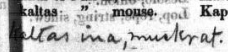
Kaltas ina, muskrat.
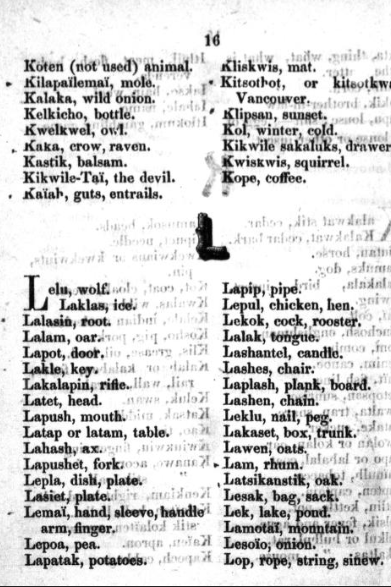
Page 16 and following, various dots next to words:
Page 21, an etymological note (also the final “n” in toshon is crossed out):

Talapush, plie, prayer (Nez-P[erces])
Page 22, another added word:
 Yayim, story,relation
Page 23, an added sub-entry:

Iutsekat oputs, ly[nx]
Page 24, an added sense:

LaHlaH, turning, falling, leaning.
Page 27, adding 2 entries:

Kwal’al-kwalal[,] to gallop
iah’an, to judge
Page 30, a set of highlighted entries:

Page 31, etymological notes on appa ‘well then, if this is the the case’, partly in not-very-expert French shorthand:

[In shorthand:] si c’est le cas.
[in longhand:] from ah bien or eh bien
On page 32, a typographical error, “beginnig”, is underlined.
