Lempfrit’s legendary, long-lost legacy (Part 26B: the Credo end)
Yes, more good stuff for us to learn from. Here’s the finale of the Credo.
Page 2 of the 26th pair of pages (mis-numbered as “25” on the original page) from this precious document again brings us plenty of stuff worth knowing about Chinook Jargon — this time moving from lists of words into texts.
(Here’s a link to the other posts in this mini-series.)
“[SIC]” shows that someone mis-wrote a word. It wasn’t necessarily Lempfrit, since he was copying from someone else’s manuscript, Modeste Demers’ now-lost original to be exact.
For today’s installment, Alphonse Pinart’s “Anonymous 1849” copy (read it for free online) lacks any pages that correspond to what we’re seeing from Lempfrit.
Where you see [le]tters in square brackets, they’re not visible on the page copy that I’m working from, but we infer that they really are there!
By the way, the notation ___ means that the preceding entry is repeated in that position, along with some additional word(s).
See if you recognize words in these unusual spellings! I think we have a couple more small discoveries today, again showing the value of examining every Chinuk Wawa document — even those that appear to be straight copies of each other!
Beginning with today’s textual materials, we have the rewarding experience of seeing how a French-speaker (in the pre-Anthropology era, no less) conceptualized the word-to-word flow of spoken Jargon. Lempfrit’s “glosses” of each Chinook Jargon word might be pretty different from how you think of each word’s meaning!
If you need some quick proof that Chinook Jargon is an Indigenous language, take a look at how different Lempfrit’s French, and the conventional English lines, are from what the Jargon here is literally — and fluently — saying.
When I say that this Chinuk Wawa is fluent, I’m saying that it’s totally characteristic stuff from what I’ve now come to call the Central Dialect. That’s the oldest variety of the language, the early-creolized Jargon associated with Fort Astoria and Fort Vancouver. The document we’re looking at here was created before the Northern or Southern dialects (associated with British Columbia and with Oregon’s Grand Ronde Reservation, respectively) even existed.
Today’s installment is the continuation of the “Credo“, i.e.:
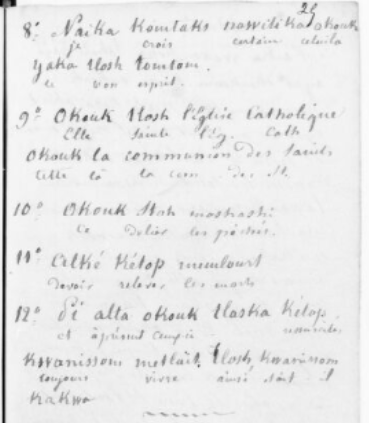
8o (…) Naika komtaks nawitika okouk
je crois certain celui-làyaka tlosh tomtom.
le* bon esprit.9o Okouk tlosh l’Eglise catholique
Elle Sainte L’Eg. Cath.okouk la communion des saints
cette là la com. des. St.*10o Okouk stoh mashachi
Ce délier les pêchés11o Alké kétop memloust
devoir relever les morts12o Pé alta okouk tlaska kétop
et à présent ceux-ci ressuscitéskwanissom mitlait tlosh kwanissom
toujours vivre ainsi soit-ilkakwa
Once again, that’s OK Chinook Jargon, but not wonderful, and in places it’s definitely not good grammar.
Here’s a traditional English-language rendition of the relevant passage:
I believe in the Holy Spirit, the holy catholic Church, the communion of saints, the forgiveness of sins, the resurrection of the body, and the life everlasting. Amen.
