Suttles, “Musqueam Reference Grammar”, Part 3
Naika wawa masi kopa Paisley pi Mokwst Alex, for reminding me of a great book by a great anthropological linguist!
Typically I’ll rake through a dictionary of a Pacific NW Indigenous language, and report to you here on the patterns of Chinook Jargon to be found there.

Image credit: Genius.com
Wayne Suttles’ “Musqueam Reference Grammar“, however, isn’t a dictionary, and I don’t know of one that’s available to me for this particular variety of what some folks have called a single, wide-ranging “Halkomelem” Salish language.
So instead, I’ll snoop through the aforementioned grammar, and…
I’m going to give you a reaction video. 🤩
Just kidding, what I’m gonna do is write my reactions to everything Wayne said about Chinuk Wawa. He had more experience than any living linguist with the Jargon, for a good stretch of years. (Then he taught Henry Zenk, and wow, look what we’ve learned!)
• Page 6 also:
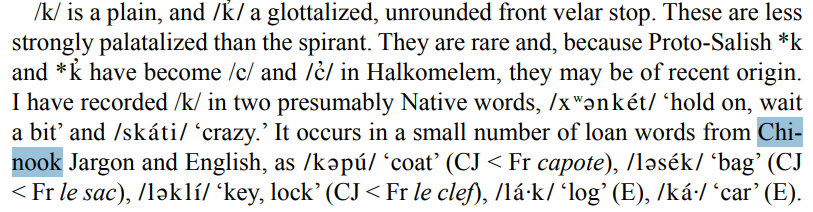
/k/ is a plain, and /k̓/ a glottalized, unrounded front velar stop. These are less strongly palatalized than the spirant. They are rare and, because Proto-Salish *k and *k̓ have become /č/ and /č̓/ in Halkomelem, they may be of recent origin. I have recorded /k/ in two presumably Native words, /xʷənkét/ ‘hold on, wait a bit’ and /skáti/ ‘crazy.’ It occurs in a small number of loan words from Chinook Jargon and English, as /kepú/ ‘coat’ (CJ < Fr capote), /lesék/ ‘bag’ (CJ < Fr le sac), /leklí/ ‘key, lock’ (CJ < Fr le clef), lá·k ‘log’ (E), /ká·/ ‘car’ (E).
Notes on this:
- I’ll be curious to see if someone can provide a parse or etymology for that word xʷənkét, partly because the word skáti is in fact not Indigenous, but from regional Chinook Jargon of the Lower Mainland and Vancouver Island, tracing back to British English scotty ‘crazy’.
- ‘Log’ is perfectly likely to have entered Musqueam via Chinook Jargon, although if it had done so back in “peak Jargon” times, I might have expected it to have mutated to *lé·k by now. By the same token, we’ve seen incontestably CJ words get taken into Musqueam and then made to sound more like English, as in the case of kinjáj for ‘Englishman’.
- Similarly, ká· ‘car’ almost certainly is from the typical Northern CJ word ka(r) which at first meant ‘railroad car; train’, but around 1900 mutated its sense toward ‘automobile’.
• Page 7:

There are five plain resonants: two nasals /m/ and /n/, a lateral liquid /l/, and two semi-vowels /y/ and /w/. Perhaps /h/ too should be classed as a resonant, as Kuipers (1967, 21) has done for Squamish and Hukari (1976b) has suggested for Cowichan. I have also recorded [r] in [santusprí], also given as [santusplí] ‘Holy Spirit’ (< Fr Saint-Esprit, possibly through Chinook Jargon), and in čéris ‘cherry.’
You bet I’ll chime in here as well 🙂
- Yes, ‘Holy Spirit’ came to Musqueam and its whole general region of the coast via Chinuk Wawa, in 2 ways:
- (A) from Francophone priests who relied tremendously on the Jargon, and in so doing led to the great majority of this language’s preserved documents; sometimes the priests’ mother-tongue pronunciations could lead to “fancy” stuff like the /r/ in santusprí .
- (B) via the later Indian Shaker Church, where the Indigenized pronunciation santusplí especially prevailed.
- ‘Cherry’ — note the singular in this English translation of čéris — showed up well within the colonial / frontier era, when Chinook Jargon was still the main intercultural language. We find exactly this pattern of (ultimately) English plural nouns for items of produce coming into Indigenous PNW languages with singular meaning, all over the broad Pacific Northwest region. (Any way that you define that term, and I’m grateful to historian Richard Mackie for making me aware of more of its variations, you’ll find this to be true.) ‘Cherry’ is probably to be attributed to Chinook Jargon.
