Suttles, “Musqueam Reference Grammar”, Part 2
Naika wawa masi kopa Paisley pi Mokwst Alex, for reminding me of a great book by a great anthropological linguist!
Typically I’ll rake through a dictionary of a Pacific NW Indigenous language, and report to you here on the patterns of Chinook Jargon to be found there.
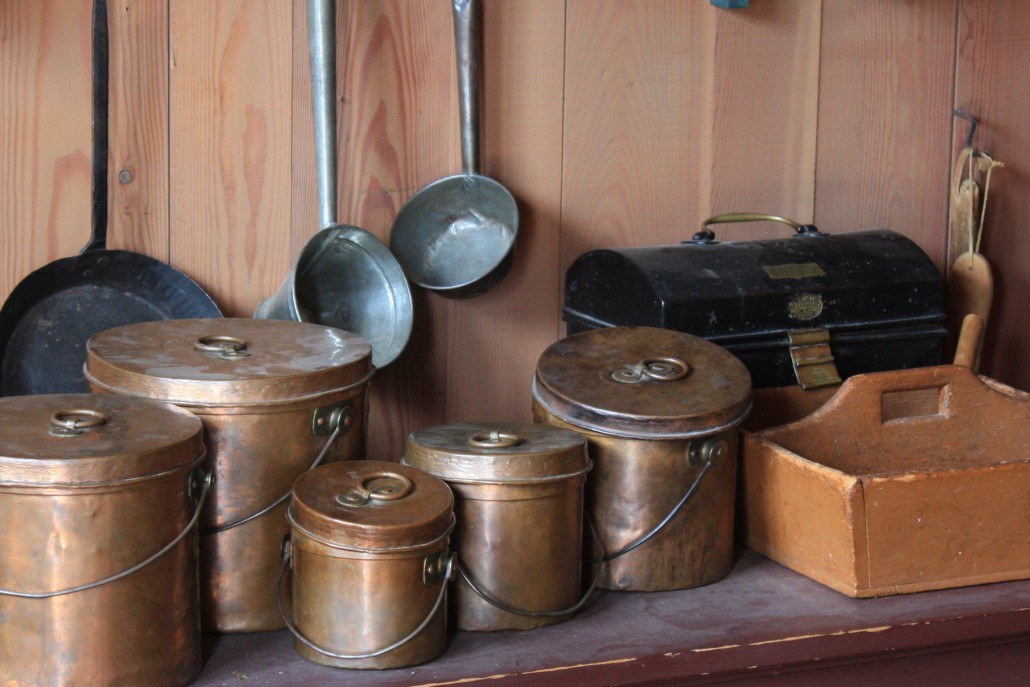
Fort Langley kettles (image credit: NancyMargueriteAnderson.com)
Wayne Suttles’ “Musqueam Reference Grammar“, however, isn’t a dictionary, and I don’t know of one that’s available to me for this particular variety of what some folks have called a single, wide-ranging “Halkomelem” Salish language.
So instead, I’ll snoop through the aforementioned grammar, and…
I’m going to give you a reaction video. 🤩
Just kidding, what I’m gonna do is write my reactions to everything Wayne said about Chinuk Wawa. He had more experience than any living linguist with the Jargon, for a good stretch of years. (Then he taught Henry Zenk, and wow, look what we’ve learned!)
• Page 6:

They also include a small number of loan words from Chinook Jargon (CJ), French (Fr) via Chinook Jargon, and English (E), as /číkmən/ ‘metal’ (CJ), /čé·k/ ‘iron kettle’ (< E jug?), /čé·ymn/ ‘Chinese’ (< E Chinaman), /šét/ ‘lead’ (the metal, < E shot), /kʷəšú/ ‘pig’ (CJ from Fr cochon), /ləpláš/ ‘board’ (CJ from Fr la planche), /píši/ ‘sin’ (CJ < Fr péché), /šípmenqən/ ‘English’ (< E ship-man and -qən ‘speech’),
/šúkwə/ ‘sugar’ (E), and from an unknown source /šəkʷəlúy/ ‘turnip.’ I have recorded [j] (as in English judge) only in /kinjáj/ ‘Englishman’ (CJ < E King George) and /kinjájqən/ ‘English (language).’
I need to make sure you all understand something: every one of the words Wayne cites here comes from Chinook Jargon. Please take note when Wayne indicates “CJ <“, i.e. directly from Chinook Jargon but having an ultimate etymology elsewhere. Here are my added notes:
- I understand /čé·k/ ‘iron kettle’ to have no relation to English ‘jug’, but instead to CJ číkmən ‘metal’, folk-reanalyzed as containing native Musqueam -mən, an Instrumental derivational suffix (see page 291 of M.R.G.).
- ‘Chinese’, /čé·ymn/, comes from CJ, which got it from another pidgin language, Chinese Pidgin English (as did locally spoken non-pidgin English). The word for ‘lead’ is from CJ shát ‘lead shot’, not directly from English.
- The word for ‘English’ (the language) contains Chinook Jargon shíp-mán ‘sailor’, i.e. ‘non-Indigenous foreigner’.
- The word for ‘sugar’ is from CJ shúkwa, which is the pronunciation at Bay Center, Washington and all over the north, distinct from anything you’d get straight from English.
- That word šəkʷəlúy for ‘turnip’, I suspect, originally denoted some other introduced starch vegetable,
- either beets (thus again from CJ for ‘sugar’, plus some extra material, with its diphthong /uy/ that Wayne Suttles says is weird for Musqueam, that reminds me of the Jargon word for ‘turnip’ as loaned into nearby ʔayʔajuθəm Salish: ʔɛlawɛʔ),
- or pumpkins and squashes (thus giving us new evidence for the spread of a French-derived lisitaluy which we only knew from Quinault Salish of northwest Washington; perfectly possible is a folk reanalysis under the influence of the better-known word shúkwa).
- I don’t want to waste the chance to remind folks that words for ‘turnip’ / ‘rutabaga’ vary wildly in languages along the Pacific Northwest coast, presumably because they were introduced early and were passed from nation to nation.
- The word kinjáj for ‘Englishman’, I want to point out, may be a more recent, and English-language-influenced pronunciation; in this quoted paragraph, you’ll see that earlier borrowings of /a/-type sounds have historically changed to /e/ in Musqueam. And as Wayne himself highlights, the /j/ sound is exceedingly rare in Musqueam, where it looks to have just recently, under steady Anglophone influence, developed from the Jargon’s typical kʰinchóch pronunciation to a more English-like one.
