“The Survey of Vancouver English”: Part 3, siwash
An interesting report, “The Survey of Vancouver English“, is subtitled “A Sociolinguistic Study of Urban Canadian English”.
This was published in 2004 by RJ Gregg et al. by Queen’s University in Kingston, ON, Canada. (Strathy Language Unit Occasional Papers number 5.)
(Click for all installments in this mini-series.)
Pages 69-70 bring us to what we might now call a problematic word…again showing Chinook Jargon knowledge quickly declining among Vancouverites.
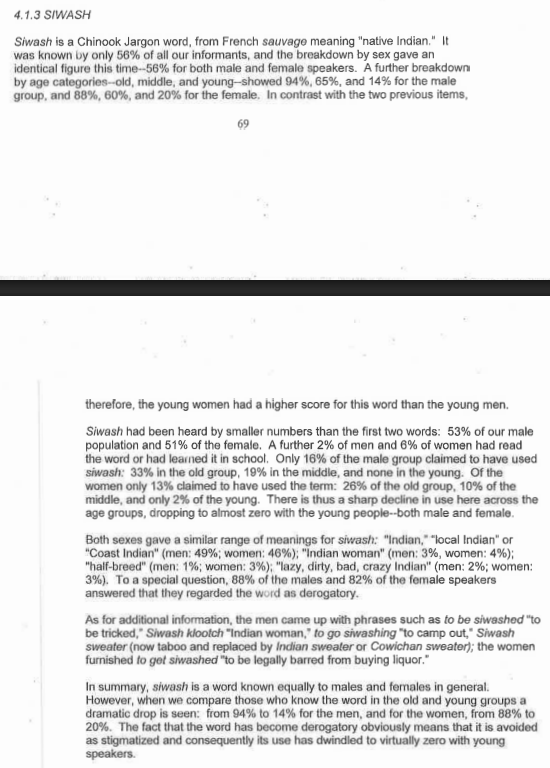
4.1.3 SIWASH
Siwash is a Chinook Jargon word, from French sauvage meaning “native Indian.” It
was known by only 56% of all our informants, and the breakdown by sex gave an
identical figure this time — 56% for both male and female speakers. A further breakdown
by age categories — old, middle, and young-showed 94%, 65%, and 14% for the male
group, and 88%, 60%, and 20% for the female. In contrast with the two previous items,therefore, the young women had a higher score for this word than the young men.
Siwash had been heard by smaller numbers than the first two words: 53% of our male
population and 51% of the female. A further 2% of men and 6% of women had read
the word or had learned it in school. Only 16% of the male group claimed to have used
siwash: 33% in the old group, 19% in the middle, and none in the young. Of the
women only 13% claimed to have used the term: 26% of the old group, 10% of the
middle, and only 2% of the young. There is thus a sharp decline in use here across the
age groups, dropping to almost zero with the young people — both male and female.Both sexes gave a similar range of meanings for siwash: “Indian,” “local Indian” or
“Coast Indian” (men: 49%; women: 46%); “Indian woman” (men: 3%, women: 4%);
“half-breed” (men: 1%; women: 3%); “lazy, dirty, bad, crazy Indian” (men: 2%; women:
3%). To a special question, 88% of the males and 82% of the female speakers
answered that they regarded the word as derogatory.As for additional information, the men came up with phrases such as to be siwashed “to
be tricked,” Siwash klootch “Indian woman,” to go siwashing “to camp out,” Siwash
sweater (now taboo and replaced by Indian sweater or Cowichan sweater); the women
furnished to get siwashed “to be legally barred from buying liquor.”In summary, siwash is a word known equally to males and females in general.
However, when we compare those who know the word in the old and young groups a
dramatic drop is seen: from 94% to 14% for the men, and for the women, from 88% to
20%. The fact that the word has become derogatory obviously means that it is avoided
as stigmatized and consequently its use has dwindled to virtually zero with young
speakers.
