Comparing apples, oranges, and soldiers
How are apples & oranges alike?
And, how are they the same thing as soldiers?
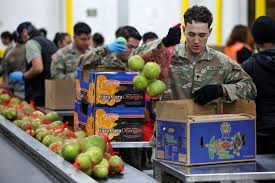
Where are the oranges? (image source: Yahoo News on X)
Well, when it comes to the history of Chinook Jargon, it comes down to being collective nouns.
Fruits & veggies were in many cases named in CJ by newly borrowed words from English that carried the English noun plural suffix, -(e)s.
This was because in the frontier era, the most frequent form of the English nouns for produce was the collective-plural one: “I’ll sell you some apples / pears / cherries / beans / potatoes“.
And because the Jargon doesn’t care about noun plurals versus singulars, that one form got used even when you meant just one apple / pear / cherry / bean/ potato.
This point has been made before.
Nobody has previously noted, though, that it extends to collective-plurals of people: “soldiers” were normally encountered as groups during the times of colonization, for instance. So the English word came into Chinuk Wawa as shúlchast, to quote the Grand Ronde form — which could also mean one soldier.
Here’s a quotation to illustrate this fact:
…wik lili, pi Valirian iaka
‘…soon Valerian’s’masachi tomtom tolo kopa iaka, pi iaka chako
‘evil heart overcame him, and he got’skukum saliks, pi iaka wawa kopa hloima
‘furious, and told the other’solshirs, pus klaska iskom ukuk solshirs
‘soldiers to take this one (soldier)’chi wash, pi pus klaska mamuk skukum
‘who was just baptized, and to beat him’kakshit iaka kopa hwip.
‘hard with whips.’
— Kamloops Wawa #174[c], March 1899, page 31
The same effect happened with the names of some ethnic groups. Jewish people were never numerous in Pacific NW frontier settings, but they were mentioned a lot in the preaching of the Catholic missionaries of BC. There, the word for one or many Jews is Shus, again from the English collective-plural form.
There seem to be other collective nouns that have come into the Jargon — from Chinookan languages.
So, for example, a word for ‘stickgame / bone game / slahal‘ is íɬukuma.
- The í- is Lower Chinookan’s prefix for a Masculine, and therefore Singular, noun…
- …but the -ma ending is that language’s Collective Plural suffix, what Franz Boas called a “Distributive“. It’s used to denote items perceived as sets, as far as I can see, rather than a counted quantity.
- This is not pointed out in the superb 2012 Grand Ronde Tribes dictionary of Chinuk Wawa, but I’ve written that the Lower Chinookan word would seem to literally mean ‘the bunch of broken things’.
Bonus fact:
A funny wrinkle:
I don’t think I’ve ever encountered ikta-s being used to mean a single ‘thing’, just groups or masses of ‘thing-s’!
Certainly a search through all issues of Kamloops Wawa for a phrase “iht iktas” brings up no results.
