“The Survey of Vancouver English”: Part 2, “skookum”
An interesting report, “The Survey of Vancouver English“, is subtitled “A Sociolinguistic Study of Urban Canadian English”.
This was published in 2004 by RJ Gregg et al. by Queen’s University in Kingston, ON, Canada. (Strathy Language Unit Occasional Papers number 5.)
(Click for all installments in this mini-series.)

Image credit: Skookum Music Festival, Vancouver, via The Georgia Straight
From it, we’re finding that Vancouverites had lost a lot of their familiarity with Chinook Jargon by 2004…So I wonder what they thought of the Skookum Music Festical in 2017!
I’m personally fascinated by the one woman’s contribution of a phrase, calling a mischievous kid “a little skookum“. This shows the survival of the other meaning this word has in CJ, “a dangerous being”, as Melville Jacobs put it.
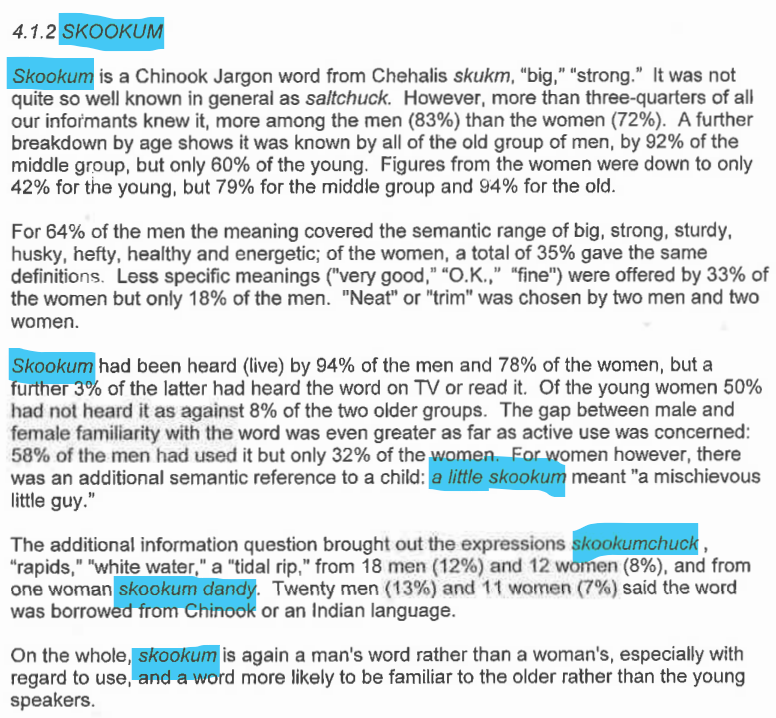
4.1.2 SKOOKUM
Skookum is a Chinook Jargon word from Chehalis skukm, “big,” “strong.” It was not
quite so well known in general as saltchuck. However, more than three-quarters of all
our informants knew it, more among the men (83%) than the women (72%). A further
breakdown by age shows it was known by all of the old group of men, by 92% of the
middle group, but only 60% of the young. Figures from the women were down to only
42% for the young, but 79% for the middle group and 94% for the old.For 64% of the men the meaning covered the semantic range of big, strong, sturdy,
husky, hefty, healthy and energetic; of the women, a total of 35% gave the same
definitions. Less specific meanings (“very good,” “O.K.,” “fine”) were offered by 33% of
the women but only 18% of the men. “Neat” or “trim” was chosen by two men and two
women.Skookum had been heard (live) by 94% of the men and 78% of the women, but a
further 3% of the latter had heard the word on TV or read it. Of the young women 50%
had not heard it as against 8% of the two older groups. The gap between male and
female familiarity with the word was even greater as far as active use was concerned:
58% of the men had used it but only 32% of the women. For women however, there
was an additional semantic reference to a child: a little skookum meant “a mischievous
little guy.”The additional information question brought out the expressions skookumchuck,
“rapids,” “white water,” a “tidal rip,” from 18 men (12%) and 12 women (8%), and from
one woman skookum dandy. Twenty men (13%) and 11 women (7%) said the word
was borrowed from Chinook or an Indian language.On the whole, skookum is again a man’s word rather than a woman’s, especially with
regard to use, and a word more likely to be familiar to the older rather than the young
speakers.

Here’s the next generation of research:
How Skookum is This? A Survey of Variation and Change in Vancouver English
https://journalling.library.mcgill.ca/article/view/1766
LikeLiked by 1 person
A fun find, thanks! Cite with care…
LikeLike
Here’s the next generation of research:
How Skookum is This? A Survey of Variation and Change in Vancouver English
https://journalling.library.mcgill.ca/article/view/1766
LikeLike