2008: Denzer-King on “doosh” meaning ‘cat’
I’d like to spend a moment with ‘cats’.
In particular, I want to talk about something that’s been said about the word for ‘cat’ in the Lingít (a.k.a. Tlingit) language of southeast Alaska and neighboring areas.
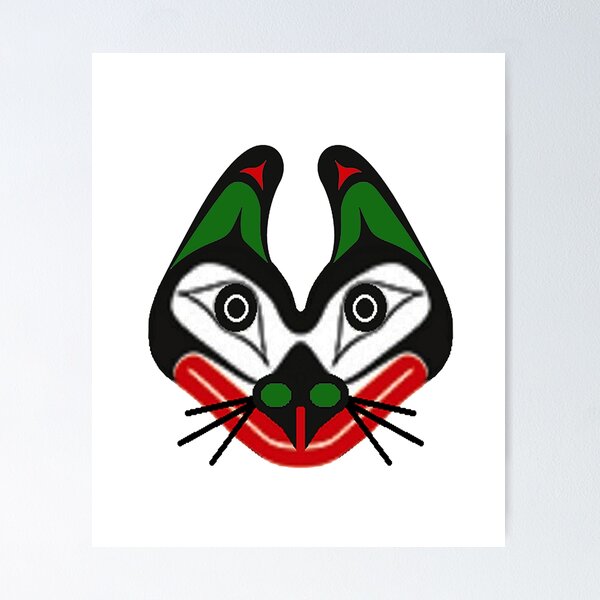
Image credit: Redbubble
I’m in the business of reviewing everything that’s been said in print about Chinuk Wawa, most of it needing clarification in light of the enormous amount that we’ve learned in the last 25 years.
Today: Ryan Denzer-King’s 2008 paper, Neologisms in Indigenous languages of North America, appeared in the Proceedings from the Eleventh Workshop on American Indigenous Languages (Joye Kiester and Verónica Muñoz-Ledo, editors), pages 25-39 (Volume 19 of Santa Barbara Papers in Linguistics).
There, we read,

The Tlingit word
dóosh [for ‘cat’] (4a) is indeed from Chinook Jargon, but since the borrowed word was púsh or
púshpúsh (also púspus in Southern Oregon), this is clearly from the same English loan as
many of the other languages surveyed. It should also be noted that Tlingit borrowings
often have opaque phonological changes created by the lack of labials in Tlingit. A
comparison of borrowings in Tlingit with the original source word shows that labials are
often mapped onto labialized velars, but this can be unpredictable. See Crippen (2007)
for more discussion of phonological mapping in Tlingit loanwords.
Lingít dóosh is not a Chinook Jargon word. It’s from Haida, and ultimately from pre-CJ English puss. The Lingít form, let me be clear, comes from Haida dúus, not directly from English. As Denzer-King notes, and perhaps as Dzéiwsh Crippen says in his 2007 paper that I haven’t seen, we’d expect any directly loaned word like puss to have emerged in Lingít as *kwóos*.
I’m not clear what’s meant by putting 2 identical accent marks on púshpúsh. That word, and the known variants of it (see my next paragraph), have initial stress only.
At the blog post I’ve just linked to, I note that reduplicated forms like púspus, púshpush, and píshpish appear more likely to be Central Salish-influenced, and attributable to Chinook Jargon, thus of a later vintage than the Haida (et al.) word. (For what it’s worth, Google Ngram Viewer suggests a reduplicated “puss-puss” was never a thing within English.)
I’m not sure which southern Oregon languages are being referrred to by Denzer-King; citations of sources would be excellent to see, but are absent from the paper’s References. I try to track all borrowings of Chinuk Wawa words into other

Métis French /minuʃ/ could also be a source. I don’t know enough about the region and (the history of) Tlingit phonology. Some languages further south lost their nasals and replaced them with dentals. The use of labrets among the Tlingit may have contributed to a labial to dental development.
LikeLike
I don’t know of French having played a sustained role on the Northwest Coast, among the Haidas. Just English. If “puss” had come directly to the Tlingits, who were in fact outliers from the Anglophone maritime fur trade, then we would’ve gotten *”kwoos”.
LikeLike
Or *”kwus”.
LikeLike
And labrets would only affect grown women’s speech.
LikeLike