The word for ‘Russian’, actually for ‘Unangax̂'(?), in Chinook Jargon
Predictably, the word for ‘Russian’ in Chinook Jargon came from English, but there’s much more to the story, including a new discovery.
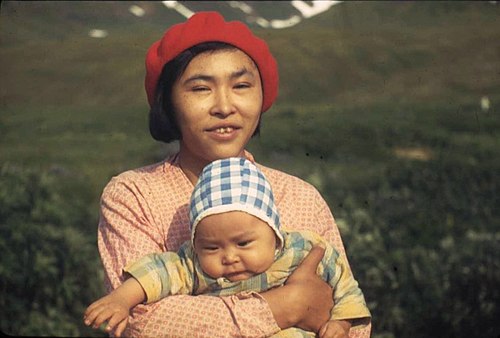
lushən tilixam (image credit: Wikipedia)
But when?
By definition, that means the English of about 1867 or later. CJ wasn’t in any significant contact with Russians or Russian speakers during the years of Russian imperial domination of Alaska. Only later did Chinook come into much usage that far north, during the time of American imperial domination. So it came in along with English-language influence.
And how?
We’re definitely talking about “just folks” English, as is normal for the kind of “on the street” speech that influenced the Jargon. Were you aware that a normal American English pronunciation of the word < Russian > was [rúšən]? (“ROO-shun”.)
More about “when”…
A look at Google Ngram Viewer, where I searched for likely spellings showing that way of saying the word, indicates that < Roossian > was the only commonly written reflection of this. It seemed to come into currency shortly after Seward’s Purchase of Alaska, around 1870, and was in peak use about 1884, bottoming out around 1890.
So…
I believe we can date the following instances of [rúšən] in 6 unrelated languages to that late frontier-era frame of 1870 to 1890:
- Eyak of S Central Alaska Territory: lú•šən
- Haida of NW BC & SW Alaska Territory: lúusan
- Sm’algyax (Tsimshian) of NW BC & SE Alaska luusn,
as in Heelda luusns a ‘na k’a Boosn ‘There are lots of Russians in Alaska (the United States)’,
where Boosn comes from Chinook Jargon bástən ‘the USA’. - Diiʔdiitidq (Ditidaht/Nitinat Southern Wakashan) of Vancouver Island BC: luuša[-]aʔtx̣
- Tuwáduqucad (Twana Coast Salish) of NW Washington Territory: lu’sH3n
- Shoalwater Bay Chinuk Wawa of SW Washington Territory: < Lushan >, presumably lúshən
More about “how”…
We can confidently infer that these are all due to Chinuk Wawa. CW was simply the primary language with which folks of PNW coastal Indigenous ethnicity, and non-Native newcomers, could and did communicate in the time frame we’ve identified.
But also…
Let’s keep in mind the way real Alaskans talk English. In my lifetime, regular folks living in south-central Alaska (such as my family) have routinely called Indigenous people of Kodiak Island, and the heritage Russians of the Kenai Peninsula (including a relative of mine), “Aleuts”. A number of knowledgeable writers have discussed this, also pointing out that folks assume the language of Indigenous Unangax̂ (Aleutian Islanders) is “Roossian”.
I only want to make it explicit, based on that information, that “Aleutian” [əlúšən] and “Roossian” have almost certainly gotten tangled up in the minds of average, modern, English-speaking Alaskans…
…And that on the PNW coast, “Russian” for a long time just meant anyone from Alaska…
…And that the big majority of “Russians” who non-Alaskan Indigenous folks, that is to the south of Alaska itself, encountered during the fur-trade era were in fact ethnic Aleuts.
So when we find a word translated as ‘Russian’ in any Pacific NW Coast language, we may need to understand that it’s first and foremost a word for ‘Unangax̂’, that is, ‘Aleut’!

Hi Dave,
This is a fascinating line of inquiry! It reminds me that I have been looking for the origin of the surname “Casimir” (also “Casmer”, in some communities), which I have been told came from “up North”. Any Russian ideas?
J.
LikeLiked by 1 person
Casimir was a popular baptismal name among French-speakers in the 1900s, so it wound up being commonly bestowed in Catholic-dominated Indigenous communities of the PNW. Similarly, I see lots of females named “Blandine” in those communities at the time — a name that’s very uncommon elsewhere!
LikeLiked by 1 person
Thanks Dave!
J.
LikeLiked by 1 person