1871, OR: “Indian council at Salem”, for back-translation into Grand Ronde Chinuk Wawa
An early reservation-era meeting in Oregon’s capital city was a Who’s Who of important Jargon speakers.
For example, from Grand Ronde Reservation, there were Solomon, Joseph Hutchins (Mose Hudson), and Louis Lipsank/Lipsack (Nipissing).

The proceedings were reported in the news in great detail, so we have what looks like a pretty accurate telling of what that last gentleman said to everyone in Grand Ronde Chinook Jargon. Does someone feel like back-translating it to Jargon?
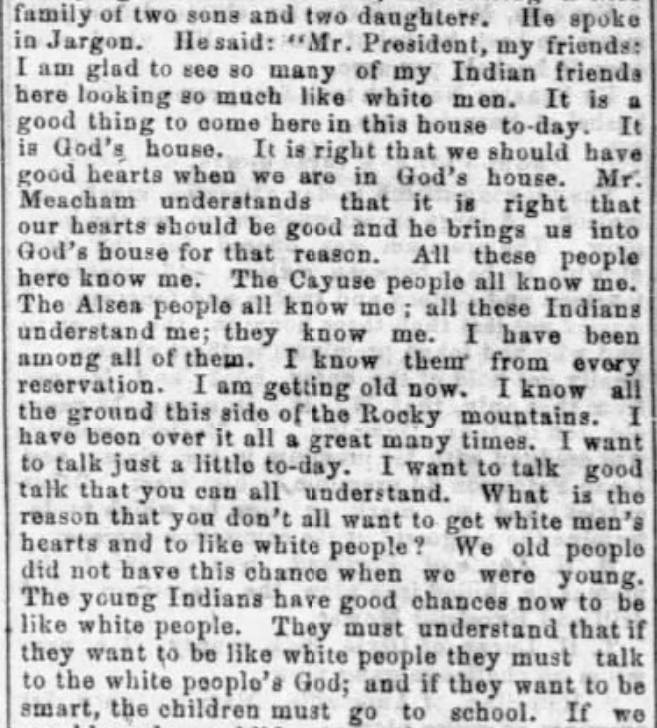

He spoke
in Jargon. He said: “Mr. President, my friends:
I am glad to see so many of my Indian friends
here looking so much like white men. It is a
good thing to come here in this house to-day. It
is God’s house. It is right that we should have
good hearts when we are in God’s house. Mr.
Meacham underatands that it is right that
our hearts should be good and he brings us into
God’s house for that reason. All these people
here know me. The Cayuse people all know me.
The Alsea people all know me; all these Indians
understand me; they know me. I have been
among all of them. I know them from every
reservation. I am getting old now. I know all
the ground this side of the Rocky mountains. I
have been over it all a great many times. I want
to talk just a little to-day. I want to talk good
talk that you can all understand. What is the
reason that you don’t all want to get white men’s
hearts and to [be?] like white people? We old people
did not have this chance when we were young.
The young Indians have good chances now to be
like white people. They must understand that if
they want to be like white people they must talk
to the white people’s God; and if they want to be
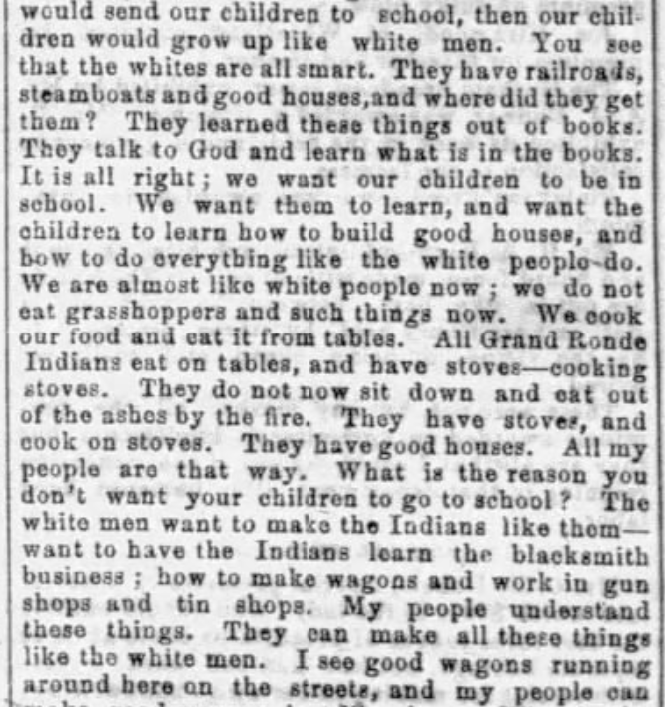
smart, the children must go to school. If we
would send our children to school, then our chil-
dren would grow up like white men. You see
that the whites are all smart. They have railroads,
steamboats and good houses, and where did they get
them? They learned these things out of books.
They talk to God and learn what is in the books.
It is all right; we want our children to be in
school. We want them to learn, and want the
children to learn how to build good houses, and
how to do everything like the white people do.
We are almost like white poople now ; we do not
eat grasshoppers and such things now. We cook
our food and eat it from tables. All Grand Ronde
Indians eat on tables, and have stoves — cooking
stoves. They do not now sit down and eat out
of the ashes by the fire. They have stoves, and
cook on stoves. They have good houses. All my
people are that way. What is the reason you
don’t want your children to go to school? The
white men want to make the Indians like them —
want to have the Indians learn the blacksmith
business; how to make wagons and work in gun
shops and tin shops. My people understand
these things. They can make all these things
like the white men. I see good wagons running
around here on the streets, and my people can
make good wagons just like them. What is the
reason you don’t all want to be like the white
people? I want you to put off your Indian
habits, and cut off your long hair, and be like the
white people in their dress and language. That
is all I have to say now.
— from the Portland (OR) Oregonian of October 14, 1871, page 1, columns 6 and 7

For those interested, there is a pretty complete copy of several days of proceedings, with a simlarly jam-packed of who’s-who in the history of settler-tribal relations in this era and speeches by leaders from GR, Siletz, Alsea Sub-Agency, Warm Springs, and Umatilla. NARA has digitized it starting here: https://catalog.archives.gov/id/164226043?objectPage=350
LikeLiked by 1 person
Masi (thank you), Peter! This is very helpful!
Dave Robertson
LikeLike