1923, WA: Still another McCluskey – Eldridge letter in Jargon!
We’ve found a number of letters written between Mr McCluskey and Mr Eldridge; it’s wonderful to discover yet another of their Northern Dialect gems…
This one is in reply to one we already knew, which was published a day earlier.
Image credit: Small Tribes Organization of Western Washington, on GiveYoung.org
The language was already at a low point of use by 1923. You’ll run into numerous misspellings and punctuation errors by the typesetter, who couldn’t have been expected to understand the forms of the words.
But this letter is in very fine Northern Dialect Chinook Jargon, including at least one loanword from a local Salish language that the writer was acquainted with as a kid — likely a dialect, such as Samish, of what us linguists insist on calling the Straits Salish language.
The occasion of the letter is the 1923 Mount Vernon, WA meeting of the NFAI (Northwest Federation of American Indians), a collective of landless tribes nowadays known as the STOWW (Small Tribes Organization of Western Washington).
I’ll add some further value, to help you read the letter:

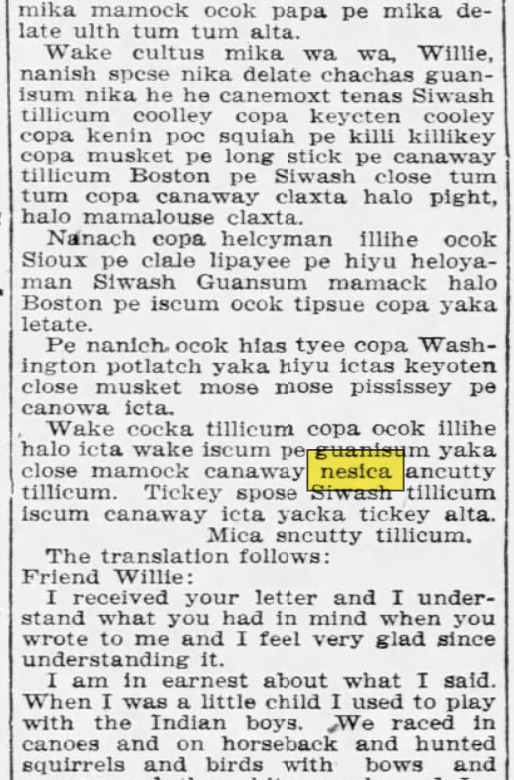
ELDRIDGE PROVES HE
CAN SWING WICKED
PENCIL IN CHINOOKAs the convention of the Northwest
Indians to be held here June 9, ap-
proaches, at which time delegates will
be selected to go to Washington, D.
C., and to put before President Hard-
ing and Congress the matter of an-
nuities promised them by Governor
Stevens and never received, several
of the “old timers” are exchanging
letters in Chinook.Hugh Eldridge, postmaster, has dem-
onstrated that he is a past master at
using this now almost extinct language,
and that in him the Indians have one
of their most warmest friends on the
coast.Mr. Eldridge was in receipt yester-
day of a letter from William McClus-
key, of LaConner, written in Chinook.
He replied in the same language, as
follows:William McCluskey, Esq.,
Farmer in charge of Swinomish
Reservation,
La Conner, Wash.,Nah Willie:
ná, wíli*:
‘Hey, Willie,’Nika iscum1 mika tzum paper pe nika
nayka ískam mayka t’sə́m-pípa pi nayka
‘I’ve picked up the letter you wrote and I’
delate cumtux mika tum tum cocka
dléyt kə́mtəks mayka tə́mtəm, kákwa
‘really understand your thinking, which is why‘
mika mamock ocok papa pe mika de-
mayka mámuk úkuk pípa pi nayka dléyt
‘you wrote that letter, and I’m really’
late ulth tum tum alta.
yútłił-tə́mtəm álta.
‘glad now.’Wake cultus mika wa wa, Willie,
wík-kʰə́ltəs nayka wáwa, wíli*,
‘My words are meaningful, Willie.’
nanish spese nika delate chachas2 guan-
nánich, spos nayka dléyt chéʔcheʔ-s*, kwánsəm
‘Look, when I was [we were?] really friends, I always’
isum nika he he canemoxt tenas Siwash
nayka híhi kʰánumákwst ténas* sáwásh
‘had fun with young Native’
tillicum coolley copa keycten cooley
tílixam, kúli kʰupa kʰíyutən, kúli
‘people, racing horses, racing’
copa kenin poc squiah pe killi killikey
kʰupa kəním,3 p’ú skwiyóxw*4 pi kə́ləkəla
‘canoes, shooting squirrels and birds’
copa musket pe long stick pe canaway
kʰupa mə́skit pi láng* stík,5 pi kʰánawi
‘with guns and bows, and every-‘
tillicum Boston pe Siwash close tum
tílixam, bástən pi sáwásh, ɬúsh-tə́mtəm
‘one, White and Native, was good-hearted’
tum copa canaway claxta halo pight,
kʰupa kʰánawi-ɬáksta, hílu pʰáyt*,
‘to everyone, no fighting,’
halo mamalouse claxta.
hílu míməlus ɬáksta.
‘no killing anybody.’Nanach copa helcyman6 illihe ocok
nánich, kʰupa x̣lúyman ílihi, úkuk
‘Look, in other places, those’
Sioux pe clale lipayee pe hiyu heloya-
sú pi ɬíʔil-lipʰyí pi háyú x̣lúyman
‘Sioux and Blackfeet and lots of other’
man Siwash Guansum mamack halo
sáwásh kwánsəm mamuk-hílu
‘Natives were always doing away with’
Boston pe iscum ocok tipsue copa yaka7
bástən pi ískam úkuk típsu8 kʰupa yaka
‘Whites and taking that hair off their’
letate.
latét.
‘heads.’Pe nanich ocok hias tyee9 copa Wash-
pi nánich, úkuk háyás táyí kʰupa wáshingtən
‘But look, the great chief in Washington’
ington potlatch yaka hiyu ictas keyoten
pátlach yaka háyú íktʰa-s: kʰíyutən,
‘gave them lots of things: horses,’
close musket mose mose pississey pe
ɬúsh mə́skit, músmus, pʰásísi, pi
‘good guns, cows, blankets, and’
canowa icta.
kʰánawi-íkta.
‘everything.’Wake cocka tillicum copa ocok illihe
wík-kákwa, tílixam kʰupa úkuk ílihi.
‘Folks in this place were different.’
halo icta wake iscum pe guanisum yaka
hílu-íkta, wík ískam, pi kwánsəm yaka
‘They didn’t take nothing [SIC],10 but they always’
close mamock canaway nesica ancutty
ɬúsh mámuk. kʰánawi nsayka, ánqati
‘acted nice. All of us(,) the oldtime’
tillicum. Tickey spose Siwash tillicum
tílixam, tíki spos sáwásh tílixam
‘people, want the Native people to’
iscum canaway icta yacka tickey alta.
ískam kʰánawi-íkta yaka tíki álta.
‘get their hands on everything they want now.’Mica sncutty tillicum.
mayka ánqati tílixam,
‘Your friend of old times,’1 Eldridge uses iskam as ‘receive, get’ in the sense of the recipient having no control. This differs from standard Chinook Jargon usage, but it’s common among Settler speakers. It’s one of the few awkward features of his grammar. I’ve tried translating it more like ‘get one’s hands on’ throughout this letter, to reflect how it would sound to most fluent hearers.
2 “Chachas” is not a previously known Chinook Jargon word. It strongly resembles the word for ‘friend’ in the Salish languages local to Bellingham, plus an unexplained -s, which is perhaps an English noun plural, such as we sporadically see in some people’s CJ. (Compare tílixam-s ‘friends; people’ and íktʰa-s ‘things, stuff, belongings, clothing, property’). Assuming Eldridge learned chachas as a child spending time with Indigenous peers, he might have understandably taken the word as meaning ‘boys’!
3 These phrases for ‘horse racing’ and ‘canoe racing’, with small variations, are known throughout the Northern Dialect area of Chinook Jargon.
4 I haven’t yet found a similar word for ‘squirrel’ in Salish languages of the Bellingham area, but I immediately recognize this one from Lower Chehalis and the other Salish languages of somewhat distant southwest Washington, where it’s approximately skʷəyúxʷ.
5 ‘Long stick’ is a new discovery for us as a Jargon expression for a ‘bow (and arrows)’. But long is definitely a normal and common Northern Dialect word, although it’s unknown in the Southern Dialect.
6 x̣lúyman is the local pronunciation of x̣lúyma ‘other, different, strange’ in the Salish Sea area. Possibly it was created by a folk etymology such as *x̣lúyma mán* ‘another person’.
7 Important note: to express ‘they, their’, Eldridge uses only the word yaka, which primarily means ‘(s)he, her, his’, etc. This “plural yaka” is widely known in all CJ dialects. It shows the influence of the grammar of Indigenous languages of the region, where a single word means ‘she, he, they’.
8 típsu is literally ‘grass, leaf, plant’, but in older Chinook Jargon it was sometimes used for ‘hair’. Much more common in all CJ dialects is yáqsu ~ yáx̣sut etc.
9 ‘Great chief’ and ‘great father in Washington’ are well-documented old phrases in Chinook Jargon that referred to any President of the USA. McCluskey and Eldridge would have grown up hearing Indigenous elders who had participated in treaty negotiations talking this way.
10 ‘They didn’t take [or get] nothing’ seems like it’s influenced by Eldridge’s own informal English. The wording of it in Jargon here isn’t so good; it sounds as if he’s accidentally written wake ‘not’ instead of his normal word for ‘they’, ya(c)ka. (Which would have been grammatical, saying, ‘they didn’t get anything’.)
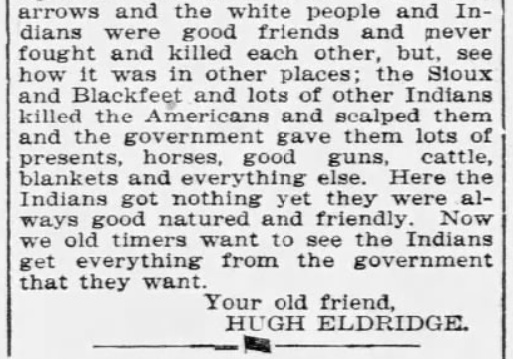
The translation follows:
Friend Willie:
I received your letter and I under-
stand what you had in mind when you
wrote to me and I feel very glad since
understanding it.I am in earnest about what I said.
When I was a little child I used to play
with the Indian boys. We raced in
canoes and on horseback and hunted
squirrels and birds with bows and
arrows and the white people and In-
dians were good friends and never
fought and killed each other, but, see
how it was in other places; the Sioux
and Blackfeet and lots of other Indians
killed the Americans and scalped them
and the government gave them lots of
presents, horses, good guns, cattle,
blankets and everything else. Here the
Indians got nothing yet they were al-
ways good natured and friendly. Now
we old timers want to see the Indians
get everything from the government
that they want.Your old friend,
HUGH ELDRIDGE.
— from the Bellingham (WA) Herald of May 30, 1923, page 9, column 4
https://www.newspapers.com/image/768762124/?match=1&terms=nesica
asdf
