1912 [about 1851?], WA Territory: Murphy recounts Indians’ love of silver coins”
I think here we learn something about the origin of the still-common phrase, “shortchanging” someone!
Here’s a neat reminiscence of frontier-era practices involving cash money in a cultural contact situation where just about everyone was speaking Chinook Jargon.
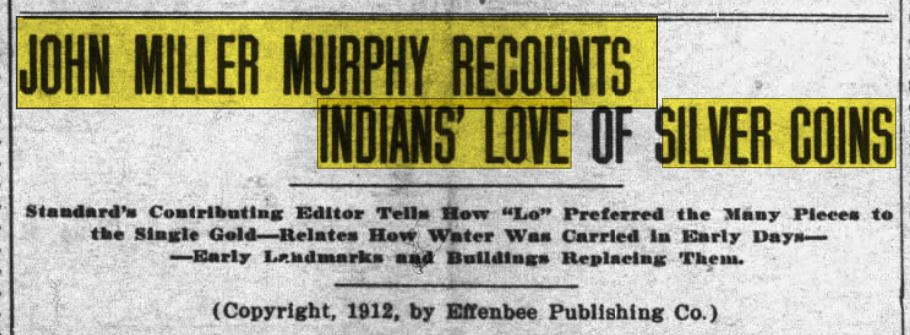

JOHN MILLER MURPHY RECOUNTS
INDIANS’ LOVE OF SILVER COINS
Standard’s Contributing Editor Tells How “Lo” Preferred the Many Pieces to
the Single Gold — Relates How Water Was Carried in Early Days —
…(Copyright, 1912, by Effenbee Publishing Co.)
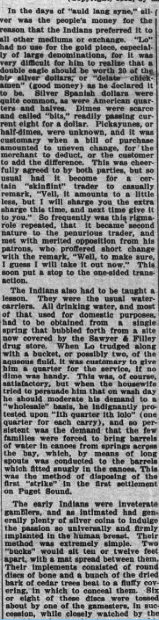
In the days of “auld lang syne,” sil-
ver was the people’s money for the
reason that the Indians preferred it to
all other mediums of exchange. “Lo”
had no use for the gold piece, especial-
ly of large denominations, for it was
very difficult for him to realize that a
double eagle should be worth 30 of the
big silver dollars, or “delate chick-
amen” (good money) as he declared it
to be. Silver Spanish dollars were
quite common, as were American quar-
ters and halves. Dimes were scarce
and called “bits,” readily passing cur-
rent eight for a dollar. Pickayunes, or
half-dimes, were unknown[*], and it was
customary when a bill of purchase
amounted to uneven change, for the
merchant to deduct, or the customer
to add the difference. This was cheer-
fully agreed to by both parties, but so
usual had it become for a cer-
tain “skinflint” trader to casually
remark, “Vell, It amounts to a little
less, but I will sharge you the extra
sharge this time, and next time give it
to you.” So frequently was this rigma-
role repeated, that it became second
nature to the penurious trader, and
met with merited opposition from his
patrons, who proffered short change
with the remark, “Well, to make sure,
I guess I will take it out now.” This
soon put a stop to the one-sided trans-
action.The Indians also had to be taught a
lesson. They were the usual water-
carriers. All drinking water, and most
of that used for domestic purposes,
had to be obtained from a single
spring that bubbled forth from a site
now covered by the Sawyer & Filley
drug store. When Lo trudged along
with a bucket, or possibly two, of the
aqueous fluid, it was customary to give
him a quarter for the service, if no
dime was handy. This was, of course,
satisfactory, but when the housewife
tried to persuade him that on wash day
he should moderate his demand to a
“wholesale” basis, he Indignantly pro-
tested upon “Ith quarter ith lolo” (one
quarter for each carry), and so per-
sistent was the demand that the few
families were forced to bring barrels
of water in canoes from springs across
the bay, which, by means of long
spouts was conducted to the barrels
which fitted snugly in the canoes. This
was the method of disposing of the
first “strike” In the first settlement
on Puget Sound.…
J. M. M.
— “John Miller Murphy Recounts Indians’ Love of Silver Coins“, Olympia (WA) Washington Standard of August 23, 1912, page 1, columns 3-4
[*] Pickayunes (picayunes) were in fact known in frontier-era Pacific NW, as I’ve shown by the existence of a word for them in Lushootseed etc.!
