AF Chamberlain’s field notes of Chinuk Wawa from SE British Columbia (Part 8: Bread, rock, mend…)
Howdy from Kamloops, BC, where I’m doing a bit of Chinook stuff today!
(A link to all installments in this mini-series!)
Material that I’ve highlighted in orange is new to us!
It’s of great interest to me that Chamberlain reports a Métis French word for ‘bread’ in southeastern BC.
That same word also shows up in the neighbouring Indigenous languages.
Father JMR Le Jeune of Kamloops noted, in a 1924 publication, that most of the French words formerly known in (southern-dialect) Jargon were then no longer used in BC, most of them replaced by English loans.
So I’m a bit skeptical of ‘bridle’, ‘grease’, ‘tongue’, ‘file’, ‘pipe’ ‘fowl’, ‘silk’, ‘oats’, ‘wolf’ here.
I’ll note any common(er) English-loaned replacements for these words, in the list below.
But the other French words in this list are known to have stayed in spoken use.
The frequent sound < ä > in Chamberlain’s data corresponds with [æ] pronunciations we hear from quite a number of audio-recorded speakers of northern-dialect Chinuk Wawa.
A reminder, Chamberlain’s < c > = “sh”.
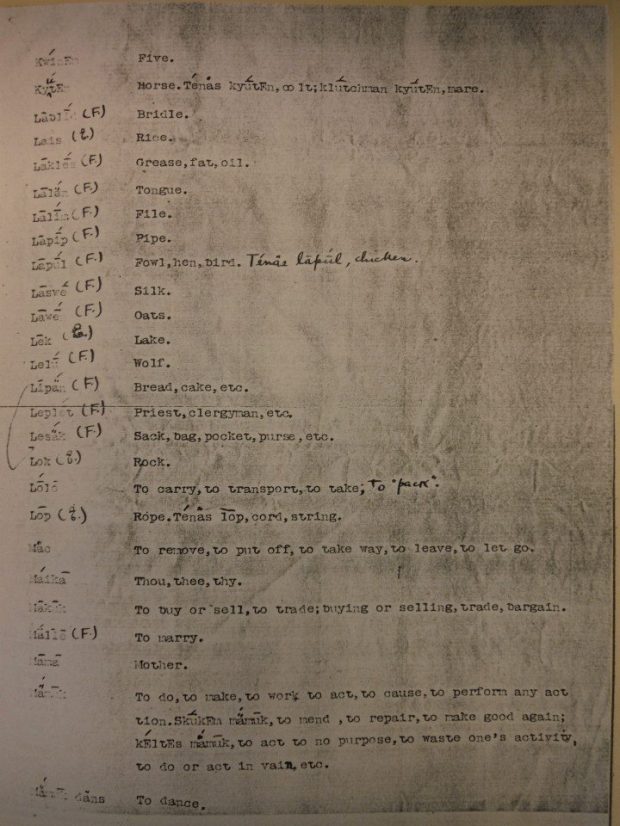
- KwínEm ‘Five’.
- KyútEn ‘Horse’.
- Ténäs kyútEn ‘colt’
[i.e. ‘little horse’]; - klū́tchman kyútEn ‘mare’.
[i.e. ‘woman horse’.]
- Ténäs kyútEn ‘colt’
- Lāblī́d (F[rench].) ‘Bridle’.
[Compare braidl in “Kamloops Wawa”.] - Lais (E[nglish].) ‘Rice’.
- Lāklḗs (F.) ‘Grease, fat, oil.’
[Compare klis/gris in “Kamloops Wawa”.] - Lālä́n (F.) ‘Tongue’.
[Interesting to see this word recorded without a final /g/. Actually common in “Kamloops Wawa”.] - Lālī́m (F.) ‘File’.
- Lāpī́p (F.) ‘Pipe’.
[Compare paip in “Kamloops Wawa”.] - Lāpū́l (F.) ‘Fowl, hen, bird’.
[Compare chikin in “Kamloops Wawa”.]- Ténäs lāpū́l ‘chicken’. [I.e. ‘chick’.]
[I.e. ‘little chicken’.]
- Ténäs lāpū́l ‘chicken’. [I.e. ‘chick’.]
- Lāswḗ (F.) ‘Silk’.
[Compare silk in “Kamloops Wawa”.] - Lāwḗn (F.) ‘Oats’.
[Compare ots in “Kamloops Wawa”.] - Lḗk (E.) ‘Lake’.
- Lelū́ (F.) ‘Wolf’.
[Compare wulf in “Kamloops Wawa”; lilu gets misused there as ‘coyote’ or ‘fox’ sometimes, showing it’s an unfamiliar word in Northern Dialect.] - Līpä́n (F.) ‘Bread, cake, etc.’
[A Métis French word, more characteristic of Chinuk Wawa’s Northern Dialect than the Southern Dialect, where it’s less documented.] - Leplḗt (F.) ‘Priest, clergyman, etc.’
- Lesä́k (F.) ‘Back, bag, pocket, purse, etc.’
- Lok (E.) ‘Rock’.
[A new loan from English.] - Lṓlō ‘To carry, to transport, to take; to “pack” ‘.
- Lōp (E.) ‘Rope’.
- Ténäs lōp ‘cord, string’.
[I.e. ‘little rope’.]
- Ténäs lōp ‘cord, string’.
- Mäc ‘To remove, to put off, to take [a]way, to leave, to let go’.
- Máikā ‘Thou, thee, thy’.
- Mākūk ‘To buy or sell, to trade; buying or selling, trade, bargain’.
- Mä́līē (F.) ‘To marry’.
- Māmā ‘Mother’.
- Mä́mūk ‘To do, to make, to work, to act, to cause, to perform any action’.
- Skū́kEm mä́mūk ‘to mend, to repair, to make good again’
[i.e. ‘strong make/work’; we’d expect this to be a noun phrase, which we do find elsewhere in Northern Dialect; if intended as a verb phrase, the word order should be reversed into ‘make strong’]; - kÉltEs mä́mūk ‘to act to no purpose, to waste one’s activity, to do or act in vain, etc.’
{I.e. ‘worthlessly do’.]
- Skū́kEm mä́mūk ‘to mend, to repair, to make good again’
- Mä́mūk däns ‘To dance’.
[I.e. ‘make dance(ing)’.]
