1872, Washington DC: The Pacific Coast Club
Was this a political organization?
Was it a bunch of folks with connections to the West Coast?
Why the anonymity?
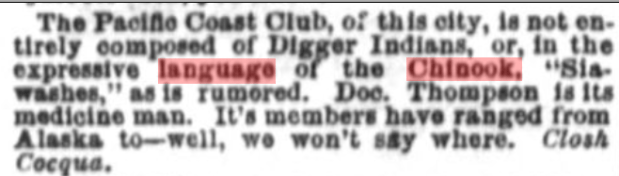
The Pacific Coast Club, of this city, is not entirely composed of Digger Indians, or, in the expressive language of the Chinook, “Siawashes,” as is rumored. Doc. Thompson is its medicine man. It’s members have ranged from Alaska to — well, we won’t say where. Closh Cocqua.
— from the Washington (DC) Daily National Republican of March 26, 1872, page 4, column 1
Siawash = sáwásh = ‘Native person’.
Closh Cocqua = ɬúsh kákwa = ‘good like that; let it be so’.
Untranslated Chinuk Wawa in a newspaper so far away from the Pacific Northwest was secret code, in effect, for the few who could grasp it.

Thanks for this interesting use of jargon so far East as early as 1872. The only Pacific Coast Club I can locate is a coursing club (hunting hare with greyhounds) in California, mostly in the late 1870s, early 1880s. Buth they show no sign of using jargon, or ‘playing Indian’ through language use, or doing whatever this East Coast group is doing. I suspect the term is referring to an informal group of elites who had spent time on the West Coast, and aim to now distinguish themselves on the Washington, DC, scene by talking their own esoteric lingo. Maybe?
LikeLiked by 1 person
Whoops. Sorry, missed your last line here. Yes, early Beltway code.
LikeLiked by 1 person
Thanks so much for your good comments, Robert. Is there any more likely explanation for a “Chinook Club” existing so far away, and specifically in Washington, at that time? We certainly know of numerous veterans of Pacific NW service who wound up in the capital and in the Civil War.
LikeLike
Yes, you’re right. It might well be Civil War veterans. There are quite a few connections between Oregon/Washington and the East Coast shortly before and after the War. (Gov. Stevens, of treaty infamy, too, if he hadn’t lost his life). Or it might have been the influence of George Gibbs, who returned to the East, and Washington, DC, I think, briefly during and after the War. (Though I think he was in Connecticut by 1872, shortly before he died. Gibbs certainly knew his jargon, and may have spread his interest to others like him. It all does sound like “club” behavior though, doesn’t it?
Since it’s the 1870s, I’m always on the lookout for Indigenous travelers to the East Coast, and the discourse they might have inspired. Beginning around 1870, in the Puget Sound region, some Puyallup and Yakama started traveling around, possibly reaching DC. They utilized Methodist and other church connections, or were attempting to act on early complaints on reservations. Words travel with people, and possibly some jargon was used by them, or to describe them, and thus might show up in distant newspapers. Some of these Indigenous travelers actually published letters and reports in newspapers, as early as 1870, having learned alphabetic literacy, and occasionally used some jargon in their writing.
I’ll keep my eyes open while scanning the papers! Thanks for the puzzle. Love your website and daily additions.
LikeLiked by 1 person
Thanks again — and I’d be fascinated to see some of the Indigenous accounts you’ve turned up.
LikeLike