Myron Eells’s hymn book (Part 1: Jesus Chako Kopa Saghalie)
Previously here, we’ve taken close looks at the quality of various song lyrics in Chinuk Wawa, some superb, some rather questionable…
(Here’s a link to all installments in this mini-series.)
Today we can start in on the collection published by Reverend Myron Eells, who pretty much grew up talking the Jargon. So we might hypothesize that his lyrics will be highly fluent. Let’s look and see, in his
“Hymns in the Chinook Jargon Language“, 2nd edition (Portland, OR: David Steel, 1889).
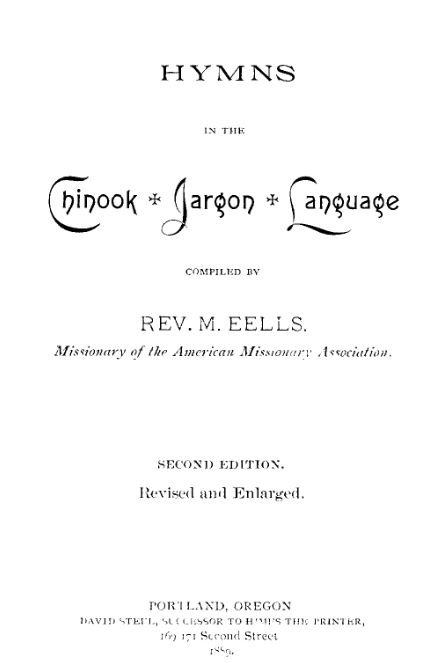
Eells supplies us with a glimpse into how his Chinook Jargon hymns were composed:
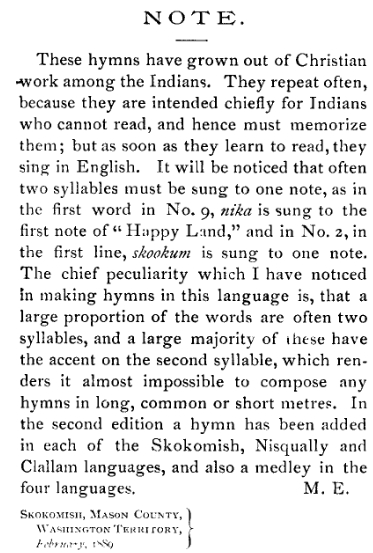
NOTE.
These hymns have grown out of Christian work among the Indians. They repeat often, because they are intended chiefly for Indians who cannot read, and hence must memorize them; but as soon as they learn to read, they sing in English. It will be noticed that often two syllables must be sung to one note, as in the first word in No. 9, nika is sung to the first note of “Happy Land,” and in No. 2, in the first line, skookum is sung to one note. The chief peculiarity which I have noticed in making hymns in this language is, that a large proportion of the words are often two syllables, and a large majority of these have the accent on the second syllable, which renders it almost impossible to compose any hymns in long, common or short metres. In the second edition a hymn has been added in each of the Skokomish, Nisqually and Clallam languages, and also a medley in the four languages. M.E.
SKOKOMISH, MASON COUNTY,
WASHINGTON TERRITORY,
February, 1889.
I disagree about the word stresses, because almost all Jargon words have stress on the first syllable. But Eells’s insights into the mechanics of creating these songs tells us much of value.
Now let’s have a look at the first hymn in the collection, which I’ll show in modern Grand Ronde spellings, plus a sense of what it’s literally saying:
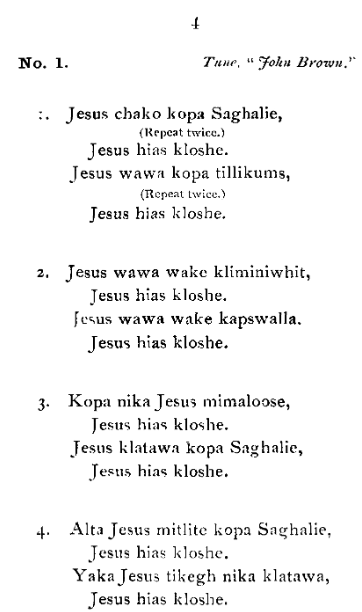
No. 1. Tune, “John Brown.”
1. Jesus chako kopa saghalie,
djísəs* cháku kʰapa sáx̣ali,
‘Jesus came from the sky’
(Repeat twice.)
Jesus hias kloshe.
djísəs* hayas(h)-ɬúsh.
‘Jesus is very good.’
Jesus wawa kopa tillikums,
djísəs* wáwa kʰapa tílixam-s,
‘Jesus talked to the people,’
(Repeat twice.)
Jesus hias kloshe.
djísəs* hayas(h)-ɬúsh.
‘Jesus is very good.’2. Jesus wawa wake kliminiwhit,
djísəs* wáwa wík t’ɬəmínxwət,
‘Jesus said “Don’t lie,” ‘
Jesus hias kloshe.
Jesus wawa wake kapswalla,
djísəs* wáwa wík kapshwála,
Jesus said “Don’t steal,” ‘
Jesus hias kloshe.3. Kopa nika Jesus mimaloose,
kʰapa náyka djísəs* míməlus,
‘It’s for me that Jesus died,’
Jesus hias kloshe.
Jesus klatawa kopa Saghalie,
djísəs* ɬátwa kʰapa sáx̣ali,
‘Jesus went to the sky,’
Jesus hias kloshe.4. Alta Jesus mitlite kopa Saghalie,
álta djísəs* míɬayt kʰapa sáx̣ali,
‘Now Jesus is in the sky,’
Jesus hias kloshe.
Yaka Jesus tikegh nika klatawa,
yáka(,) djísəs*(,) tíki nayka ɬátwa
‘It’s him, Jesus, that wants me going’
Jesus hias kloshe.
Here’s Eells’s own idea of what the above says:

In #4, I guess Eells or the typesetter mis-wrote < yahwa > ‘there’ as yaka ‘he, him’!
Overall, this simple song is indeed pretty understandable. It doesn’t show much indication of high fluency in the grammar of Chinook Jargon — but it isn’t bad CJ either.
We’ll see a number of further samples of Eells’s Chinuk Wawa in the rest of this mini-series, so stay tuned!

Better than the doleful Calvinist number where he says, on the basis of zero evidence, that Jesus doesn’t like people dancing.
LikeLiked by 1 person
🙂
https://www.biblicalarchaeology.org/daily/people-cultures-in-the-bible/jesus-historical-jesus/jesus-as-lord-of-the-dance/
LikeLike