1923: A re-discovered Kamloops Chinuk Wawa publication
By a very lucky random chance, I’ve learned of a publication in Kamloops Chinook Jargon that we hadn’t seen before.
I’ve just received a copy of issue #26 of the journal Printing History (Summer 2019).
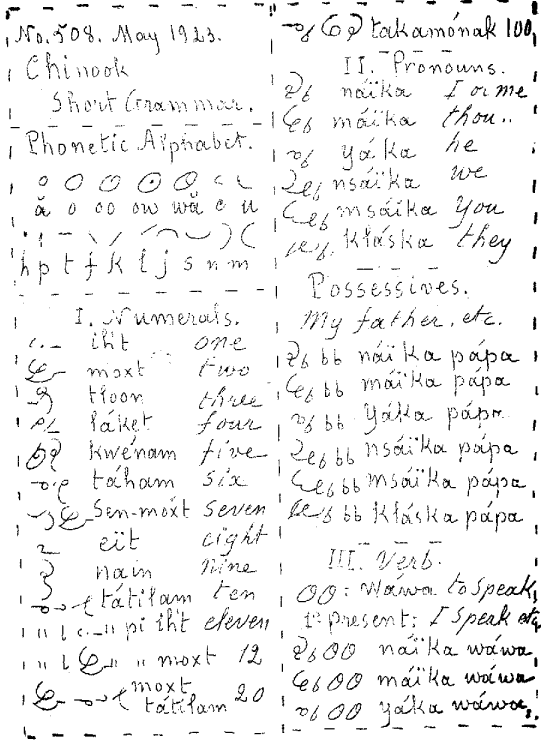
The title page of the grammar (page 22 of Voremberg’s article)
In it is an article by Fuchsia Voremberg, “Chinook Jargon and Itinerant Mimeography in the Pacific Northwest” (pages 22-33).
The author is a host of the British version of a popular TV series, “Antiques Roadshow”, which probably relates to her finding the item we’re talking about.
It’s a piece that I’ve seen mentioned in bibliographies, but have never found a copy of:
[Kamloops Wawa] “#508. May 1923. Chinook Short Grammar”, obviously by Father JMR Le Jeune.

It would be wonderful to get a copy of the entire publication, which has at least eight pages. Just two of those are shown in Voremberg’s article.
The 1923 piece is clearly a practice run towards the more well known 1924 “Chinook Rudiments” by Le Jeune, experimenting with a different style of stress marking and so forth.
The fact that Le Jeune assigned it an issue number indicates that he saw himself as continuing to publish the Kamloops Wawa newspaper — but the latest issue before it, as far as I’ve found, was in 1918.
I expect this will be quite a valuable document for us to understand Northern Dialect Chinuk Wawa, and the history of the BC “Chinuk Pipa” literacy.

David Corbett left a very perceptive comment about this article — I’m sorry I seem to have accidentally deleted it! David, could you possibly re-send it?
— Dave Robertson
LikeLike
This is an another example of how the pronunciations of semicircle vowels are distinguished by direction. In “Lebatèm” (“le baptême”), twice in “lemaliaj” (“le mariage”), in “lekalem” (“le Carême”), and at the start of “leshaple” (“le chapelet”), the vowel is clockwise and pronounced /i/ (as in Michif “li”). In “lekateta” (“les Quatre-Temps”), “lepishil” (“les vigiles”), and the end of “leshaple”, it is counterclockwise and pronounced /e/ or /ɛ/.
One might argue that this pronunciation distinction was not maintained by all speakers and reflects Le Jeune’s awareness of the French etymons. Even so, there is a minimal pair in “tatilam” (counterclockwise) and “lakateta” (clockwise), so it must reflect a real pronunciation distinction in Chinook itself. (In “te”/“ti”, it is usually written clockwise, as in “ankati” and “tilikom”, so there must be a reason for the consistent exception in “tatilam”.)
I hypothesize that there are two semicircle vowel letters in Chinuk Pipa, not one, but that the distinction is obscured for two reasons: they are written identically in many medial contexts, and the distinction is not as simple as clockwise vs. counterclockwise.
LikeLike
Thanks for this excellent comment, David C, and for the hard work of thinking that went into it.
A couple of brief contributions:
Le Jeune gives the impression of having settled on absolutely standardized ways of writing each word in Chinuk Wawa, wouldn’t you agree? That is, the small semicircle vowel (which I lazily always transcribe as “i”) will typically be written just clockwise in for example “tilikom”. And the Indigenous writers whose letters are preserved are very consistent in replicating Le Jeune’s way of writing each word.
My other comment, for what it’s worth, is to wonder whether Le Jeune was in the process of innovating a “schwa” symbol, with some of his uses of “i” in Chinook Jargon. We know that in the original French-language Duployan shorthand, there’s no symbol at all for the frequent schwas of French. So masculine singular “le” is written as just “l” in French Duployan. We know for certain that Le Jeune had varied responses to the schwa sounds of Chinuk Wawa, writing them with any of the shorthand symbols “a”, “i”, “o”, “u”, “yu” (as I transcribe them), as well as sometimes using no symbol at all. To a significant degree, which symbol he used for CW schwa is predictable from the phonotactic environment — for instance, before a nasal consonant, he usually writes it as “o”.
I’m hoping you’re on track to crack the code of predicting which sounds “i” represents in any given Chinuk Pipa word.
LikeLike
Pingback: 1923, BC: “Chinook Short Grammar” (Kamloops Wawa #508) | Chinook Jargon