Bodies of water in northern Chinuk Wawa
Here’s some cool relief from the PNW heatwave going on right now 🙂
Spoiler alert — “tumwater” is fake news for northern CW … I’m guessing ‘waterfall’ must be skukum chok (a very common phrase in BC) … if not a newly borrowed English *watir fol* !
From JMR Le Jeune’s wonderful book “Chinook Rudiments“, 1924:22…
Here, we get another snappy example from Le Jeune of the intricate grammar of possession in Chinuk Wawa — where < tlap >, i.e. t’ɬáp ‘catch; find’, equals ‘manage to have; wind up having’!
Anyway, read on for a cool and refreshing lesson about water:
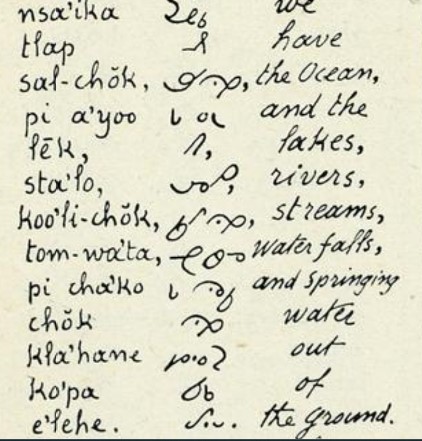
nsai’ika nsaika We
tlap tlap have
sal-chŏk, sol chok, the Ocean,
pi a’yoo pi ayu and the
lēk, lik, lakes,
sta’lo, stalo, rivers,
koo’li-chŏk, kuli chok, streams,
tom-wa’ta, tomwata, water falls,
pi cha’ko pi chako and springing
chŏk chok water
kla’hane klahani out
ko’pa kopa of
e’lehe. ilihi. the ground.
One neat tactic in this sentence is the use of (h)ayu ‘many’ to show the plural meaning of lik ‘lakes’!
In my analysis of the language, the phrasing chako chok klahani kopa ilihi (cháku tsə́qw ɬáx̣ani kʰapa íliʔi) does not literally mean what Le Jeune says, ‘springing water out of the ground’. That’s a free translation. Instead, the phrase is saying ‘(there) comes water of the ground’.

Hi Dave,
I concur with your more practical translation; much as you have pointed out before, Euro translations mangle things by adding poetics, that were not there before. Indigenous languages here at least, are nothing if not practical, so “springing” may be an anglo-mangle…
LikeLiked by 1 person
I should also add here, the striking similarity between LeJeune’s “nsai’ika” (we), and the Nlaka’pamuxcin word for “my family; my home; my people”, which is “nkseytkn”. Which makes sense as a great number of LJ’s informants would have been able to speak several languages, and possibly borrowed here and there.
LikeLiked by 1 person
That’s an amazing connection to draw, I like it!
LikeLike
tom-wata “water falls”
If this is a plural noun (= English “waterfalls”) it seems to have been interpreted as a verb phrase (= water does fall), with “tom’ from French “tombe”, the 3d singular indicative of “tomber” ‘to fall’. Does this make sense?
LikeLiked by 1 person
Also an amazing connection! You folks are making me think quite a lot today. We do know that Chinookan from the earliest moments of contact with non-Natives had an ideophone /tə́m/, with the final consonant prolonged at will, to connote the sound of a waterfall…
LikeLike
Interesting. Are there examples of this element in actual use? If this apparently native element referred to the sound of a waterfall, why did it need to be reinforced by an apparently imported one meaning “water” in order to describe the watery phenomenon?
LikeLike
A fair question. The 2012 Grand Ronde Tribes dictionary glosses the Chinookan ideophone as ‘thump’. I seem to recall Lewis & Clark having encountered people saying “tumm” or some similar spelling, in the vicinity of a waterfall.
LikeLike
And just to add to the mix, is our own TumTum Lake, and the falls at the lower end of the lake. Wikipedia thoughtfully offers this:”Tumtum Lake is a small lake located in the Upper Adams River valley in the Interior of British Columbia, Canada.[1] It is a popular fishing lake, containing rainbow trout, bull trout, and whitefish.[2] “Tumtum” is a Chinook Jargon word for “heart”, or the “pulsing of the heart”,[3] and may refer to the sound of the waterfalls on the Upper Adams River downstream from the lake”.
LikeLiked by 1 person
“Two hours’ ride brought to my ears the music of the “tum tum orter;” {162} the Indian-English for the “thundering waters” of the Shutes.[226] These are the only perpendicular falls of the Columbia, in its course from the junction of its great northern and southern branches, to the ocean. And they do indeed thunder.
…
[226] All early travellers speak of the attempts of the Indians, in their designation of the neighborhood, to express the sound of the falling waters. Lewis and Clark speak of it as “tumm;” according to Ross (our volume vii, p. 133), it was “Lowhum.” The Shutes (Des Chutes) is another name for the Great Falls of the Columbia.—Ed.”
Farnham’s Travels in the Great Western Prairies, etc.
LikeLike
Franz Boas’s “Illustrative Sketch” of Lower Chinookan mentions tEmm ‘noise of feet’ and tumm ‘noise of fire; noise of bear spirit’.
LikeLike