Blankenship, “The Early History of Thurston County” (Part 5 of 5)
Let’s finish up this mini-series with some bits of quoted Chinuk Wawa and humor …

CC Simmons (image credit: Find A Grave)
Christopher Columbus Simmons: I imagine he got his name by being “the first white child born north and west of the Columbia River”.
He was born in 1852 to Settler of 1844 and well-known US government treaty translator (Chinuk Wawa-English) Colonel Michael Simmons, who “located his claim at the falls of the Deschutes River, which was then known by the Indians as ‘Tumchuck‘ — throbbing water.” (pages 252-253 of CC’s biography).
This is not in the local tribal languages, but instead it’s Chinuk Wawa tə́m-tsə̀qw ‘falls, rapids’, a synonym of tə́m-wàta, which is the variant that became the name of the Settler town, Tumwater.
“Some Tumwater Reminiscences, contributed by Ada Sprague Mowell” seems to recall the typical practice of Native women coming to Settler communities to sell their wares:
Across the bay there was an Indian village and whenever there were rumors of war we children used to terrify ourselves with imagining that these Indians would capture us. The old squaws with their baskets of olalies [‘berries’], or of oysters, clams or fish hanging over their backs suspended from a broad band across the forehead, were familiar sights to our youthful eyes.
(page 313)
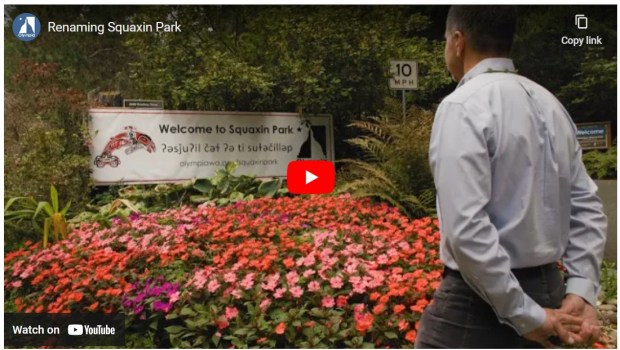
Image credit: City of Olympia
The article on “Priest Point Park” (now Squaxin Park) involves memories of early Oblate Catholic missionaries using the Jargon with the area’s tribal people:
One pioneer woman, who as a young girl, lived on a homestead in the neighborhood, recalls visiting the Mission while school was in session and seeing the dusky young students poring over their lessons. This lady also tells about the natives’ love for singing. The priests taught them the chants of their services [in Chinook Jargon] to their great delight. Sometimes she said, an Indian would be picking berries back in the underbrush. He would begin to sing or chant, another voice would take up the refrain in another part of the woods and then another and another until the strain would reach the fishermen out on the waters, and the clam diggers along the beach, who would join their voices in swelling the volume of sound until the woods and shore would ring with the wild melody.
(page 361)
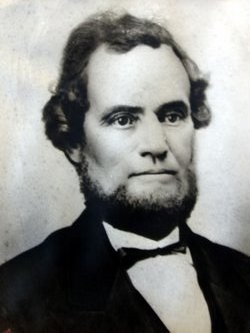
The well-spoken Judge Christopher C. Hewett (1809-1891) (image credit: FindAGRave)
An article on “The Judiciary of Thurston County” has a very funny recollection:
As an illustration of force of habit, the following good story is told of Judge Hewett, conducting a case one day:
The Chinook Jargon was so much in use in early days that many of the most expressive phrases had become so common that they were frequently employed in every day speech.
On this particular occasion, two attorneys clashed in animated dispute over one of the most important points of the trial and in the heat of the moment, voiced some expressions in Chinook, not complimentary to each other. Judge Hewett, thinking to rebuke the wranglers for their disregard of decorum, laid down the following rule: ‘Gentlemen of the Bar, you will hereafter confine yourself to the English language. I don’t purpose to permit any more of this cultus wawa in court.’ the judge himself joined in the laugh which followed.
(page 365)
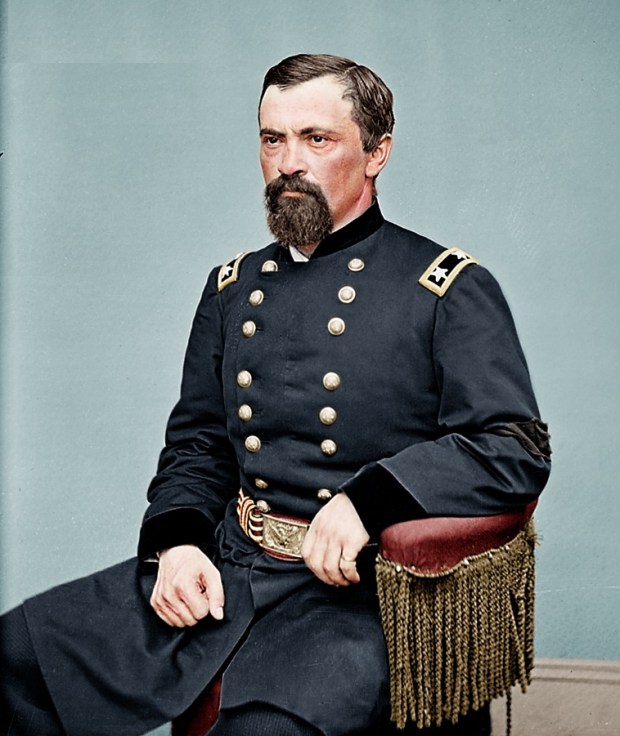
The jovial August Valentine Kautz, 1828-1895 (image credit: WesternTheaterCivilWar.com)
More frontier humor is found in the book’s “Chronological Table”, which contains an entry for July 9, 1853 (eh? a Saturday…did they hold off the celebration till the weekend?), at a 4th of July celebration, where various toasts were proposed:
Lieut. Kautz, U.S.A[rmy]., responded to [an invitation to] “Army and Navy,” and offered ‘The citizens of Olympia — may they always have high tides, so that, like clams, they may be ever happy.’
(pages 375-376)
