“Músmus-latèt” people at Skeetchestn, BC!
Hayu masi to Alex Code for reminding me of this striking episode in the Kamloops Wawa newspaper!
Previously on ChinookJargon.com, we shared músmus-latèt, a Jargon term for traditionally ‘flat-headed Natives’, courtesy of Henry Zenk.
It’s southern dialect, and there, it means literally ‘cattle-head(ed) / cow-head(ed)’.
Alik Code reminded me that this same phrase is found in the northern dialect, with a more insulting meaning.
Here’s the whole incident in Jargon, from a Secwépemc community. (That’s the “Shuswap” Salish people of southern interior British Columbia.)
Material in < angled brackets > below is not in Chinuk Pipa shorthand in the original newspaper.
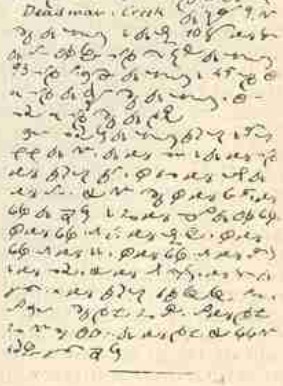
< Deadmans Creek > Kopa Fibrwari < 9 >, liplit
‘On February 9th, the priest’chako kopa Skichistin pi kopa Sondi < 10 > Marsh klaska mash
‘came to Skeetchestn and on Sunday the 10th of March they laid’kopa ilihi ukuk mokst tilikom chi mimlus kopa Skichistin.
‘in the ground those two people who had just died at Skeetchestn.’< 93 > tilikom lahanshut kopa Skichistin pi < 45 > iskom [likalisti].
‘Ninety-three people made confession at Skeetchestn and 45 took communion.’Ayu tilikom kopa Bonapart chako kopa Skichistin. Wiht
‘Lots of people from Bonaparte came to Skeetchestn. Also’tanas ayu tilikom chako kopa Kamlups.
‘a few people came from Kamloops.’Kansih tanas man kopa Skichistin kwanisim patlach sik
‘Several young men from Skeetchestn keep causing’tomtom kopa liplit, kopa klaska taii pi kopa klaska tilikom.
‘grief for the priest, for their chief and for their people.’Klaska kwanisim kuli, wik kata klaska stop kopa
‘They’re always wandering around, nothing can get them to stay at’klaska ilihi. Pus liplit chako wik klaska mitlait, klaska
‘their own place. When the priest comes they aren’t there, they’re’mamuk kopa tkop man pi ikta klaska tolo kopa ukuk mamuk?
‘working for White people but what do they get out of that work?’Wik klaska mamuk hilp kopa klaska Sondi haws, wik klaska
‘They don’t help out with their church, they don’t’mamuk hilp klaska papa, wik klaska mamuk hilp klaska kluchmin
‘help out their fathers, they don’t help out their wives’pi klaska tanas, pus klaska tlap chikmin, klaska mash [Ø] kopa
‘or their kids, if they get money, they spend it on’kaltash. < X > Klaska kwanisim kakwa musmus latit,
‘no-good things. [“X” seems to show making the Sign of the Cross.] They always seem bull-headed,’ilo kansih chako komtaks ikta tlus. Ilo klaska komtaks
‘never learning (to do) anything good. They don’t understand’ikta liplit iaka wawa. Kopit klaska komtaks pus makmak liplit
‘anything the priest says. They only know how to insult the priest’kanamokst kaltash tkop man.
‘along with the no-good Whites.’—
— Kamloops Wawa #127 (April 1895), page 52 ← (click this link to view the original Chinuk Pipa page, and the entire issue of the “Chinook Paper”!)
Nice Chinook Jargon reading practice, eh?
You can see musmus latit here is a more literal metaphorical image…is that a contradiction in terms?…than the southern-dialect usage as ‘having a flattened forehead’. Here it’s a negative judgment of someone’s character, which is not really the point of the southern expression.
Bonus fact:
I’ll want to write a separate article about that makmak. You know it’s the normal word for ‘eat’ — but, here, it doesn’t mean ‘eating the priest’. Instead, it’s a cool northern-dialect expression that has to do with bad behavior towards others…

I’ve heard it also to mean “bull-headed” (just plain thick and rebellious at times).
However, it is the description of the youths in this piece that brings to mind the likelihood that these lads had had enough of being preached at in their years of detention in residential institutions, where, at the same time, had been told their people, and their culture was “cultus”…ergo, they hate everyone. This linguistic analysis reminds us, that despite the many ways in which stuff can be presented, when studying historical (and contemporary) human behaviours, there is a reason for every one of them…much of which has been passed down from one generation to another.
LikeLiked by 1 person
Agreed, not hard to understand these young men’s feelings. One clarification — they would’ve been too old to have been in even the first crop of residential school kids. The writer’s description of them as being more interested in making a living in the newer Settler-dominated economy explains things pretty well for me. Chinook writing, for an ironic instance, was pretty clearly a tool for achieving a grasp of English, which in turn was all about being able to get a job and deal with the government.
Dave R.
LikeLike
Agreed on some points, Dave, but by 1895, we’d already had 5 years of KIRS, and 20 years of missionization prior to that here. The influence of non-Indigenous youths and co-workers was, however, just as toxic and detrimental as the church was…especially here, where logging, mining and rail crews, errant seasonal workers, ranch and farm owners, cops, local clergy and townsfolk all combined to produce an effective and divisive force against indigeneity…all while using CJ to communicate with.
LikeLiked by 1 person
No arguments there. Settler culture was massively disrupting Indigenous life by 1895!
LikeLike
It was…some of it still is.
J.
LikeLiked by 1 person