‘Islands’ in southern and northern CW
No dialect is an island!
The two main varieties of Chinuk Wawa have an enormous amount in common, and couldn’t exist without each other.
But after a fairly early date (call it 1858), they steadily grew in different directions that tell you a lot about the communities who spoke them.
Here’s a typical difference between the 2 dialects of Chinook Jargon, showing how they’re similar but different.
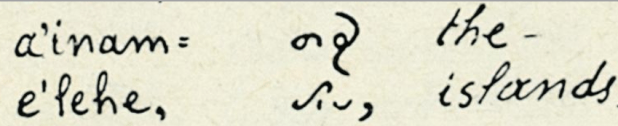
JMR Le Jeune’s “Chinook Rudiments”, 1924:22
In the north, we have several pronunciations of the more-or-less recently borrowed English ‘island’:
- ainam ilihi / a’inam e’lehe, as seen in the illustration, is literally ‘island country; island place’ but we’re told it just means ‘the islands’
- ailan in KW #88 etc. (more common), and ailan ilihi in KW #105 etc. (less common) which usually means ‘an island country’ such as Japan
- ailand in KW #145 etc. (more common), and ailand ilihi in KW #145 etc. (less common)
“Tanas ilihi” in the north (for instance KW #118a) always means ‘a bit of dirt’ or ‘a small place’ — never ‘island’. So it has just its literal meaning.
But that same phrase in the south, spelled tənəs-íliʔi nowadays in Grand Ronde style, is the oldest pedigreed word for ‘island’, and it just about always means ‘island’, and not ‘a bit of dirt’ etc. It’s that firmly established.
We can refer to our constant observation about the northern dialect — that it had longer significant contact with English while Jargon was still in frequent use up north — so it took in plenty of English words that are more precise than the already existing Jargon terms that they replaced. Ainam / ailan / ailand truly have much narrower meanings than tanas ilihi.
Speakers of the southern dialect, best preserved at Grand Ronde Indian Reservation, typically knew English well (I think usually better than Native people in the north did!), but they had a cultural preference for preserving the existing, more often Indigenous-sourced, words in Jargon.
These differing attitudes show up in countless ways that distinguish the northern & southern dialects of Chinuk Wawa!
