Millicoma, or, fictional Chinuk Wawa noble savage humor
I’m mostly just transcribing the Chinuk Wawa sections from this folksy parody…
Read the entire newspaper clipping to get a sense (if you’ve got none) of a genuine, smart-alecky, kind of offensive genre of folk literature in USA frontier culture.
This specimen sports authentic earmarks of a local legend, in that “Millicoma” could be modeled after the local tribal/language name “Milluk”, and in that Chinook Jargon plays a prominent role — untranslated, because everyone understood it even this late on the Oregon coast. (Such translations as are tendered by the scribe* are purely jocular.)
It also builds on the firmly established tropes in our national psyche of the Mayflower’s landing, of Capt. John Smith & Pocahontas, of “dusky maidens” irresistible to lonesome white pioneer guys, and so forth.
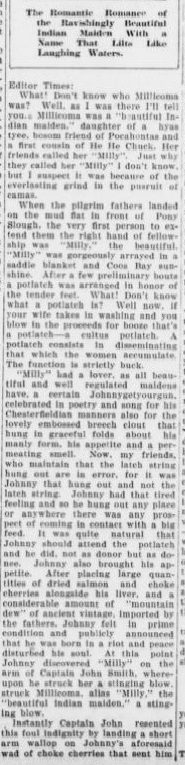
From the Coos Bay (OR) Times of November 8, 1911, page 6, columns 4 and 5:
“MILLICOMA”
The Romantic Romance of the Ravishingly Beautiful Indian Maiden With a Name That Lilts Like Laughing Waters.
Editor Times:
What! Don’t know who Millicoma was? Well, as I was there I’ll tell you. Millicoma was a “beautiful Indian maiden,” daughter of a hyas tyee [háyás(h) táyí ‘big chief’], bosom friend of Pocahontas and a first cousin of He He Chuck [híhi tsə́qw ‘Laughing Water’, punning on the English nickname Chuck]. Her friends called her “Milly”…
…After a few preliminary bouts a potlatch [pá(t)lach ‘a giveaway ceremony] was arranged in honor of the tender feet. What! Don’t know what a potlatch is? Well now, if your wife takes in washing and you blow in the proceeds for booze that’s a potlatch — a cultus potlatch [kʰə́ltəs pá(t)lach ‘free gift’, punning on the literal meaning in Jargon ‘a gift for nothing, a useless/worthless gift’]…
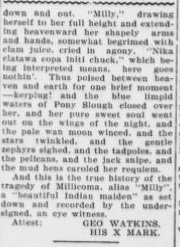
…”Milly,” drawing herself to her full height and extending heavenward her shapely arms and hands, somewhat begrimed with clam juice, cried in agony, “Nika clatawa copa initi chuck [náyka ɬátwa kʰapa ínatay tsə́qw ‘I’m going to/over across the water’],” which being interpreted means, here goes nothin’…
Attest: GEO WATKINS,
HIS X MARK
* The author, George Watkins, is probably the Marshfield lawyer who we know of from his role in Annie Miner Peterson’s 1918 divorce; see page 151 of Lionel Youst’s good biography of her, “She’s Tricky Like Coyote: Annie Miner Peterson, an Oregon Coast Indian Woman” (Norman: University of Oklahoma Press, 1997 [Civilization of the American Indian Series, Volume 224]).

According to Hanis-speaker Lottie Evanoff (and niece of Annie Miner Peterson), Millicoma is a Native word – a toponym – and also, funnily enough, on modern maps applied to the wrong river. Oops.
First, the meaning. Per Lottie it is from a Hanis phrase, Millukw-u-mæ meaning Milluk’s people. The Milluk speaking people of the lower bay had upriver fishing rights on what is today known as the South Fork Coos River, and so this river was known as Millukw-u-mæ. Somehow, tho’, some early pioneer heard the name but got confused and plonked the name on the wrong river – it was applied to the ‘north fork’, and thus it is still known today on maps as the Millicoma (the north fork’s name was originally Kuggwich, no known etymology).
Local basket collector Agnes Sengstacken wrote a little “Indian romance” book and also used the name Millicoma for her hero. It too falls into the then-popular trite romantic twaddle of dusky-maiden-chief’s-daughter-doomed-romance-dies-at-end. Yawn. These things were a dime a dozen. I’ve noticed there is still a BS romance on that same old theme attached to Big Stump (about 4 miles south of Waldport) about doomed romance between…oh I think their names were Whispering Wind & Cougar’s Eye or some such fluff. (The real story is, Hummingbird and Bumblebee put the stump there to mark the center of the world. No romance. Also, no deaths mentioned in story.)
LikeLiked by 1 person
hayu masi! dret mayka kəmtəks ukuk iliʔi yaka ikanum (you sure know the stories of the land)!
LikeLiked by 1 person
I’ve been working on sorting out place names on the CLUS and to a lesser extent Alsea part of the coast for awhile! It’s an interesting way to look at a map. And some names are still there – like Millicoma even if it did get moved a bit.
LikeLiked by 1 person