Chinook prayer at Siletz Fair by Shasta Rev. John Adams, 1915
More than half a century into the reservation era, Chinuk Wawa had quite a presence at the major interethnic social event of the year for Siletz, Oregon.
A Native preacher gave an invocation in the Jargon; people still remembered his uncle by a Jargon name; and a noted anthropologist/linguist whose work in the region was largely conducted via the Jargon made a speech.
From the Toledo Lincoln County [Oregon] Leader, Friday, September 3, 1915, page 1, columns 1-2:
The opening exercises of the
fair at Siletz were as follows:
Prayer by Rev. John Adams, In
Chinook (a full blooded Shasta
Indian and a nephew of the no-
ted war chief, Tyee John. It is
said by persons that were in the
Rogue River War of 1855-6 that
John’s voice could be heard one
mile from the mountain tops
giving orders to his warriors.
He had the power of uniting all
the different tribes of Southern
Oregon in a general war on the
whites, the same as Pe-Pe-Mo-Mox
had in uniting the tribes in
Eastern Oregon. … Prof. [Leo] Frachten-
berg spoke on behalf of the
Smithsonian Institute. He has [sic]
ethnological work among the In-‘
dian tribes.
Those coho sticks we recently discussed were on display, as well as items from another game that I make out from the blurry text as nuhl dulth sticks (I could be misreading tha; as usual, asterisks show my uncertainty). These and more appear in a startlingly-titled second newspaper article:
From the Portland Sunday Oregonian, August 29, 1915, page 13:
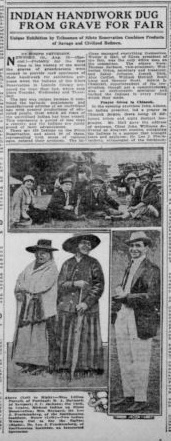
INDIAN HANDIWORK DUG
FROM GRAVE FOR FAIRProbably for the first
time in the history of the world
the graves of grandparents were
opened to provide rare specimens of
their handiwork for exhibition pur-
poses when the Indians of the Siletz
Reservation In Lincoln County pre-
pared for their great fair, which took
place Tuesday, Wednesday and Thurs-
day. The fair was unique because it com-
bined the barbaric implements and
manufactured artlcles of an uncivilized
age with present productions of edu-
cated people, from which all trace of
the uncivilized Indian has been erased.
This represents a period of less than
a century, and the Indians are justly
proud of their advancement.
…Prayer Given in Chinook.
In the opening exercises John Adams,
an Indian preacher, led a prayer in
Chinook Jargon, there being 17* dif-
ferent tribes and eight distinct lan-
guages. … Dr. Leo J. Frach-
tenberg, ethnologist of the Smithson-
ian Institution Indian research divi-
sion, represented that Institution …
From a grave was dug a basket so
beautiful in design and color that Dr.
Frachtenberg offered, only to be re-
fused, $100 for it.
… Beads which the
Hudson Bay Company had had made
especially for trading with the In-
dians…were displayed…
[and] coho sticks for the game our
hockey comes from and nuhl dulth*
sticks, for a woman’s game from
which schoolboys get their [game of] dog and
cat, aroused interest.
Maybe “nuhl dulth” is from the Siletz Dee-ni language (Athabaskan)?

My (and a lot of my cousins’) great grandpa was John Adams – he was not full blood Shasta – his father was from a village on the Applegate River (Dakubetede/ Applegate River Athabaskan) his mother – like is stated – was Shasta and a sister to Tyee John. He was at Table Rock Reservation with his family and saw when people came into Table Rock Res and insisted that his uncle, Tyee John allow the arrest of some of his sons – to be taken for trial – the trial found them innocent, but a mob took them and hanged them when they were set free.
He came to the Siletz Reservation as an orphaned boy ca 1856-57 – both of his parents having been killed in the Rogue River wars.
LikeLiked by 1 person
hayu masi for sharing your deeper knowledge here, R.K. This context makes the story more meaningful.
Dave Robertson
LikeLike