Indian John Casino describes a Chinook aboriginal game, in Chinuk Wawa, 1905
In this old newspaper article about “Stone Implements Used by the Oregon Indians”, I discovered a previously unknown oral text in Chinuk Wawa. (By that, I mean specifically lower Columbia River-area Chinook Jargon.)
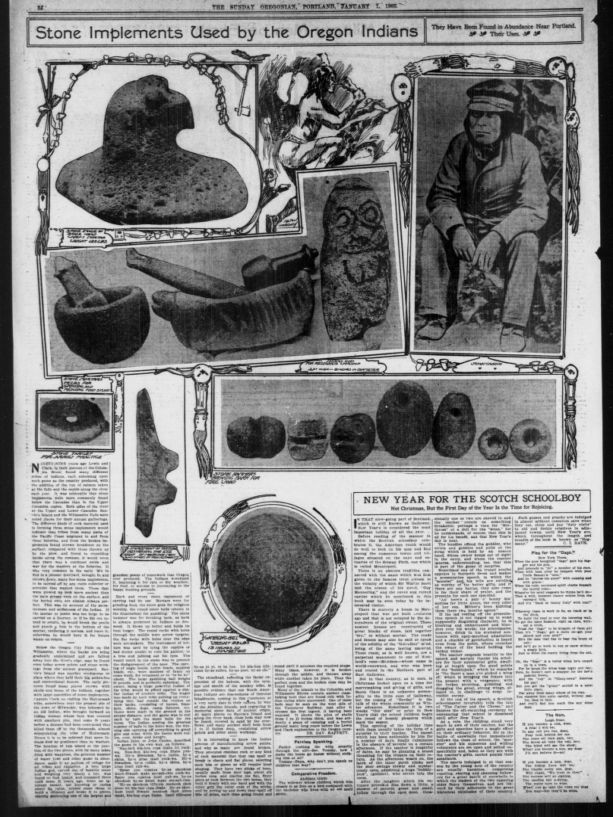
The text is from “Indian John” Casino, a Chinook, and it tells how this large stone “gambling ball” was used. (Does Verne Ray mention this in his ethnography?) The article tells,
The large gambling ball weighs 93 pounds, and is perfectly spherical. The owner, being a large powerful Indian of his tribe, would be pitted against a similar Indian of another tribe. The wager was made by each tribe putting up everything they had outside the clothes on their backs, consisting of horses, blankets, skins, dogs, camp fixtures, etc. Holes were made in the ground at the proper distance, and the game was to roll each by turn the stone balls for the holes. The Indian scoring the greatest number of balls in the holes won. the winning side carrying off everything in great glee and eclat, while the losers were sullen, sour, broke and hungry.
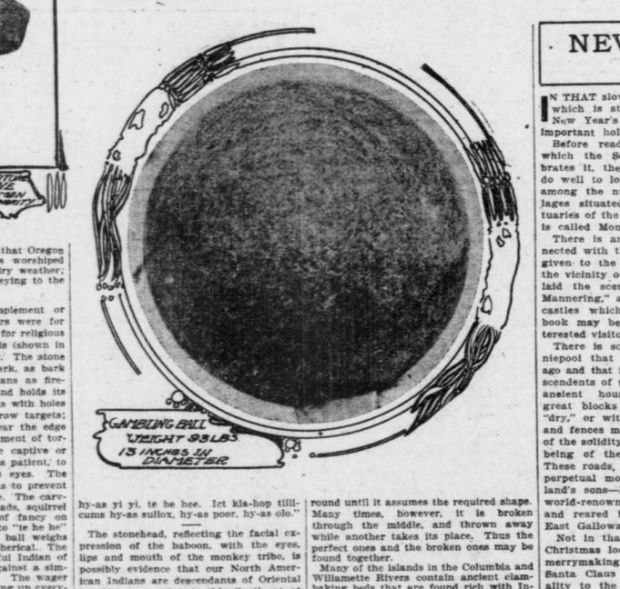
Here’s John Casino’s Chinuk Wawa explanation (preserving the typically random punctuation you find in newspaper Chinook), with my interpretation put between the lines:
[column 2:]
Indian John, or John Casino, described the game In his own way, as follows:
“Nan-itch kla-hop copa illahe ict yock-
“See, [there were] holes in the ground, one here.wa. Nan-itch kla-hop copa illahe yah-
See, [there was] a hole in the ground over there.wa. Hy-u Siwashes, hy-u cuitin, hy-u
[There were] lots of Indians, lots of horses, lots
skins, hy-u ictas inati yock-wa. Hy-u
of furs, lots of goods on this side here. [There were] lotsSiwashes, hy-u cuitin, hy-u skins, hy-u
of Indians, lots of horses, lots of furs, lotsictas inati yah-wa.
of goods on that side over there.“Spose you comtux hy-as skookum
“You should understand that they were strong
klosh – Siwash wake me-sah-chie yock-wa.
good Indians, not bad ones, over here.Spose you comtux inati yah-wa hy-as;
You should [also] understand that on that side over there they were veryskookum hy-as klosh wake me-sah-chie.
strong, very good, not bad.“Hy-as skookum tillicum mamook okok,
“The strong[est] people would ‘put’ thisstone ict kla-hop copa illahe. Hy-as skoo-
stone [into] one hole in the ground. The strong[est]kum inati Siwash mamook okok stone
Indians of the other side would ‘put’ this stonemoxt, kla-hop copa illahe. lnati tillicums
[into] two holes in the ground. The other-side people[column 3:]
hy-as yi yi, te he hee. Ict kla-hop tilli-
would give a big whoop (?) and laugh. The one-hole peo-cums hy-as sullox, hy-as poor, hy-as olo.”
ple would be [left] very upset, very poor, [and] very hungry.”
— The Portland (OR) Sunday Oregonian, January 1, 1905, page 34, columns 2 and 3
A few short notes on the speaker’s way of expressing himself, before I move on to his identity…
- I like his way of labeling the two “sides” in a gambling match, inati yock-wa and inati yah-wa (literally ‘across/other side there’ and ‘across/other side here’). A perfect description of what such events looked like, and an elegant way to avoid the kind of borrowing that happened around Kamloops, BC. (Said was used for ‘side’ there). Relatedly, inati tillicums ‘the other-side people’ brings to mind a local expression for one of the communities at Grand Ronde Reservation.
- Spose to indicate ‘should’ is more typical of old-time lower Columbia and Grand Ronde usage than elsewhere. Elsewhere, spose / pus is pretty much limited to meanings like ‘if; when’.
- You and poor are some of the few English words code-switched (or else recently borrowed) into the speaker’s Jargon. Both have synonyms in “straight” Jargon — mayka and łax̣awyam respectively in the 2012 Grand Ronde dictionary.
- The non-use of a preposition (or I would call this a “null” preposition) for ‘into’ is quite fluent Jargon in all regions, and rarely mastered by whites. So this, along with the unique spellings used, testify to the authenticity of the reported text.
- Yi yi, which the context suggests means some kind of celebrating or ‘whooping’, is a new word in my experience of the Jargon. Te he hee, which occurs elsewhere on the page too, is a new variant of the verb ‘to laugh’. It’s impressive how often we still find words to add to the known vocabulary of this language.
Who was John Casino? It seems he had already passed away by the time of this article. Could he have been Chief Casino or Cazenove, the famous Comcomly’s successor as Chinook leader? Samuel Parker made note of this chief in 1835.
This article suggests John Casino was born about 1792. That would make him the right age to have become a chief in the 1830s.
Here are a few rather unprocessed notes relating to John Casino, to encourage someone into further study:
Fine Collection of Indian Relics. At the Smith Memorial Church. Fair View, the Archaeology Society gave an open meeting and entertainment Monday evening, which was well attended. There was music by the members and the chor us, after which a lecture was delivered on “Arrowheads and Other Indian Rel ics.” Rev. W. T. Scott was in charge of the affair for the evening. He was as sisted by A. L. Stone. Miss L. T. Hlggins. S. Johns, F. Conley and other members qf the society. At the close of the enter tainment the audience adjourned to the Quarters of the society in the building formerly occupied by the school, w here the relics are on deposit. Here half an hour was spent in Inspecting the collection, wjttch is very full and highly creditable te the organization. Here are four very fine mortars, with their pestles, stone chisels, hammers, and many peculiarly shaped relics, which had been picked up in the neighborhood. In the cabinet also are the cooking utensils of Indian John Casino. A number of valuable reports and books have been received from Wash ington, and placed on the shelves. The specimens have a special interest for the reason they have been gathered mainly through the exertion of the members, and also from the neighborhood. In the lot there are several hundred, and they would be of value In any cabinet. The society also has a fair collection of arrowheads, which are In the possession of Miss L. t! Hlggins. secretary. Much interest is dis played in the neighborhood, and the so ciety has proved helpful In promoting a social spirit, as well as in encouraging the study of archaeology. Other public meet ings are to lollow every two weeks.
— The Portland (OR) Morning Oregonian, February 13, 1901, page 8
John Casino’s involvement with this collection of artifacts is mentioned here too.

Dave,
Really interesting discovery here (“John Casino”). Casino was the usual English form for Chinookan kʼiásnu, name of the prominent Multnomah-Wakanasisi chief of the fur-trade era. One of Casino’s wives came to Grand Ronde; Casino himself died before the res (about 1847 I think). Wonder if this John Casino is the same as “Indian John,” of whom there are a number of photos, including one of him standing by a traditional L Columbia bark-roofed plank house. Melissa Darby has done quite a bit of archive sleuthing in pursuit of Indian John. Local Whites referred to him as a “Multnomah”, he self-identified as Klickitat. Yet he has a flattened head. Klickitats were moving into the area then – much of Casino’s later following was Klickitat, although he clearly started his career near St. Helens, OR, as a Chinookan chief. Must get going now. But I will study this at more length. Henry
On Sun, Oct 16, 2016 at 2:58 PM, Chinook Jargon wrote:
> chinookjargon posted: “In this old newspaper article about “Stone > Implements Used by the Oregon Indians”, I discovered a previously unknown > oral text in Chinuk Wawa. (By that, I mean specifically lower Columbia > River-area Chinook Jargon.) The text is from “Indian John” Casi” >
LikeLike
I’m in agreement with Henry that “Indian John Casino” was not the same person as Chief Trader/Diplomat Kiesno of the Multnomah Chinook (Wappato, Wakanasisi). The later passed away Fall of 1848 at Ft. Vancouver and according to Gibbs, none of his sons survived.
Boxberger’s reporting on the 1839 Hudson’s Bay Company census details both Kiesno and Chona-Chona as residing at the Cathlacanasese Village (Hewlett Pt., WA). Smith recorded in 1856 that Chona-Chona (Wakanasisi) was 1st Chief of the Ne-Pe-Chuck (Skillooot). Suggesting the possibility the Chona Chona may have assumed Kiesno’s role as a leading figure after 1848.
David Lewis noted that Smith’s discussions on the movements of Chona-chona suggest a close relationship with the Cascades. “Chona-Chona of the Ne-pe-chuck tribe left here on the 17th ult (December) to got to the Cascades, and he has not yet returned.” Its likely Chona-chona was enumerated along with fellow Wakanasisi with the lower Cascade bands.
Enjoyed the read and information,
David
LikeLike
And thanks for your information too, David.
So perhaps Chona-Chona and/or (John) Casino “carried” the name k’iasnu, in the traditional sense? Rather than as a white-style family name.
I’m grateful for the knowledge you guys are sharing here.
LikeLike
Pingback: Keel-A-Pie, the Chinuk Wawa operetta (second page) | Chinook Jargon
Pingback: How Mourning Dove was right: The Tee-hee-hee Stone | Chinook Jargon