Pidgin sign languages in the Pacific Northwest
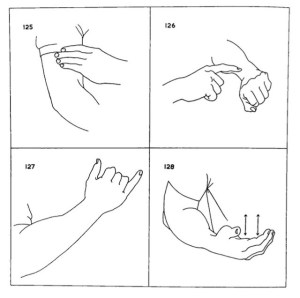
Thanks to the wonderful language-themed radio series A Way With Words, who give a justified hat tip to Atlas Obscura, we’re led to an article by Robert E. Johnson about “An Extension of Oregon Sawmill Sign Language”. (Current Anthropology 18(2):353-354, 1977.)
On JSTOR, you can read it for free if you register.
In my dissertation I refer to Meissner and Philpott’s slightly earlier work on PNW sawmill sign languages, which gives a visual lexicon of many dozens of signs.
Johnson’s stuff is new to me, and I’d be intrigued to track down the two additional articles of his listed in its bibliography.
For the moment, I’m just enjoying learning more about non-oral pidgin languages, of which our region had several. (Aside from the gestures widely, if shallowly, documented as having accompanied Chinook Jargon.)
Happy listening and reading!

I am aware of seven signed pidgins, of which four are found in North America (Plateau Sign, Inupiaq-Koyukon Sign, Plains Indian Sign and Stó:lō country Sign; the last is known to me only through a mention in your disertation).
The three others are Queensland Aboriginal Sign, Arnhem Land Aboriginal Sign and Early Nicaraguan Sign.
The Nicaraguan one creolised, and the Australian ones seem to have been interethnically only secondarily (their primary use, as I recall, was rather ceremonial, hunting-related and the like).
I should perhaps add that I use the term “pidgin” only about varieties created and used by people with no other language in common, as opposed to things such as monastic and hunting sign systems.
When you said that “our region had several”, where you by any chance also including something that I didn’t know about?
LikeLike
Hi Mikael, it’s nice to hear from you here. No, unfortunately I’m not referring to any previously-unknown sign languages here.
I do have in mind that there were likely additional ones in the Pacific Northwest, since for example sawmill sign languages only came to be documented in their decline, and there’s every reason to think there were at least more dialects of these.
Also it’s imaginable that indigenous sign systems existed that we know little or nothing of; obviously sign languages have typically gone unnoticed and underdocumented in the world, and more are discovered all the time. We can keep our eyes open as we read with curiosity through the great amount of frontier-era memoirs, etc.!
LikeLike
Mikael’s allusion to that Nicaraguan sign language can be found in William Washabaugh’s Five Fingers for Survival. Alas, I’ve already shed my copy of it, and Amazon wants over a $100.
LikeLike