Three Mox places, or, I digress
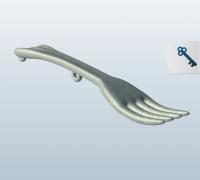
river fork (lure)
In a comment to my post about Molalla-area pioneers, Sara Palmer raised a question about an Olympic Peninsula place name:
We see “Mox Chehalis” here in the south Sound as a road and watercourse name over west of Capitol Forest, between McCleary and Highway 12, so I think that’s a spelling that had some currency in the region at one time. I can’t imagine it’s anything but chinuk, but I haven’t had a reason to research it yet. I do drive it pretty regularly when I’m on that side of the forest….
Sara, thanks for raising this. I’ve been told by locals that “Mox Chehalis” is indeed Chinook Jargon, and that it means “Two/Both Chehalises”, i.e. Upper and Lower, i.e. Oakville-ish and Shoalwater Bay.
This leads to something else interesting.
William Bright’s book on Native American placenames tells a couple of similar names: Mox Chuck “two streams” in Grays Harbor County and Mox La Push “two mouths” in King Co.
Bright goes on to say the latter connotes “two forks” of a river. (Compare mox la-boós “the forks of a river” as a phrase in J.K. Gill’s 1884 edition of his Chinook Jargon dictionary, which could suggest that the phrase was in some kind of wide use.)
If anyone is in need of 2 more cents to pay their taxes, I’m happy to point out that especially if it’s White folks that coined Mox La Push, there’s a reasonable chance that they (also) (amusingly) had in mind the Jargon word for the eating utensil “fork”, la-poo-shét in Gill’s 1884 spelling.
I say Whites because it’s in their languages of course that you have the metaphor of a fork for eating food and a divided watercourse being similar to each other.
Do you think my theory, um, holds water?

Do English speakers think of table utensils when talking about “the forks of a river” or “a fork in the road”?
It seems to me that CW “push” and “boos” (if actually distinctly pronounced) are compatible both with ‘(la) bouche’ (mouth, including the “mouth” of a river) and ‘(la) fourche’ (pitchfork, fork in a road, in a stream; also a few other meanings all sharing the idea of “forked” = ‘partially divided’). If a small stream divides shortly before reaching a larger river, or the sea, the location could be called either “les fourches” or “les bouches”, both words being appicable as well as phonetically similar.
“La fourche” is a very old French word, and “la fourchette” (eating fork) is literally ‘little pitchfork’. The word was coined in the 1500’s or so to refer to the utensil, which was invented in Italy and brought to France by an Italian heiress who came to marry the heir to the king of France. (Before that, French people ate with a spoon, or a knife and their fingers).
In any case, ‘la pooshet’ seems to be either the obvious CW equivalent of “la fourchette” (for eating), or of a hypothetical diminutive “la bouche-ette” (applied to the mouth of a little river).
LikeLike
I doubt any English speakers consciously imagine an eating fork when they talk about the forks of a river. It’s just that the sense of humour that I often see among 19th-century anglophones who used Chinook Jargon among themselves often involves this kind of trite punning. Remember for example the translation Potlatch Skookum Stick for the “Potlatch Club” of Olympia, WA.
LikeLike
My question was rhetorical of course!
LikeLike
Mox La Push means river with two mouths, with La Push coming from French la bouche into the Chinook Jargon, the same as the town of La Push at the mouth of the Quillayute River on the Quileute Reservation on the Olympic Peninsula. The name Mox La Push refers to the former Black River that usually drained Lake Washington, to join the Cedar and White (now Green) Rivers to form the Duwamish River that drains out to Elliott Bay. Between the lake and its confluences with the Cedar and White Rivers, the Black River could sometimes flow backwards into the lake when high water came rushing down the Cedar too fast to drain down the lower Black River into the Duwamish River. Thus two mouths, depending on which direction it was flowing. See David Buerge’s Renton: Where the Water Took Wing, Windsor Publications, 1989.
LikeLiked by 1 person
Thanks so much for your comment, Paul, I had not known of this other Mox La Push and I really appreciate learning about it from you. David Buerge does excellent work so I’ll look forward to tracking down the book you recommend!
Dave Robertson
LikeLike