The Iron Klooch
[Not for the most sensitive ears.]
If I had accesss to the Murray-Latta fonds at UBC Archives, the blueprints for the Iron Klooch would make a spectacular illustration here.
That’s your basic Kellington Slimer machine, of course.
It’s preternaturally hard to chase down a picture of this device, so here as a replacement is an engraving from “Nam-Bok, The Liar” by Jack London, a fiction that at least employs the vintage Northwestism klooch.
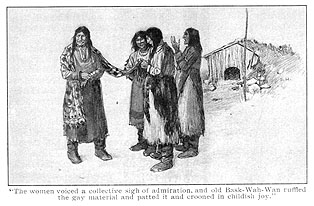
Klooch is obvious of derivation. You’d’ve started with Chinuk Wawa łúchmən ‘woman’, borrowed into English with the ‘white’ pronunciation kloochman. Once the word was in frequent Anglophonics use, it’d sound goofy to those pale ears, so you’d lose the man part. La voilà, a new synonym for squaw. Really? Yes, all that work just to steal a word, mutilate it, and insult Indigenous women.
Why Iron Klooch as the name of a mechanical invention? This cannery equipment would’ve superseded many of the hitherto indispensable female workers from the region’s tribes, who had brought with them exquisitely highly developed skills at processing the traditional harvest of salmon. So then, by analogy with the equally poorly-aging name ‘Iron Chink‘ fish-beheading and -gutting machine (invented 1903)…

…naturally you marketed your labor-extinguishing device as the Iron Klooch.
I got nothing else. A historical fact we’ll try to deal with.

They have one of those fish machines at the Royal BC Museum. I think the person writing the interpretive signs for that one had quite the challenge.
LikeLike
I’d like to visit that exhibit. “Iron Klooch” is certainly a unique BC English phrase, lots of historical value if you can figure out how to present it.
LikeLike
I’m curious how prevalent klootchman was in comparison to klootch – there’s klootch canyon by Hazelton, and a few other klootch things, but I’ve never seen anything local with klootchman…. Maybe klootch became a regional thing…
LikeLike
That’s my sense too, primarily a BC-ism, in various spellings.
I find “klutch” from 1890 in a Nelson paper; “klootch” at least as far back as an 1894 New Westminster newspaper article about Chief George of the Capilano tribe; “klooch” from 1905 in a Ladysmith newspaper. I have a hard time finding occurrences of the word in WA & OR newspapers, except for a couple occurrences of “klooch” as a spelling of “kloshe” (‘good’). A rare instance is a mention of Quinault “old klootches” in the Portland Oregonian from 1904. I’ll post an image from the same month, same paper, as an example of now-antiquated language.
LikeLike
I’ve heard a few definite examples of kloshe pronounced as “kloosh” as well, at least by people in this valley.
LikeLike
You’re getting some nice data, Dale. Any documentation of spoken Chinuk Wawa is rare and valuable!
LikeLike
I grew up in Prince Rupert and worked in the canneries in the mid-1960s to mid-1970, and they still used the term “chink machine”; only 15 years in 1967, when I worked in the canneries, I was also-sometimes- referred to as a “klootch”, a common derogatory word for indian girls and women. In the 80s, my daughters informed me that the word was changed to “chug”. But I have never understood the word “klootchman” before this, only in terms of my research which refer to Indian women married to white men as klootchmen.
LikeLike