The end of the mystery of Dr Thomas Sanderson Bulmer
Dr. Thos. S. Bulmer looms large in history of Chinook Jargon, if we’re to be impressed with his voluminous entries in the landmark Bibliography of the Chinookan languages that James Constantine Pilling published through the Smithsonian in 1893. (Download that must-have from that link!)
He had a colorful life, I’ve found by doing a bit of research. Unfortunately nobody’s tracked down his Chinook Jargon papers, but I can share some clues to his trail on this earth…can you build on these clues?
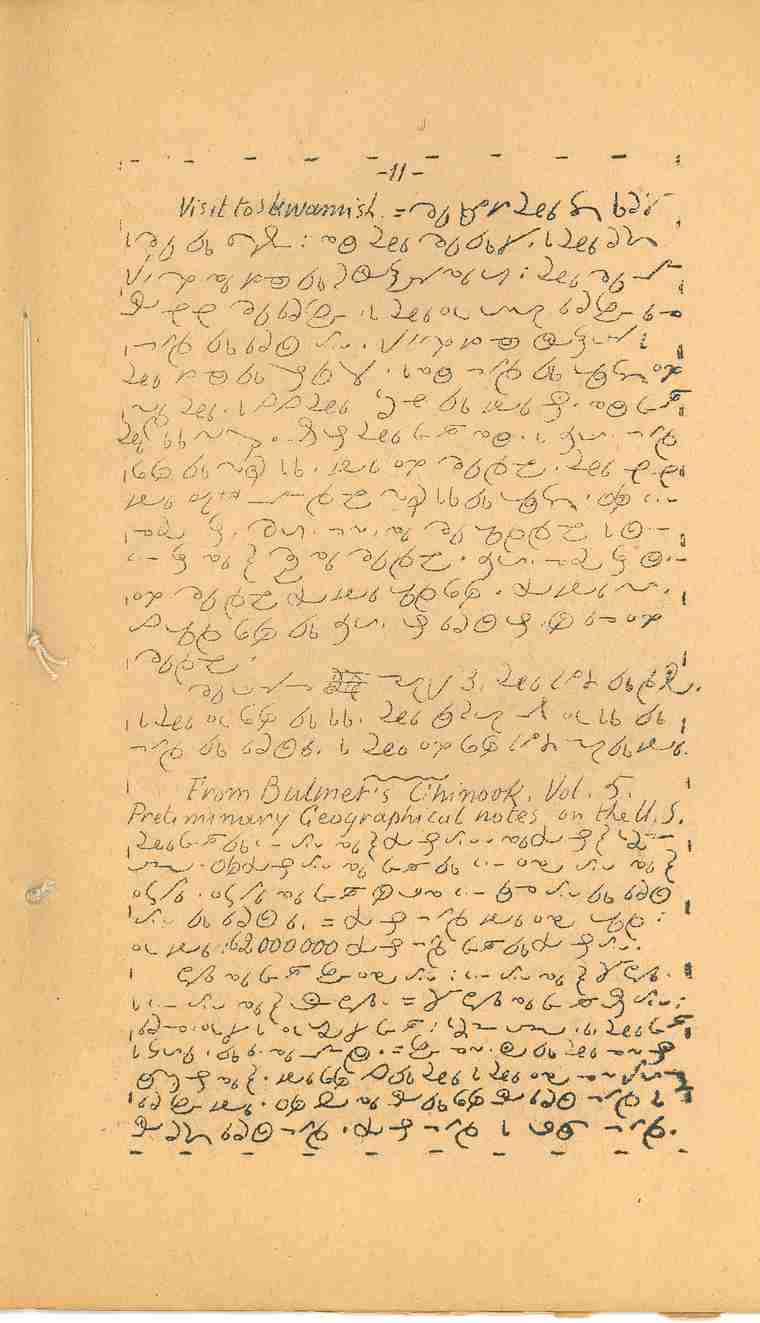
Here is one sample of his Chinook Jargon work, as published in shorthand in 1893 by Father Le Jeune’s Kamloops Wawa newspaper (thanks to USask Special Collections and Dr. Keith Carlson). Click to see if you can read it:
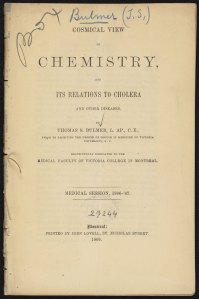
A bit earlier, aged right about 30, he was practicing and publishing in Eastern Canadian medical circles:
A public record exists of his allegedly being robbed by his housemaid, who accused him of drugging and seducing her, in England, 1871.
In a sort of creepy irony, Bulmer was elected a fellow of the Obstetrical Society of London, 1872.
You can read his professional advertisement on arriving in New Zealand, 1877.
By 1881, TSB was in Australia, where among many activities he published books on big questions of the day:
- “Notes on Darwinism” (1881)
- “Memo for thinking men” (1883, also about evolution)
- “Small-pox: its origin, signs, and symptoms; also, the germ and contagion theories, pt.1” (1884)
Bulmer’s professional judgment as quarantine inspector was seemingly openly questioned in a public controversy in Australia, 1882.
Bulmer is on record corresponding with the British Medical Journal, 1888.
Bulmer arrives in Utah, where he is touted as a bit of a celebrity, 1895.
Bulmer’s suicide in Texas is reported, October 17, 1898, in the El Paso Daily Herald. Thereabouts, he’s been viewed as at best a local crank–apparently a recently arrived homeless pauper. This is just about the only mention I’ve found outside of the Chinook Jargon literature of his working on a “grammar of the Kanuck [sic] language“. (And that’s the only time I’ve seen our many-epithetted CJ called that!)
KILLED HIMSELF
Dr. Bulmer's Remains Found.

As was feared Dr. T. S. Bulmer in a
fit of despondency committed suicide.
Tbe first news received in El Paso of
his death came yesterday about 1:30
when Judge Harper received a mes-
sage from Sierra Blanca saying that
the searching party had found the re-
mains of the missing man and wanted
instructions as to what to do with them.
The message did not get here in time
to send a coffin there for the remains
to be brought here, so the judge wired
back to bury the body at the county's
expense.

The details of the doctor's actions
prior to his death are very meager.
All that could be learned was from a
passenger conductor of the G.H. who
told the HERALD reporter that Dr.
Bulmer came to one of the conductors
and asked him to give him a free ride
to San Elizario, and the conductor told
him that he couldn't do it, as it was
against the rules to carry anybody free;
and this refusal seemed to distress the
doctor very much. A number there at
the eatlng house immediately made up
a purse to buy the ticket for the old
man, but he would not accept the
money, and said afterwards that he
would walk over into Mexico.

     Before be started out on this walk,
however, be gave away everything he
had, supposedly, and started out. It
was noticed that he had neither water
nor anything to eat when he left the
station, and some thought maybe be
was going out fur a short walk, but
others feared that he had some inten-
tion of doing away with himself,
for he had told one or two different
things which led them to be-
lieve that he would commit suicide.
Before he left the house he gave about
everything he had to one person or an-
other and upon giving his valise to a
woman be told her that be wanted her
to keep the valise as it contained all
his papers and might come into use
sometime soon for purposes of identi-
fication.

     When his body was found yesterday
it was in a very decomposed state. He
has killed himself by cutting his throat
with a razor, the only thing which he
had kept.

     Undertaker J.C. Ross of this city
tola a reporter of the HERALD that on
the 9th day of last month he had re-
ceived a letter from the doctor, asking
the undertaker to take care of his re-
mains should he die suddenly, although
he disclaimed any intention of commit-
ting suicide. In the letter he said that
he was a 33d degree mason and as re-
ferences he gave the name of Collector
Bauche of Juarez and Jesus Medina of
Mexico City, who knew him as being
of the fraternity.

     Mr Ross said that be had wired
Mexico City for instructions as to
the disposition of the remains of the
doctor, but as yet has received no an-
swer. The doctor's professional card
is an interesting one, it reads:

     T.S. Bulmer, M.D., C.M., L.S.A.
L., M.R.C.S. England. Registered in
United States, Great Britain, Canada,
and Australia. Formerly Superinten-
dent of Quarantine of New Zealand and
Australia. Honorary correspondent of
Smithsonian Institute of Washington,
D.C. Member of Roise Society, Angl.,
and various societies of Egypt, Mexico and
Great Britain.  Office and resi-
dence, San Elizarlo, Texas.

     The doctor was a well known writer
and he has added many specimens to
the collections in the Smithsonian
Institute. His writings concerning
the early inhabitants of this section
of the country are standard. Perhaps
his best known contribution to know-
ledge is the dictionary of certain
elemental Indian tongues, made after
long residence among certain tribes of
Mexican Indians.

     -----
Visitors to Casas Grandes, at the
terminus of the Sierra Madre railroad,
will easily recall Dr. Bulmer as the
short, stocky, nervous, unsteady little
man, who seemed to be ready to meet
every visitor and pour into his ears,
however unwilling, a resume of
all he knew. It is true, the
doctor was a great bore, particularly if
one was in a hurry, but it was none the
less interesting at times to sit down
and listen to the o!d man as he rambled
on, telling of his early life, his
many and varied experiences.
and of what he had accomplished
for science. The first impression
one would gain was that the man was
not sincere, but after a number of
these encounters it became clear that
the doctor had once been all, or nearly
all, that he claimed to have been, but
that be had dissipated to such an ex-
tent that be had lost his hold on the
better things of life.

     When the new railroad approached
Casas Grandes, and the engineers were
casting about for a route, if possible,
through the mountains toward the
south, the doctor approached the build-
ers of the road and offered for a good
consideration to reveal the location of
a way through the mountains toward
the south, to San Miguel, which would
be perfectly suitable for the railroad
extension. He declared that the loca-
tion of this route bad been revealed to
him by an Indian, and that while be
had subsequently verified the truthful-
ness of the report, the trail was so sit-
uated that no person not already fami-
liar with it could possiblv find it. His
proposition was not accepted.

     Dr. Bulmer claimed to be thorough-
ly informed upon the mineral and oth-
er resources of the district around
Casas Grandes. Much of his informa-
tion was undoubtedly correct, and of
value, but the old man's habit of talk-
ing for effect often led him into indi-
scretions of speech, and the consequence
was to discredit in the eves of most
people much of what he asserted to be
true.

     It was always difficult to get the old
doctor to confine himself to the subject
under discussion. He would wander
often and far from his story, and
this made it difficult to
gain any connected information
from him. In Casas Grandes Dr. Bul-
mer lived in a room attached to a
stable. The room was perfectly bare,
containing nothing but an old hair
trunk or two, a broken chair of un-
known age, and a few rock specimens
and ancient utensils picked up in the
vicinity.

     One day he showed us all he had that
remained of his treasures of earlier
times. He took from the trunk a roll
of parchment and showed diplomas
from numerous colleges, medical
schools, and scientific societies,
as well as certificates of ap-
pointment to various positions
under the British and Canadian
governments. He showed us a bundle
of letters and pressed us to read them,
for "Here," he said, "is positive proof
of what I have told you." There
were letters from a number of more or 1ess
noted scientists, which showed that
he had really made some notable con-
tributions to the sciences of ethnology
and anthropology.

     One of the doctor's pet theories in re-
gard to this country was that the In-
dian tribes of the southwestern United
States and western Mexico come ori-
ginally from what is now British North
America. He was recently engaged
upon a dictionary of the Kanuck lan-
guage, in which be traced many
points of similarity with tne Indian
languages of this section. A certain
ancient round tower in Casas Grandes
was asserted by the doctor to be built
after tbe peculiar style of the Cana-
dian tribes, found nowhere else.

     About a year ago Dr. Bulmer told
the writer that he was "tired of living
like a beast among the dirty Mex-
icans," and that he proposed to move
to the States. Early this Spring he
came to this city, and was here for
some time. In March the HERALD
received the following letter from him:

     "SAN ELIZARIO. Tex., March 7, 1898
EDITOR OF THE HERALD:

     "Dear Sir. Please find some official
information from Smithsonian Institu-
tion, Washington, which may be inter-
esting to Indian lorists.

     "I am now investigating the Indian
traditions. I may say that the Indians
sent to the Philadelphla Centenary
as Montezuma's remnants were only
the Piros and Tiwa Indians residing
near Ysleta. Yours &c,

     "T.S. BULMER, M.D."

     From time to time he sent short com-
munications to this paper. The last
one received from him follows:

     TO LOVERS OF INDIAN LORE.

     The Indians at Ysleta in Texas, are
a remnant of the Indians of the Tiwa
or Tigua branch of the Tanoan stock
who with some Piros left their villages
(principally Ysleta, Socorro and Sen-
ecu) on the upper Rio Grande in New
Mexico and fled with Governor Otermin
at the time of the Pueblo rebellion
against the Spaniards in 1680.

     San Antonio is the patron saint of
the villages In New Mexico and of the
Pueblos now there resident and the
saint's name is also applied to the
Tiwas of Ysleta in Texas.

     The remnant of the Piros tribes still
live at Senecu, opposite Ysleta. The
change of the river bed (Rio Grande)
has placed Senecu on the old Mexican
side of the river.
The above was murder to transcribe from a badly OCR’ed scan.
Bulmer’s legacy wasn’t helped any by the fact that the poor devil was still endorsing what may have been snake oil (made from celery, coca and viburnum, and probably alcohol) years after his death, 1902.

All in all, a colorful and troubled life.
Maybe the Chinook Jargon elements of it that have remained a tantalizing mystery to us — troves of unpublished materials — are to this day waiting to be found somewhere down on the border of Texas and “old” Mexico.

Pingback: Visit to Skwamish, a CJ text | Chinook Jargon:
Pingback: From Bulmer’s Preliminary geographical notes on the US | Chinook Jargon: