Noticing another linguistic-archaeological layer in the history of Chinook Jargon’s reduplication
Let’s see how briefly I can state this revamp of my research findings:
Reduplication of full “words” existed in Chinuk Wawa probably from the start — i.e. in the early-creolizing Central Dialect, of the lower Columbia River.
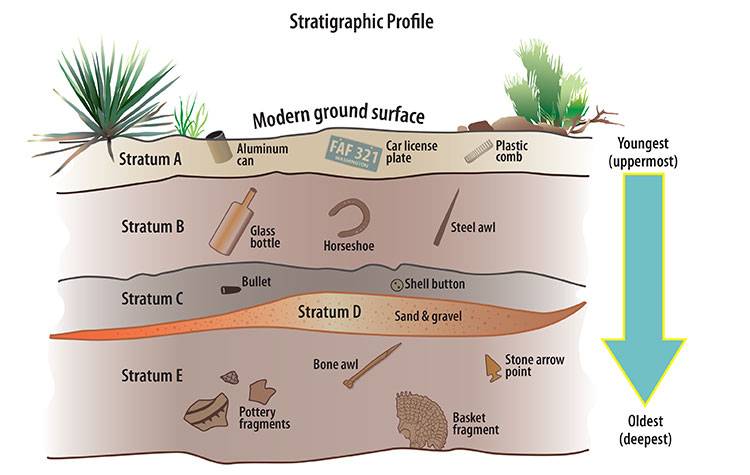
Stratigraphy in archeology (image credit: University of South Alabama)
It involved ONLY ideophones inherited from Lower Chinookan, and a small number of adverbs from that same source.
In the mid-1850’s, the two other dialects came into existence:
The re-pidginized Northern Dialect lost essentially all ideophone words, and retained the existing reduplication of only a couple of adverbs. (Iht-iht “this one and that one; some ones here & there” and ka(h)–ka(h) “here & there; all over the place”.) Iht-iht now felt so non-reduplicated that we find lots of variations on it: iht pi iht “one and an(other)” / iht kopa iht “one by one” / etc.
The re-creolized Southern Dialect, though, kept the ideophones & all existing reduplication, and under newly strengthened SW WA Salish influence, added to it. The broad pluractionality thereof got generalized into a new usage, verb reduplication.
