To back-translate: Sam N. Eyley Jr. & Sr.
Add this to our enormous heap of material to get “back-translated” to Chinuk Wawa!
That’s stuff that we have in some language, usually English, that we know or reasonably infer came from a CW original.
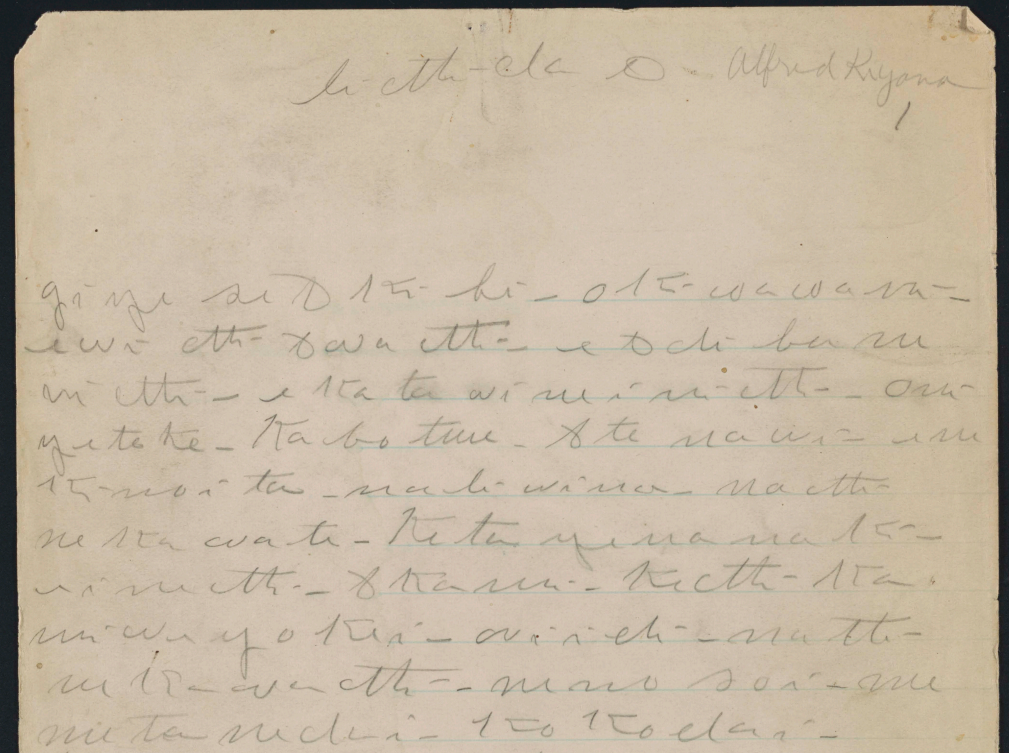
Petit Jean stories came to lots of North American tribes;
the one above is told in Meskwaki a.k.a. Fox (Algonquian family) by Alfred Kiyana
(image credit: Smithsonian Institution)
By the time we get all such material put back into the Jargon, we’ll have one of the world’s largest literatures in an Indigenous language.
Today’s candidates are the “Tales of European Origin” in the Sahaptin language which show massive traces of Chinook Jargon (presumably Central Dialect, since this is from the Columbia River region).
Given their nature, these tales can be hypothesized to have come from a creolized Chinuk Wawa source, I imagine in the historical Métis community stretching from Fort Vancouver northwards into the Cowlitz Valley and beyond.
Thus, a “European origin” is a bit beside the point, much as is saying there are “French” words in the Jargon; what’s relevant is an eastern Canadian source during the overland fur trade.
“Their nature” includes the fact that these are Petit Jean stories, and that they involve a ton of post-contact elements such as playing cards, kings, and lamps, and Jargon-sourced words such as lawen “oats” and sitkum-san “noon”.
It will, then, require someone, or a team, who can speak or take the time to learn Sahaptin as well as Jargon, to do this job. Doable, if you ask a linguist 😁 Make it your Masters or PhD project…
Where to find those texts? “Northwest Sahaptin Texts”, in English: volume I page 249-251 (Eyley Sr.) & 252-268 (Eyley Jr.); in Sahaptin: volume II pages 217-234 (Eyley Jr.).
