lo vs. la for “law”: Competing English dialects influencing Chinuk Wawa, past and present (Warning: I’m going to call your accent THICK)
Ah, the story of lo and la and dueling English dialects!
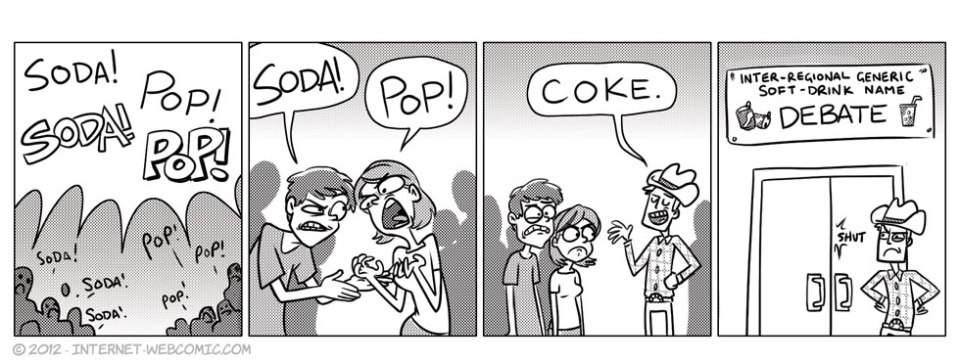 Image credit: Language Learning Institute
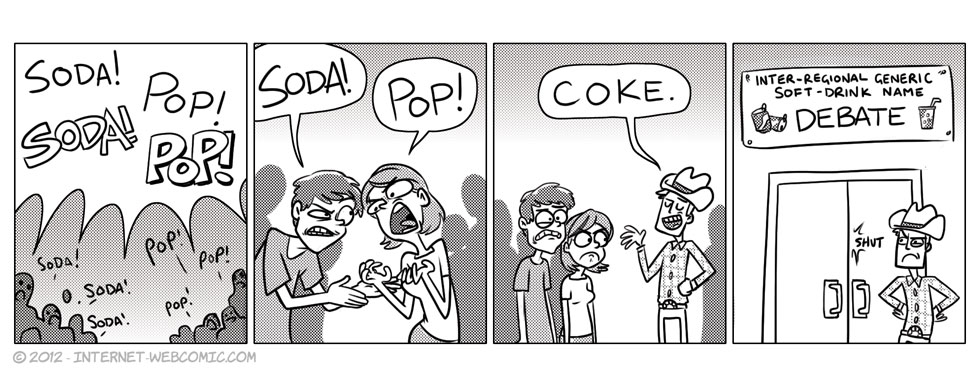
And, to be fair, competing foreign accents, notably Francophone ones.
Back in earlier days, you’ll find the English loan Noun, law, all over the place in Chinuk Wawa. Makes sense, in that it represents a concept not precisely mirrored in the Indigenous languages’ cultures.
(#BACK-TRANSLATING THE TREATIES)
But you’ll find it sometimes as lo, and sometimes as la.
The explanation for this is straightforward. Some dialects of English, such as my modern Northwest USA one, say la. Some, such as the various British dialects of fur-trade officials, sound more like lo.
Plus, you had speakers of Métis/Canadian French, accustomed to their word loi which sounds similar (but different). Formal speech, such as that of lawyers and government workers, has [lwa]. Michif, which we believe is very similar in its French component to what was being said informally on the lower Columbia River, has < lway >, sounding like [lwey].
I’m interested in how we find the pronunciations of at least 2 distinct English dialect blocs preserved in a Chinook Jargon word. It’s similar to how we sometimes find “silk” in CJ expressed as laswey, and sometimes as laswa. (From different French dialects.)
It tells you a lot about the history of the Jargon.
Just so, in the present day:
The Pacific Northwest English dialect that we’ve now developed — by “leveling” the previously existing array of dialects here — has been putting heavy pressure on how we pronounce Chinuk Wawa.
Especially (and I feel this is more or less predictable, in language-contact situations) in the area of the vowels.
The Jargon’s diphthong /aw/ tends to come out as [æw], because that’s how we talk in our modern THICK PNW ACCENT®.
Also noticeable is Jargon /u/ being pronounced as [υw], same reason: the THICK PNW ACCENT® of 2026.
Also, /t/ at the end of syllables is routinely [ʔ] from folks raised speaking our region’s English, so #THICKPNWACCENTof2026 again!
None of this stuff should be a surprise to anyone.
Countless are the times I’ve shown in this space that we can determine the etymologies of a lot of Chinuk Wawa words right down to the dialect of a SW Washington Salish language, or the dialect of French etc., that contributed a given word.
Keep your eyes open for further examples!
